A 1,000-page casebook changes the question. So does a full Gemara, a medical textbook open to a dense diagram, or a reference volume that refuses to stay open. A book stand is not much use if it tilts nicely for ten minutes but flexes, slides, or makes you crane over the desk for the next three hours.
For serious reading, the stand is part of the workspace. It determines where the material sits, whether pages stay put, and whether the desk remains a place to concentrate rather than a small engineering project involving a stack of spare books.
A book stand has two jobs, not one
Most stands are designed around the first job: holding a book at an angle. That is useful, especially for a recipe book or a light paperback. But angle alone does not solve the problem of prolonged reading. If the book remains only a few inches above the tabletop, your head and shoulders still spend much of the session tilted down toward it.
The second job is height. A stand that brings the reading surface up toward a natural working position lets you read with less of that familiar forward hunch. For a law student briefing cases late at night or a bochur deep into a long seder, that difference is not decorative. It affects how long the setup remains comfortable enough to keep working with attention.
This is where many inexpensive wire, bamboo, and plastic stands reach their limit. They can offer a pleasant tilt, but they are usually low to the desk and intended for lighter loads. Raise a heavy book by placing it on a pile of other books, and the arrangement becomes unstable, cluttered, and slightly absurd.
Why heavy material exposes weak stands
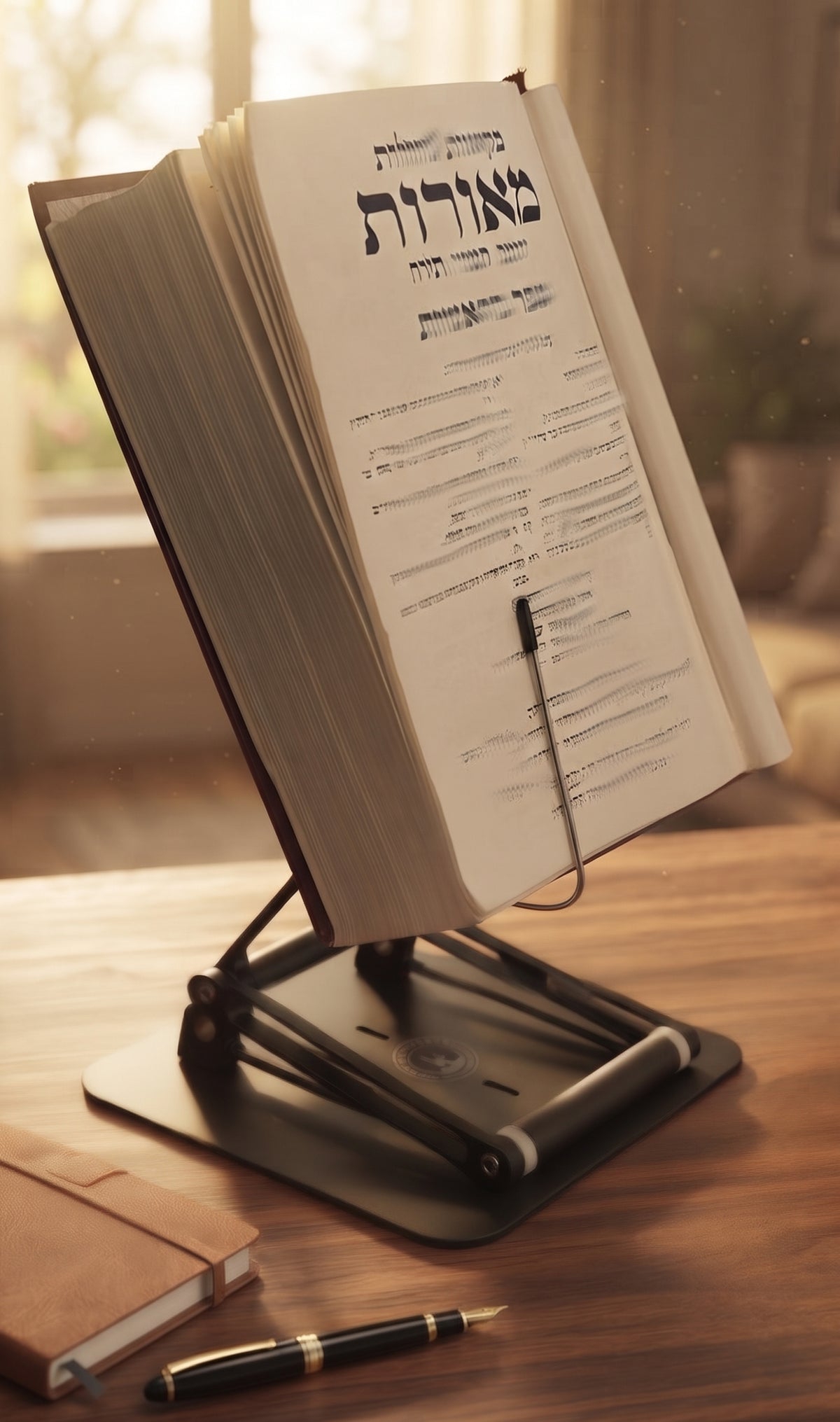
A stand does not need to be large to hold a paperback. Heavy material is less forgiving. A substantial textbook puts weight far from the support point, and a thick open book shifts as you turn pages. A full Gemara brings its own combination of size, weight, and frequent page movement.
A useful stand needs a stable base, a platform that does not bow, and joints that do not gradually give way under the load. It also needs a support lip strong enough to carry the book without making page turns unnecessarily awkward.
There is a trade-off here. The lightest stand in a bag is often the one least suited to carrying a serious volume. A heavy lectern may be solid but cumbersome to store or transport. The sensible middle ground is a portable stand built from materials that can actually bear the work asked of it.
A good test is straightforward: picture the heaviest book you regularly use, not the thinnest one on your shelf. If you would hesitate before setting that volume on the stand, it is probably not the right stand for your daily setup.
Height changes the way you use a desk
The practical value of a taller book stand becomes obvious during a long session. Instead of leaning over pages on the desk, you can bring the book higher while keeping the keyboard, notes, or writing space below available. That makes a small desk work harder without turning it into a paper tower.
Height adjustment also makes one stand useful in more than one setting. A student may use it low during a focused reading block, then raise it when working through a chapter while taking notes. A researcher can shift between a sourcebook and a laptop without dedicating half the desk to permanent equipment. A learner can set a sefer at a comfortable level for a lengthy chavrusa without treating the dining table like a temporary beis midrash construction site.
The important measurement is not simply the overall height of the stand. It is the height of the book's support point. A platform may appear tall in a product photo while the actual book sits much lower than expected.
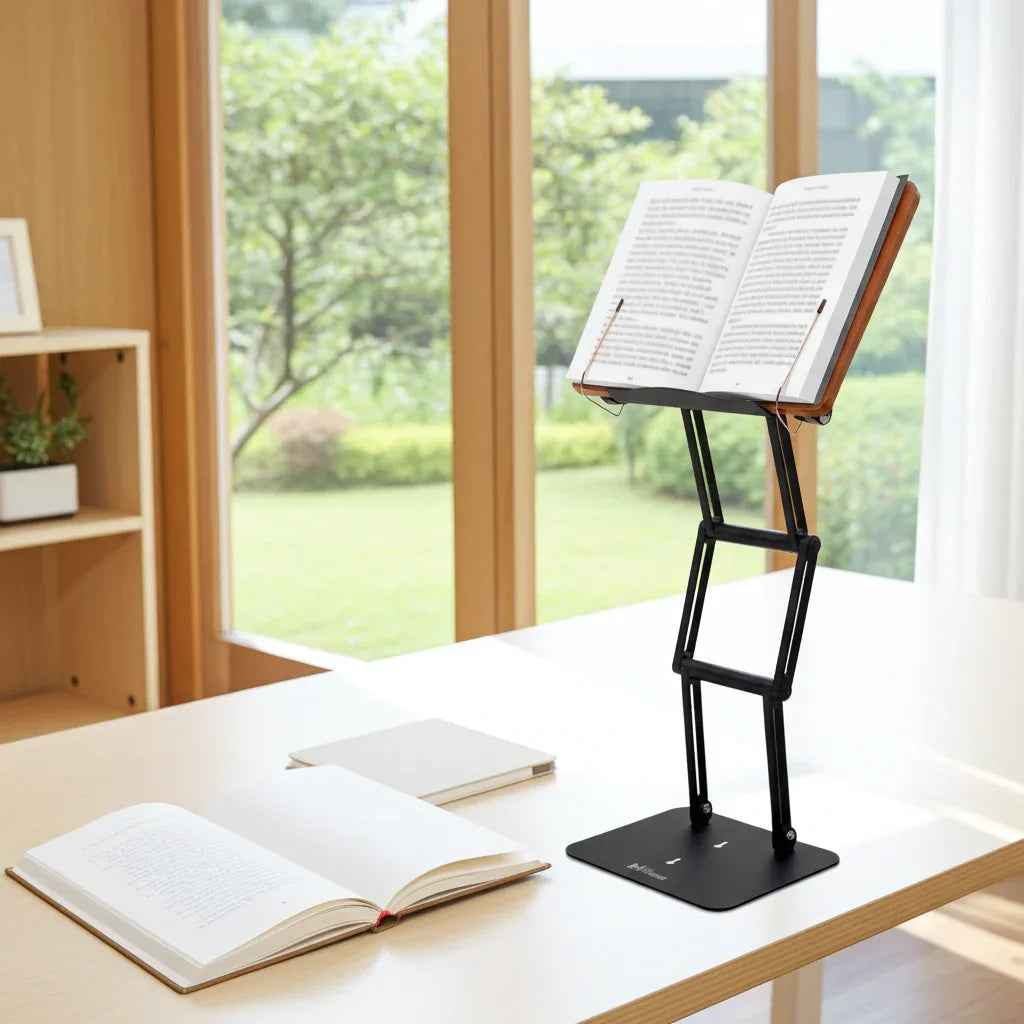
For comparison, The Stander reaches 17.8 inches from the tabletop to the support lip, with the book sitting higher still. That is a different category from a low-angle holder. It gives the stand the range to support reading while seated or while working at a higher surface, without relying on stacked books to make up the difference.
Adjustability should stay where you set it
Many adjustable stands look promising until weight is added. The platform drifts downward, the angle changes after a few page turns, or the whole thing develops a gentle wobble that becomes surprisingly distracting once you notice it.
Friction joints address this problem when they are built to hold their position under real load. They allow you to set the height and angle without knobs protruding everywhere or complicated mechanisms slowing down setup. The key is not that a stand adjusts. Nearly everything adjusts once. The key is whether it remains stable after you adjust it.
For reading-heavy work, angle should be easy to change because different tasks call for different positions. You may want a steeper angle for close reading, a lower angle while marking up a page, or a more upright setting for consulting a source while typing. The adjustment should serve the work, not become another thing to fix every fifteen minutes.
Details that matter after the first week
The platform size, page holders, and folded size can sound secondary until the stand becomes part of a daily routine. A narrow platform may be fine for a tablet but awkward under a wide textbook. Weak page clips can cover text or fail to hold a thick set of pages. A stand that cannot be stored easily tends to remain on the desk, where it either earns its space or becomes clutter.
For a stand intended to handle several kinds of material, look for a platform wide enough for the books you actually use. A 32 x 22 cm, or 12.6 x 8.7 inch, platform gives a substantial base for a textbook, Gemara, laptop, or tablet without turning the whole unit into furniture. Adjustable page holders are especially helpful when a book's binding wants to close the pages you are trying to read.
Storage matters too, particularly for students moving between an apartment, library, classroom, or beis midrash. A stand that folds flat can go into a bag or slide onto a shelf instead of demanding a permanent corner of the desk. The useful question is whether it folds without becoming fragile. Compact is good. Compact and rigid is better.
A practical setup for long reading sessions
Start with the material, not the stand. Put the heaviest book you expect to use on the platform and set the support lip securely beneath it. Open the book to a typical middle section, where the pages have enough weight to test the page holders honestly.
Then raise the book until you can read without repeatedly dropping your head toward the desk. Adjust the angle so the text is easy to follow and the book feels settled rather than perched. If you take handwritten notes, leave enough clear desk space below the platform to work without constantly moving the stand.
Give the setup a five-minute reality check. Turn several pages. Rest your hands on the desk. Shift in your chair. If the platform moves, the book slides, or you find yourself leaning in anyway, make the adjustment now. The best setup is not the most elaborate one. It is the one you stop noticing because it lets you stay with the material.
For a cookbook, the same principles apply, though the load may be lighter and the need for height less demanding. For sheet music, a firm platform and reliable page holders matter most. As a portable lectern, stability and a quick fold are the deciding details. A well-built stand should handle these jobs without pretending they are identical.
Build quality is not a luxury feature
A book stand used occasionally can get away with modest materials. One used through law school, medical training, years of research, or daily learning needs more from its frame and hardware. Aluminum keeps the structure manageable to carry; stainless steel fasteners help the moving parts remain dependable; properly designed joints keep the chosen position in place.
The Stander uses a 5052 aluminum alloy frame, stainless steel screws and nuts, and friction joints. At 1.5 kg / 3.3 lb, it is substantial enough to feel planted while remaining practical to carry. It has been tested with books up to 5 kg / 11 lb, which is the sort of specification worth considering if your usual reading material could double as a doorstop.
It folds flat to 7 cm / 2.75 in for storage or a bag, or 10 cm / 4 in including the book lip. That is a useful compromise: enough structure for serious work, without requiring a dedicated shelf in every room.
The right book stand is the one that supports the way you actually read - heavy books, long sessions, real page turns, and limited desk space included. If that sounds like your work, see The Stander and judge the build, range, and specifications for yourself.