Ancient Ergonomics: What the Talmud Teaches About Back Pain (Ketubot 111a)
Let’s get real: we’ve all slogged through long stretches of sitting at a desk, only to realize our shoulders feel like they’ve aged a decade. The fix? Wellness gurus—yes, centuries late to the party—tell us to get up and move. But guess who already said that in Ketubot 111a, over 1,800 years ago?
“A person should spend a third of the day sitting, a third standing, and a third walking.” — [https://www.sefaria.org/Ketubot.111a]
No, the sages weren’t pulling a fast one—they simply nailed it then, and that truth still holds today. Timeless truths. Literally "sage" advice!
Ancient Wisdom Meets Modern Science
Today’s ergonomic research confirms that timeless advice. According to research published via BioMed Central, systematic reviews of sit-stand workstations found no loss in productivity—and in some cases, even improvement. Switching postures didn’t impede work; it improved comfort.
One randomized trial, called Stand@Work, showed a reduction in sitting time of roughly 73 minutes per day, with perceived benefits to both comfort and cognition.
But beware: prolonged standing (especially over two hours without breaks) can lead to leg swelling, back pain, and circulatory risks. [Wikipedia] {SciTechDaily]
Experts now urge movement, not immobility. It gets better: small "walking snacks"—think one‑minute breaks every 30 minutes—lower blood pressure and reduce blood sugar spikes by up to 58%. Movement is queen. [The Times] [SciTechDaily]
In short: sitting is bad—and standing still is no cure. What matters is the flow. To master your posture, you need to follow the sages: sit, stand, and walk.
Why Traditional Standing Desks Miss the Mark
Most sit‑stand desks are bulky, expensive, and stationary. Sure, they let you stand—but only in one place. There is no wandering from the sofa to the counter, or moving from the kitchen to your Shtender.
Beyond that, let's be real: a standing desk doesn't always fix the problem! If you switch to standing but your neck remains angled toward the floor, you’ve simply moved the pain to a different height.
For a deeper look at why elevation matters more than just "standing," check out our guide on how to read without neck pain.

That’s where The Stander shines:
-
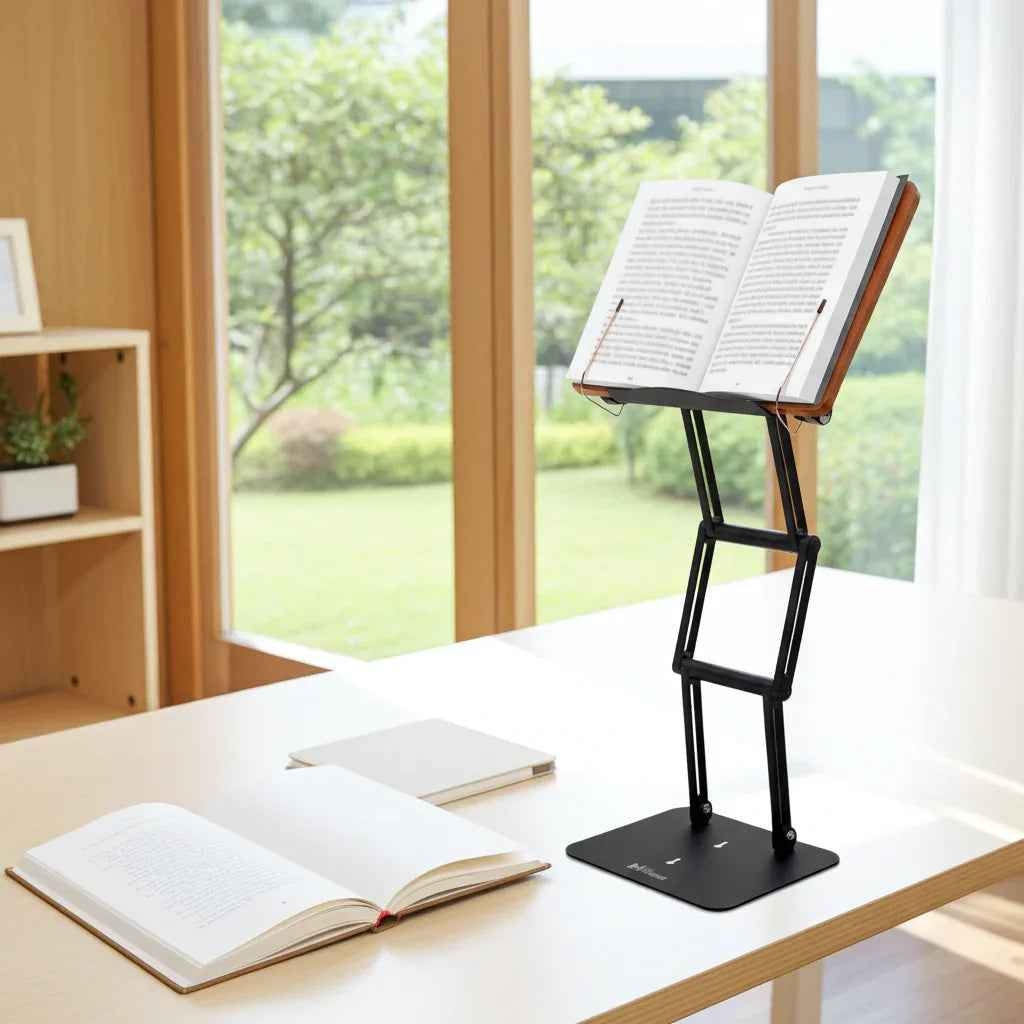
A portable adjustable platform for books, tablets, prayer volumes, and laptops.
-
Works anywhere — desk, couch, kitchen, bais medrash, or library.
-
Instant Transition: Switch from sitting to standing in seconds without the bulk of a permanent desk.
Unlike fixed furniture, the Stander 1.1 allows you to study a page while cooking or learn on the living room floor—while staying mobile.
If you are comparing different setups, see our 2026 guide to ergonomic book stands.
How to Use The Stander (Following the Sage Protocol)
When the Sages said divide your day, they didn't mean four hours like this and four hours like that. They meant change it up!
- Sit: Use a chair with a back and lean into it.
- Stand: Move your Stander to a counter or high table. Keep your posture upright—NO SHLUMPING!
- Walk: Because The Stander is portable, you can move your "workstation" to a different room entirely, getting those "walking snacks" naturally.
For students dealing with massive volumes, we’ve specifically engineered this for stability. See why it’s the best book stand for intensive studying.
Talmudic Wisdom Built for Modern Workflow
Our sages didn’t have $1,000 standing desks or ergonomic chairs. They simply knew:
-
Sit too long? Bad.
-
Sit with no back support? Bad.
-
Stand too long? Also bad.
-
Move and alternate? That’s the sweet spot.
If our sages taught us this in Ketubot 111a, and modern research backs it—maybe it would be wise... to listen? Add the Stander to that, and you've optimized your ability to keep this sage advice! Plus, the Stander keeps you moving without a dusty standing desk hogging your space.
👉 Interested in tapping into both ancient wisdom and modern ergonomics?
➡️ Discover the Stander 1.1 here
Other Related Blogs:
Best Book Stand for Law School Books
How to Study Longer Without Neck Pain
A Practical Guide to Scholar Desk Ergonomics