A 1,000-page casebook does not belong propped on a stack of folders. Neither does a full Gemara balanced on a half-closed laptop. An adjustable book holder is meant to put serious reading material where you can actually work from it for hours - without the familiar cycle of leaning forward, shifting around, and losing your place when the book slides.
That sounds obvious until you look at most book stands. Many are designed for a paperback recipe book or a tablet. They tilt, they sit a few inches above the desk, and they may be perfectly acceptable for light use. The problem begins when the material is large, heavy, and open for an entire morning, seder, or late-night exam review.
For law students, medical students, researchers, and serious Torah learners, the right holder is not a decorative accessory. It is part of the work setup.
What an Adjustable Book Holder Must Actually Adjust
“Adjustable” gets used generously in this category. A stand that lets you choose among three tilt positions is adjustable in the narrowest sense. But it does not solve the central problem of long reading sessions: the book remains low on the desk.
A useful adjustable book holder changes both angle and height. Angle helps you set the page at a comfortable reading position. Height brings the material up rather than asking you to spend hours folded over it. Those are separate adjustments, and a stand that handles only one leaves a large part of the job unfinished.
This matters especially with a dense textbook or sefer. A light paperback can be picked up, moved, and held without much disruption. A heavy open volume tends to stay put. If it stays put at desk level, you do the moving instead.
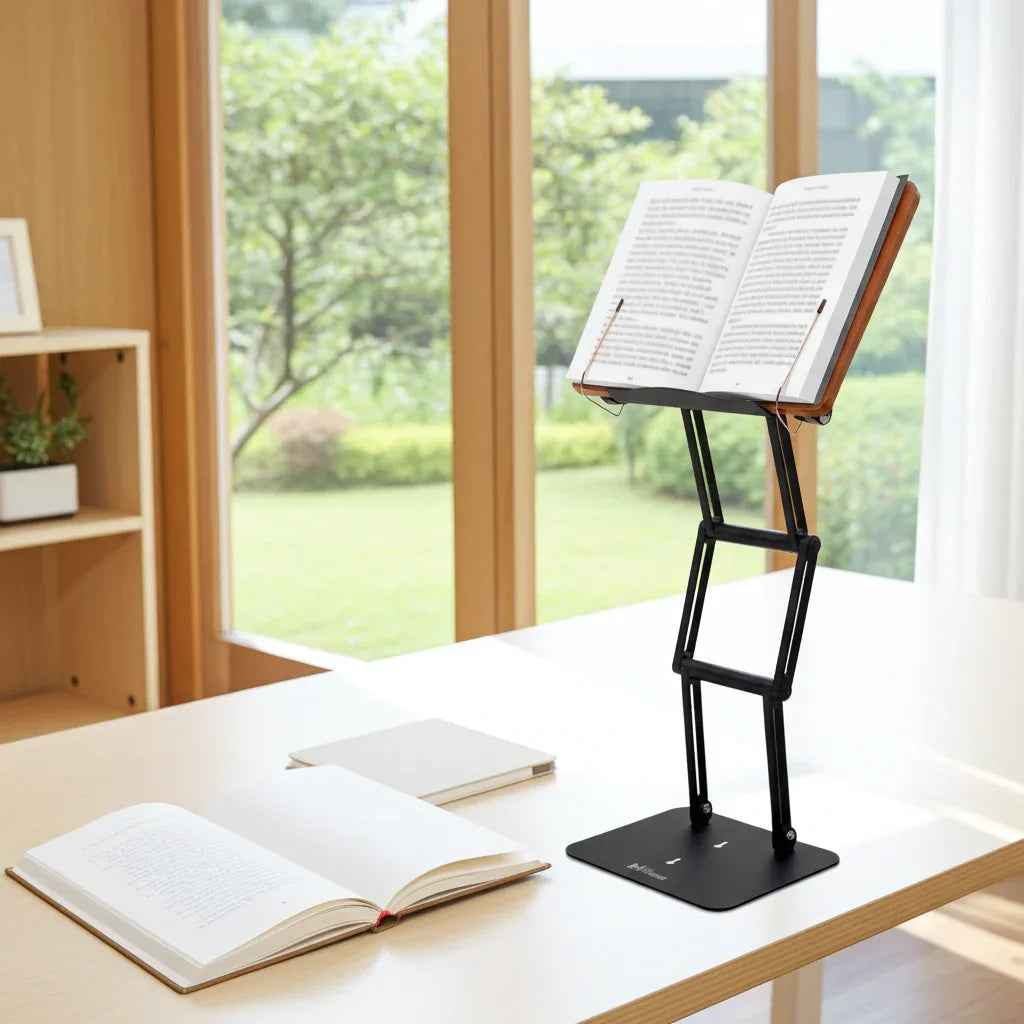
The Stander was built around that distinction. Its support lip rises 17.8 inches from the tabletop, with the book sitting higher still. That gives the stand a range ordinary desktop book holders simply do not have. It can support a book at a genuinely useful working height while seated or standing, rather than merely giving it a slight tilt near the surface.
Height Is Only Useful If the Stand Stays Put
Raising a book creates leverage. That is why many lightweight wire, bamboo, and plastic stands feel acceptable with a slim notebook but become less convincing once a large reference book is involved. The platform may flex, the angle can drift, or the whole stand can feel one page turn away from a small desk disaster.
A serious holder needs enough structure to carry the load without becoming a piece of furniture. The trade-off is real: a sturdier stand weighs more than a thin folding rack. But if you regularly use a law casebook, a medical text, a full Gemara, or a laptop, low weight is not the only measure of portability. A stand that is easy to carry but cannot confidently hold the thing you carry it for is mostly an optimistic idea.
The Stander weighs 1.5 kg / 3.3 lb and is tested with books up to 5 kg / 11 lb. Its frame is 5052 aluminum alloy, with stainless steel screws and nuts. Friction joints hold the selected height and angle without drifting. Those details are not there to make a specification sheet look busy. They address the usual failure points: sagging joints, loose hardware, and a platform that behaves differently once a heavy book is placed on it.
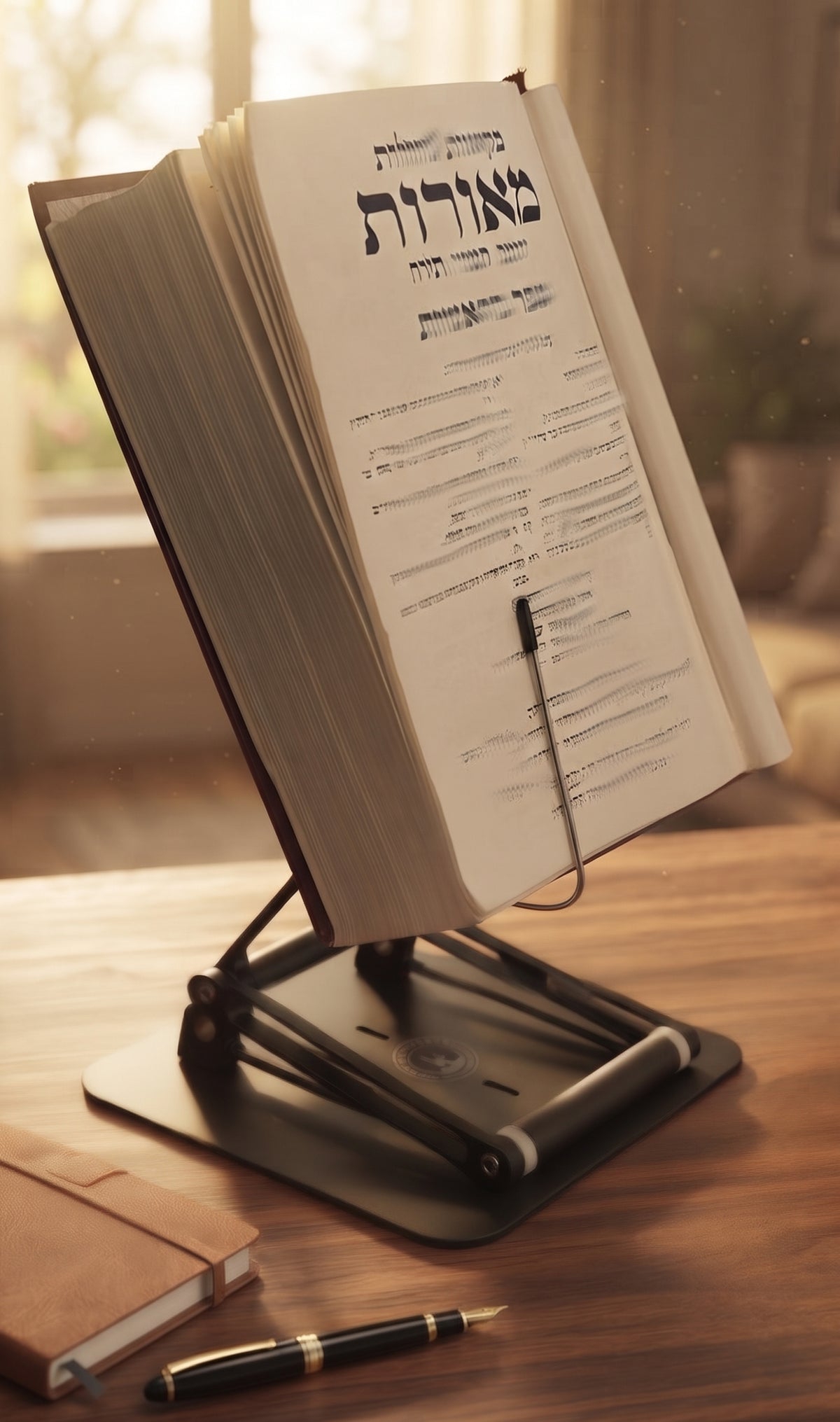
Its 32 x 22 cm (12.6 x 8.7 in) wooden platform gives a substantial book a proper base, while adjustable page holders keep an open volume in place. That is useful when you are moving between a source, notes, and a marked page - or when the book has the stubborn habit of closing exactly where you need it open.
Adjustable Book Holder or Basic Book Stand?
The choice depends on what and how long you read.
A basic tilted stand can be enough for occasional recipes, a slim paperback, or a short reference check. It is inexpensive, compact, and does not pretend to be more than it is. If your book is light and your sessions are brief, there is no reason to overbuild the problem.
The calculation changes when reading is central to your day. A student reviewing a heavy text for several hours needs more than a page prop. An attorney working through a large annotated volume, a clinician consulting a reference text, or a bochur learning a long seder needs a stable surface that stays at the chosen height and angle. Re-adjusting a stand every few minutes is not an ergonomic routine. It is an interruption.
A traditional shtender understood this principle long before the modern desk accessory market appeared. It gave a sefer a dedicated place and gave the learner a working posture appropriate to extended study. A modern adjustable holder should preserve that logic while fitting a desk, apartment, office, or beis medrash setting.
A Setup That Holds Up Through a Long Session
The best setup is usually less complicated than people expect. Start with the material you will actually use, not a thin test book. Place the holder directly in front of your main working position and open the book to a typical section. Raise the platform until the text is comfortably in your natural line of reading, then set the angle so the pages are easy to follow without the book fighting gravity.
Next, secure the pages with the holders and test the setup the way you work. Turn several pages. Rest your hands on the desk. Make a note. If the book shifts, the platform dips, or you find yourself leaning forward, adjust before the session begins. A few minutes of setup is cheaper than spending three hours negotiating with a stand.
For a laptop, the same principle applies: use the stand for the task in front of you, and set the platform deliberately rather than treating it as a permanent piece of desk clutter. For a cookbook or sheet music, lower placement may make more sense. For a portable lectern, stability and page retention become the priority. Adjustment is useful because the work changes.
Portability Without the Flimsy Compromise
There is another trade-off worth stating plainly. A tall, heavy-duty holder will not disappear into the side pocket of a small backpack. Nor should it try. The question is whether it stores and travels sensibly between home, office, library, yeshiva, or school.
The Stander folds flat to 6.5 cm / 2.6 in for storage or a bag. Including the book lip, it is 10 cm / 4 in. That is compact enough to put away after work or carry when you need it, while retaining the frame and joint strength required for a heavy volume. A flat-folding design also makes a cleaner desk more realistic. When the work is done, the stand does not need to occupy the room like a small construction project.
Who Benefits Most From a Higher-Capacity Holder
An adjustable book holder earns its place when the reading material is substantial and the sessions are frequent. That includes graduate students buried in assigned reading, professionals who consult physical reference books, and learners who spend real time with a Gemara or sefer. It also makes a thoughtful gift for a bar mitzvah, chasan, graduation, or anyone beginning a serious course of study.
The practical test is simple. If you have ever stacked books to raise another book, held down pages with one hand, or abandoned a stand because it wobbled under the volume you actually use, you are no longer shopping for a casual book prop. You need a support system designed for the weight and duration of serious work.
The Stander is $95 plus shipping in the US, with free 30-day returns. If your reading setup needs to support heavy books at a useful height rather than merely tilt them, take a closer look at The Stander.