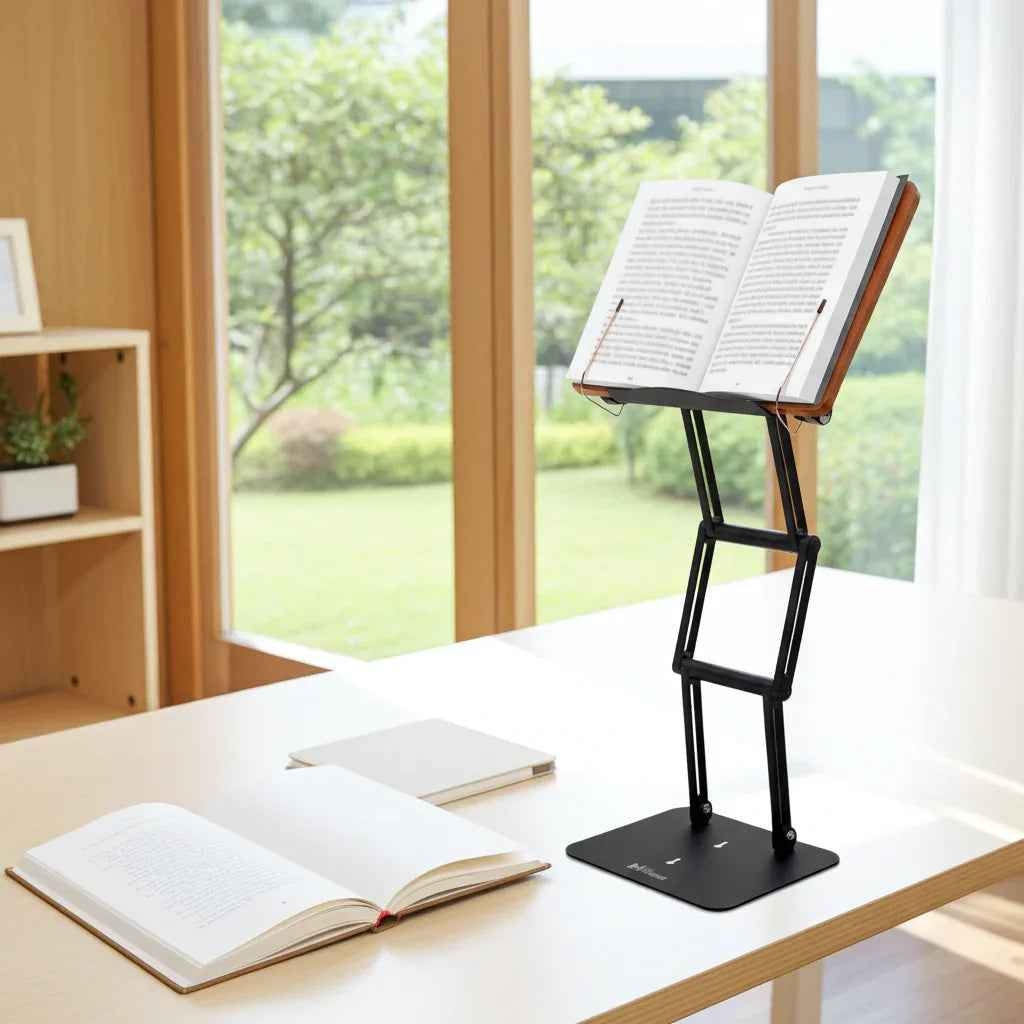
A heavy anatomy text sliding flat across your desk is more than a nuisance. It pulls your head down, rounds your shoulders, and turns an hour of focused study into a slow buildup of neck and upper back strain. The right book stand for heavy textbooks changes that equation by bringing the page to eye level and keeping substantial weight stable while you work.
That sounds simple, but this category is full of products that look capable and fail under real load. A stand that works for a paperback or tablet often starts wobbling the moment you place a dense law casebook, medical atlas, or large religious volume on it. If your reading sessions are serious, the stand has to be serious too.
What a book stand for heavy textbooks needs to do
The first job is structural stability. Heavy textbooks create leverage, not just weight. When a large book sits high on a stand, every joint and hinge has to resist torque. Weak plastic pivots, undersized bases, and shallow ledges may survive light use, but they tend to sag, shift, or collapse once the load gets real.
The second job is ergonomic positioning. A good stand should elevate the book enough to reduce neck flexion, not merely tilt it a few degrees. Many low-cost models offer a reading angle but very little height. That may help a little, but it still leaves you looking downward for hours. For students, researchers, and desk-based professionals, the real benefit comes from moving the text closer to eye level.
The third job is usability during long sessions. Heavy books need page holders that do not fight you every time you turn a page. The platform should be wide enough for oversized texts, firm enough not to bounce while writing notes, and adaptable enough to work whether you are reading, annotating, or referencing material beside a laptop.
Why flimsy stands fail under serious study
A lot of book stands are designed around convenience, portability, and low price. Those are not bad priorities, but they create trade-offs. Thin wire frames fold flat nicely, yet they often flex under dense books. Light plastic designs are easy to move, but they rarely inspire confidence when supporting several pounds at an elevated angle.
There is also a difference between supporting weight briefly and supporting it daily. A stand may hold a large textbook for ten minutes in a product photo. That does not mean it will maintain position through a three-hour study block, repeated angle adjustments, and constant page turning over months or years of use.
For serious users, this matters. A stand is not desk decor. It is part of your working posture. If it slips, shakes, or forces compromise, you unconsciously return to hunching over the desk. At that point, the stand has stopped doing its job.
How posture changes when the book comes up
Most people notice discomfort gradually. The head moves forward, the upper spine rounds, and the desk becomes the place where long reading sessions start to feel physically expensive. With a proper stand, the book rises into your natural line of sight. That reduces the degree of cervical flexion and helps keep the chest more open and the shoulders less collapsed.
That does not mean every ache disappears just because you raised the book. Chair height, desk height, lighting, and overall work habits still matter. But elevating a heavy textbook is one of the most direct corrections you can make, especially if you spend hours reading dense material.
This is why a premium stand often functions as more than a book holder. It becomes an ergonomic tool. Better reading posture usually improves visual comfort, concentration, and endurance. You spend less energy managing discomfort and more energy staying engaged with the material.
Key features to look for in a book stand for heavy textbooks
Height adjustment should be near the top of the list. Angle-only adjustment is better than nothing, but it is not enough for many workstations. If you want meaningful neck strain reduction, the stand should raise the book substantially, with enough range to suit both seated work and moderate standing use.
Material quality matters just as much. Metal construction, especially with well-engineered joints, usually performs better than lightweight commodity designs. Aluminum components can provide an excellent balance of strength, durability, and clean movement when they are properly made.
Base design is another detail people underestimate. A narrow or unstable base can make even a strong platform feel insecure. Heavy books need a stand that remains planted during use, especially when you are turning pages, marking passages, or resting your hands lightly on the text.
The book tray itself should also be considered. Wide support, a secure lip, and practical page holders make a major difference with oversized textbooks. Some stands technically hold the book but block too much of the page or make page turns awkward. That becomes frustrating fast if you are reading closely.
One stand, multiple serious use cases
The best heavy-duty stands are not limited to textbooks. The same engineering that supports large academic books often translates well to laptops, tablets, notebooks, cookbooks, and sacred texts. That versatility matters if your desk has to support study, writing, remote work, and reference tasks in the same day.
For many users, a stand that can shift from textbook holder to laptop riser is more valuable than owning multiple weaker tools. It simplifies the desk, maintains a more consistent ergonomic setup, and gives you one stable platform for different forms of focused work.
This is also where the modern shtender concept has real relevance. A raised study platform has long existed to support sustained reading with seriousness and intention. In a contemporary workspace, that same idea extends naturally to legal texts, research volumes, tablets, and digital devices. The principle is unchanged: bring the work to a better height, and the body works better with it.
Who actually needs a heavy-duty textbook stand
If you spend ten minutes reading before bed, you probably do not need a premium stand built for load and elevation. But if you are a medical student working through dense review books, a law student handling large casebooks, a graduate researcher surrounded by reference texts, or a professional reviewing printed materials for hours, you are in a different category.
The same is true for religious scholars and serious learners using substantial sacred texts. Stability is not a luxury in that setting. It is part of sustained, respectful study. A stand should feel dependable enough that your attention stays on the page, not on the hardware.
There is a cost trade-off here, and it is worth stating plainly. Heavy-duty stands cost more than basic reading racks. But if your current setup contributes to daily discomfort or fails repeatedly under real use, buying cheap often becomes the more expensive path.
What sets a premium stand apart
A premium stand earns its place through consistency. It holds position under weight. It adjusts smoothly. It feels stable at useful heights. It supports real work, not just light display use. That difference is obvious the first time you place a thick textbook on the platform and the stand does not flinch.
Products built for serious study also tend to reflect better design judgment. They do not chase novelty. They solve the actual problem: how to support heavy reading material at a height and angle that protect posture and improve focus. That is the standard a true ergonomic stand should meet.
For users who want one tool that supports textbooks, laptops, tablets, and long desk sessions with confidence, this is where a product like The Stander 1.1 fits naturally. The value is not simply that it holds a book. The value is that it holds demanding work without compromise.
Choosing the right stand for your desk
Start with your heaviest regular item, not your lightest. If the stand can support your largest textbook well, it will usually handle everything else. Next, consider how high you need the material to sit relative to your eye line. If you work at different desks or alternate between seated and standing positions, adjustment range becomes even more important.
Then think about how you actually study. If you annotate heavily, stability during hand contact matters. If you reference material beside a laptop, footprint and versatility matter. If your reading is long-form and frequent, durability matters more than compact storage.
The best choice is rarely the cheapest or the most portable. It is the one that keeps your posture stronger, your workspace more functional, and your attention where it belongs. When a stand is built well enough for heavy textbooks, your desk starts working like a place designed for serious thought.