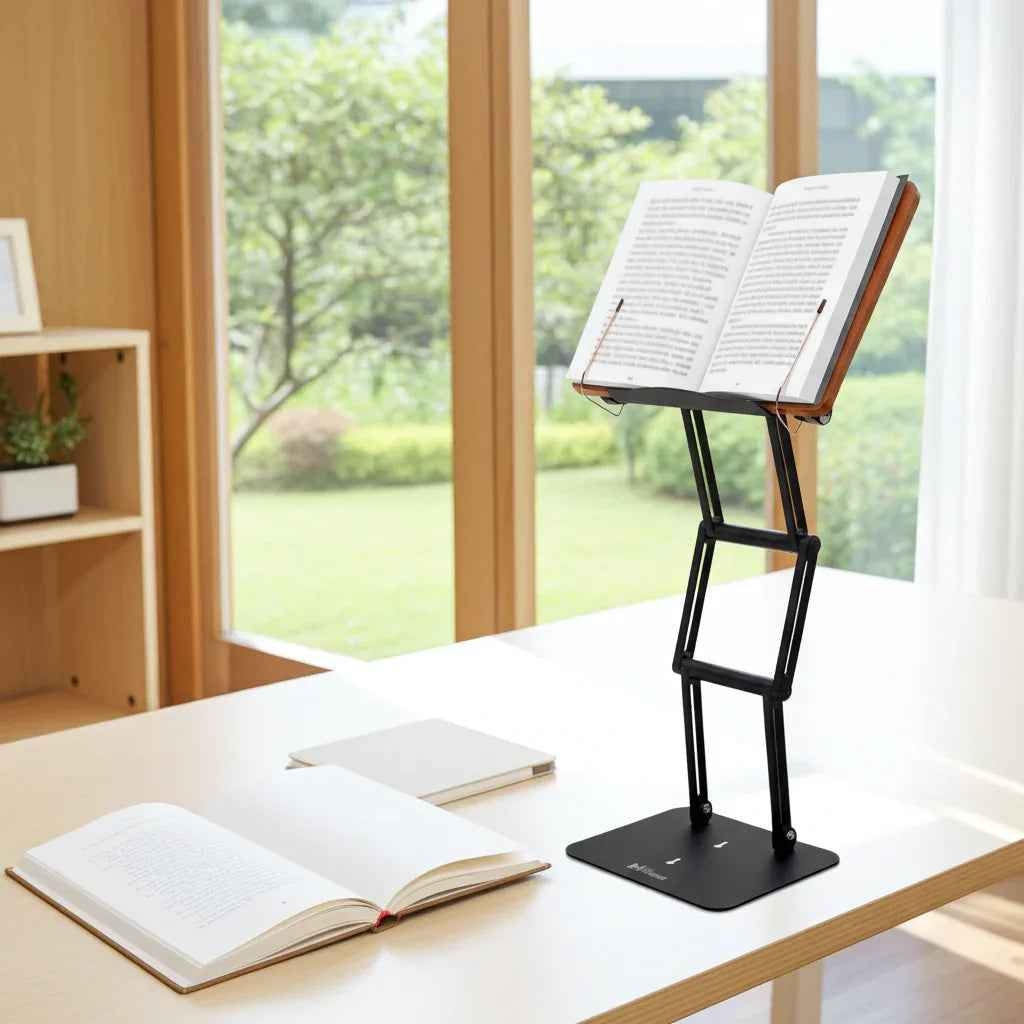
Many people ask, "How can I Reduce Neck Pain?" Reading shouldn't hurt. If you’re halfway through a chapter and already reaching for your neck in pain, your setup is working against you.
A few hours with your chin tipped down over a textbook, or even just cracking open that novel you've been meaning to read for so long, can leave your neck feeling tight, heavy, and oddly exhausted. If you have ever finished a study session, work block, or just from pleasure reading or looking at your tablet, you found yourself rubbing the base of your neck, wondering why reading feels physically draining, you may have had the thought: "can a book stand reduce neck pain?"
In many cases, the answer to that is a resounding "yes!" The right stand changes the position of the material, which changes the position of your head, which reduces strain on the cervical spine.
However, that does not mean every book stand is a cure-all. Neck pain is usually either a posture problem, a workstation problem, a duration problem, or it signifies problems of a physical nature. Very often it may be your body telling your "it's all of the above!" A stand can make a meaningful difference when it is tall enough, stable enough, and adjustable enough to support the way you actually read and work.
Can a book stand reduce neck pain during reading?
Yes, because the basic mechanism is straightforward. When a book lies flat on a desk, your eyes drop and your head follows. That forward and downward posture increases the load on the muscles that support your head and neck. Over time, those muscles fatigue, your shoulders round forward, and your upper back starts doing a poor imitation of a question mark.
The Physics of "Text Neck": For every inch your head tilts forward, it gains roughly 10 lbs of "effective weight" on your upper back and neck muscles.

A book stand interrupts that pattern by elevating the page closer to eye level. That simple change can help you keep a more neutral neck position, with less forward head posture and less sustained flexion. For readers, students, and scholars who spend long stretches with dense material, that is not a minor comfort upgrade. It is a structural improvement to the way the body interacts with the task.
This matters even more if you switch between books, notes, and a laptop throughout the day. Repeatedly looking down, then up, then down again creates a stop-start strain cycle. A properly positioned stand can reduce those exaggerated changes in angle and make your visual field more efficient.
Why neck pain happens at the desk
Neck pain during reading is rarely about one dramatic movement. More often, it builds from low-grade stress repeated for hours. The common culprit is sustained neck flexion - the posture where the head tilts forward and down while the shoulders collapse inward.
The human head is not especially heavy in a neutral position. It becomes a different story when it drifts forward. The farther forward the head sits, the harder the neck and upper back muscles have to work to hold it there. That muscle demand can lead to soreness, stiffness, tension headaches, and the familiar ache between the shoulder blades.
Desk setup plays a major role. A low reading surface encourages slouching. A flimsy stand that wobbles under a heavy textbook forces constant micro-adjustments. A stand with limited elevation may improve things slightly, but not enough to put the text where your eyes naturally want it.
This is why serious readers need more than a decorative accessory. They need a support tool that holds substantial material at a meaningful height, without sagging or shifting.
Is your current stand failing you?
- The "Sink" Test: Does the height slowly drop as you work?
- The "Wobble" Factor: Does it shake when you turn a page?
- The Height Ceiling: Is the top of your book still 6 inches below your eyes?
How a book stand helps the cervical spine
A good book stand does three useful things at once. First, it raises the material. Second, it angles the material for easier viewing. Third, it keeps the material fixed in place so your body does not compensate for instability.
Those three functions matter because the cervical spine responds best to alignment, not effort. If you have to hold yourself rigidly upright just to keep reading, the setup is still failing you. The goal is a working posture that feels sustainable, where the page is presented to you instead of forcing you to fold yourself down toward it.
For many people, the most immediate benefit is reduced chin drop. When the text is elevated, your line of sight stays more level. That reduces the amount of time your neck spends bent forward. Over a 20-minute session, that may feel like a small change. Over months of studying, writing, or religious learning, it becomes significant.
There is also a concentration benefit. Less physical discomfort usually means fewer posture resets, fewer breaks caused by tension, and better continuity of thought. Ergonomics is not just about pain avoidance. It is also about preserving mental performance.
The catch: not every stand will help
If a stand is too short, too unstable, or too weak for the materials you use, it may do very little for neck pain. In some cases, it can even create a new problem by forcing awkward viewing angles.
A lightweight stand designed for a tablet may not support a legal text, medical reference, or large religious volume without wobble. A stand with poor joint strength may slowly sink during use, pulling the book lower as you work. That means your posture improvement disappears gradually, often without you noticing until the tension returns.
Height range matters more than many people realize. The stand should bring the book high enough that you are not still looking sharply downward. Angle adjustment matters too. A page that is too vertical can create glare or visual strain, while one that is too flat defeats the purpose.
This is where premium engineering earns its place. A serious ergonomic stand should be built for actual load, actual study time, and actual repetition. That is the difference between a tool that supports posture and one that merely occupies desk space.
What to look for if neck pain is the goal
If you are choosing a stand specifically to reduce strain, prioritize function over novelty. The best design is the one that keeps your reading material stable, elevated, and easy to see for long periods.
- Prioritize Height: The closer the top portion of the page gets to eye level, the less your neck has to flex.
- Demand Stability: Heavy books need a stand that does not shake when you turn pages or annotate. This is especially important for students, attorneys, clergy, and researchers using dense materials.
- Seek Versatility: If you move between textbooks, tablets, and a laptop, a multi-use stand creates a consistent visual field.
A well-built adjustable platform like The Stander 1.1 is designed with that kind of serious use in mind, especially for users who need real elevation, durable joints, and support for substantial books rather than light casual reading.
A stand works best as part of a posture system
Even an excellent stand does not excuse a poor desk setup. If your chair is too low, your shoulders are shrugged, or your keyboard position twists your arms outward, neck pain can persist. Ergonomics works as a system.
Your feet should feel supported. Your shoulders should stay relaxed rather than lifted. If you are typing while reading from a stand, keep the keyboard close enough that you are not reaching forward. If you are handwriting notes, place them so you are not constantly rotating your neck to one side.
Work duration matters too. A better posture is still a posture held over time. If you read for three hours without moving, some stiffness is still likely. Brief resets help. Stand up, roll the shoulders, change visual distance, and then return to the task.
If neck pain is severe, radiates into the arm, causes numbness, or persists regardless of setup changes, it is worth getting medical guidance. A stand helps with mechanical strain, but it does not replace evaluation for an underlying condition.
Who benefits most from a raised reading platform
The biggest gains usually show up in people who spend long sessions with physical material. Students bent over textbooks, academics reviewing articles, professionals working from printed briefs, and religious scholars studying sacred texts often carry the highest posture load.
"In the Beit Midrash or a law library, the physical weight of the books is only half the battle. The duration of the study is what causes the strain. A stand that sinks over an hour is just as bad as no stand at all."
For these users, the stand is not a convenience item. It is part of the work environment, much like a proper chair or monitor position. The more serious the reading, the more valuable a stable elevated platform becomes.
There is also a quality-of-life factor. Reading should not feel like a neck endurance test. When the material is positioned correctly, the body settles, the eyes track more comfortably, and sustained focus becomes more realistic.
So, can a book stand reduce neck pain? Yes - when it meaningfully raises your material, supports a neutral head position, and stays stable under real use. The right stand will not do every job by itself, but it can remove one of the most common causes of desk-related neck strain. If your work depends on hours of reading, that is not a small improvement. It is a better way to study, think, and keep going tomorrow.
Don't let a posture problem shorten your study session. Experience the difference professional-grade elevation makes.
Explore the Stander 1.1 Engineering →