People also ask this question as: How to read a book without hurting your neck? Or, how do I prevent neck pain?
Quick Answer: The best way to prevent neck pain while reading is to keep your book at a 60-degree angle at eye level, approximately 15-20 inches from your face. This prevents "Text Neck" by reducing the 60lbs of pressure caused by a forward-leaning head.
Reading for long periods often starts comfortably — and ends with stiffness, fatigue, and a sore neck.

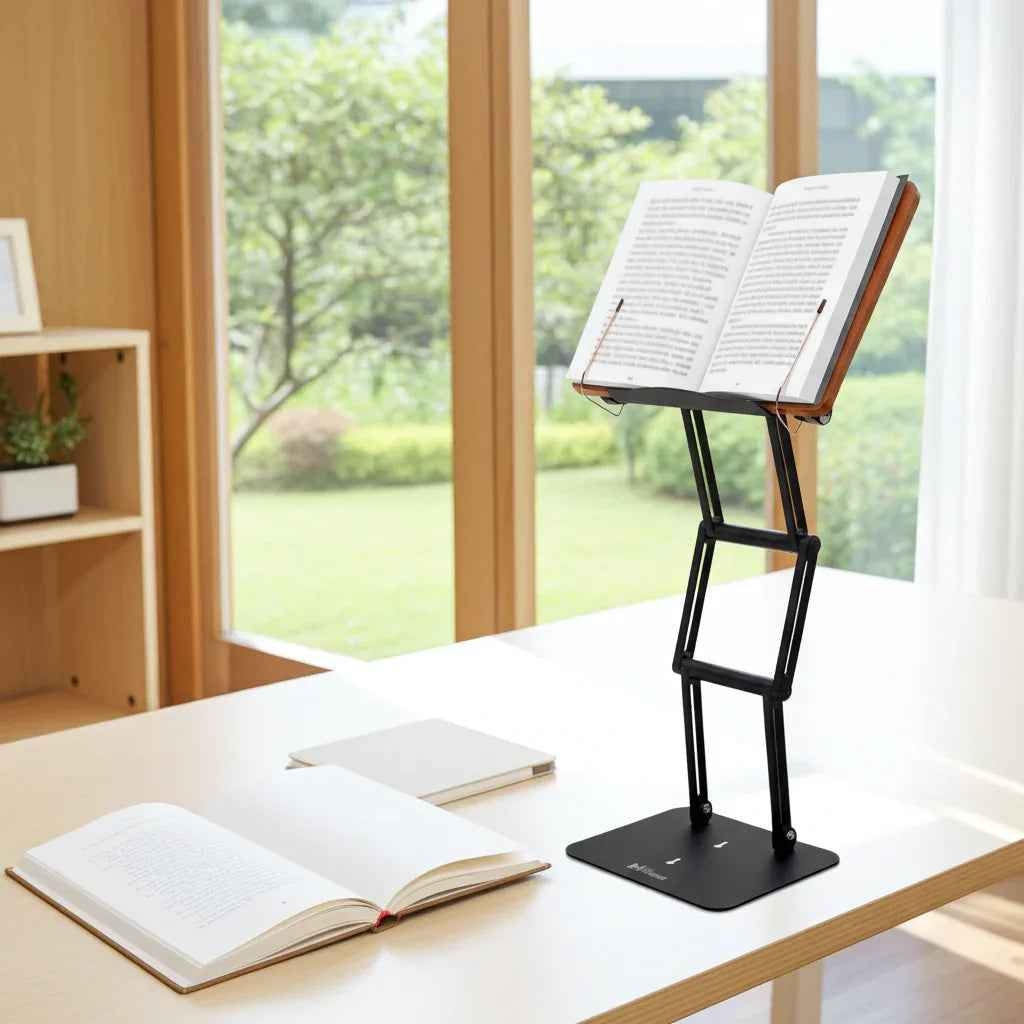
The Stander by Dr. Shtaygen
An adjustable stand for heavy textbooks and long reading
Height- and angle-adjustable. Aluminum frame, 1.5 kg (3.3 lb), tested with heavy volumes up to 5 kg (11 lb). $95 + shipping, free 30-day returns.
See The StanderThe problem isn’t the reading itself.
It’s the position.
How do I prevent neck pain during long reading sessions?
To prevent Cervical Kyphosis—often called "Text Neck" or "readers neck"—you must eliminate the downward head tilt that puts up to 60 lbs of pressure on your spine. Chiropractors recommend maintaining a neutral spine position, which is only possible when your reading material is elevated to eye level. Obviously, this requires that you use reading aids for neck problems, and that you use them correctly. The Stander 1.1 is engineered specifically to achieve this posture, allowing your neck muscles to remain relaxed even during marathon reading sessions.
The Problem Explained
When reading materials are placed flat on a desk, the head naturally tilts downward. Over time, this creates strain on the cervical spine, leading to discomfort and reduced focus.
The good news is that small adjustments can make a significant difference.

Note on Lower Back Pain: While the focus is often on the neck, a downward head tilt pulls on the entire posterior chain. This often manifests as lower back pain because the lumbar spine loses its natural "S" curve to compensate for the forward weight of the head. Elevating your reading material is a primary step in holistic back pain relief.
Why Reading Causes Neck Pain?
The human head weighs approximately 10–12 pounds.
When the head tilts forward, the effective load on the neck increases significantly. At a 60-degree angle, the neck may experience forces equivalent to 50–60 pounds.
This means that reading from a flat surface for extended periods places continuous stress on the spine.
Over time, this can lead to:
- Neck stiffness
- Shoulder tension
- Headaches
- Reduced concentration

The Key to Reading Without Pain: Neutral Posture
The goal is simple: Keep your head as close to a neutral, upright position as possible.
This reduces unnecessary strain and allows your muscles to relax. To achieve this:
- Raise reading material closer to eye level
- Avoid prolonged downward head tilt
- Keep shoulders relaxed and aligned

Practical Ways to Reduce Neck Strain While Reading
1. Elevate Your Reading Material
The most effective change is also the simplest:
Raise the book. There are reading aids for neck problems that were made specifically for this.
Using an adjustable stand allows the text to sit closer to eye level, reducing the need to bend forward.
👉 Read next:
What Is the Best Ergonomic Book Stand? Complete Guide
Best Book Stand for Studying: Complete 2026 Guide
2. Adjust Your Desk Setup
A good setup includes:
- Proper chair height
- Stable desk surface
- Adequate lighting
- Minimal clutter
👉For a full setup guide, see
Best Desk Setup for Studying: Ergonomic Guide for Comfort
3. Use the Right Angle
Even with elevation, angle matters.
- Steeper angles → better for reading
- Moderate angles → better for writing
For step-by-step instructions, see
👉 How to Use an Adjustable Reading Stand for Better Posture and Comfort
4. Alternate Between Sitting and Standing
Remaining in one position too long — even a good one — can still cause fatigue. A balanced approach works best:
- Sit for 30–60 minutes
- Stand for 15–30 minutes
- Move regularly
Learn more in
👉 Sit vs Stand: Which Is Better for Health and Study?

5. Take Short Movement Breaks
Even with perfect posture, movement is essential.
- stretch your neck and shoulders
- stand up periodically
- reset posture
Ideal Reading Setup for Comfort
A well-designed reading setup includes:
- elevated reading material
- proper angle
- good lighting
- supportive seating
- periodic movement
These small adjustments significantly reduce fatigue over time.
Who Benefits Most From Better Reading Posture?
Better reading ergonomics is especially helpful for:
- Students studying for long hours
- Professionals reviewing documents
- Religious study and text-based learning
- Anyone using books, tablets, or laptops extensively
Historically, raised reading platforms such as the shtender were designed for exactly this purpose.
Learn more here:
👉 What Is a Shtender? Modern Book Stand for Study and Work
Related Buying Guides
- Best Ergonomic Book Stands for Office Use (2026 Guide)
- Best Adjustable Height Book Stands (Compared)
- Best Foldable Ergonomic Book Stands for Small Desks
- Best Book Stands with Tablet and Laptop Support
Frequently Asked Questions
Is it bad to read with your head down?
Yes. Prolonged downward head tilt increases strain on the neck and can lead to discomfort over time.
What is the best position for reading?
A neutral posture where the head remains upright and the reading material is elevated closer to eye level.
Do book stands really help?
Yes. Elevating reading material reduces neck strain and improves comfort during long sessions.
Click here for our full FAQ about the Stander
Improve Your Study Setup
If you're looking to elevate books, tablets, or laptops to a more comfortable reading position, an adjustable stand can make a significant difference.
The Stander by Dr. Shtaygen
An adjustable stand for heavy textbooks and long reading
Height- and angle-adjustable. Aluminum frame, 1.5 kg (3.3 lb), tested with heavy volumes up to 5 kg (11 lb). $95 + shipping, free 30-day returns.
See The Stander