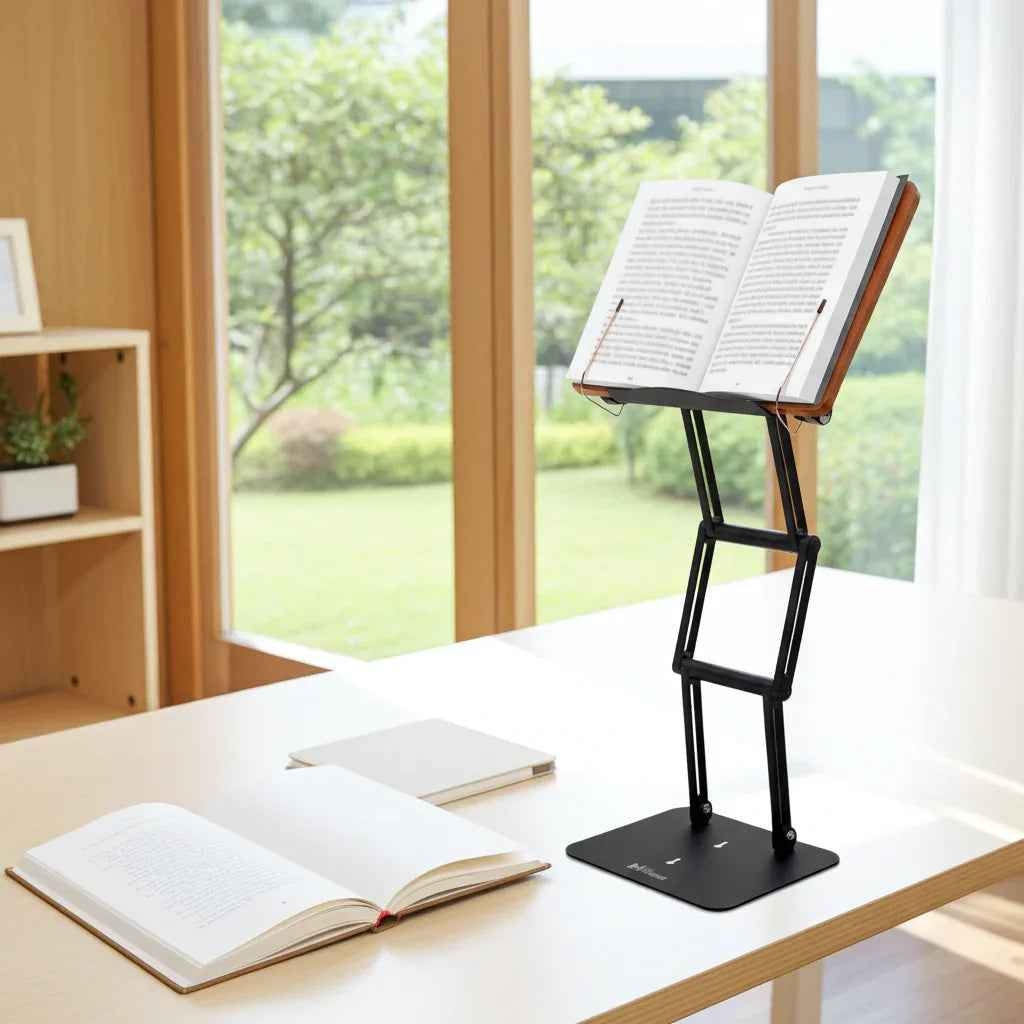
A desk can have an excellent chair, a proper monitor, and still create the same old ache at the base of the neck if the material you actually read sits flat on the tabletop. The best book stand for office functionality is not a decorative cookbook prop. It is a working tool that brings books, documents, tablets, and even a laptop into a position that supports focused work without asking your cervical spine to spend the day folded forward.
For researchers, attorneys, students, accountants, clergy, and anyone who reads for more than a few minutes at a time, this is a meaningful distinction. A stand that is too low, too light, or too narrow may hold a paperback. It may also become one more office accessory that fails precisely when the work gets serious.
What Office Functionality Actually Requires
Office functionality means more than keeping a book upright. A useful stand must fit into a real workflow: reading a reference book beside a monitor, reviewing printed material during a video call, following sheet music, holding a tablet for a presentation, or moving between seated and standing work.
That requires three things: usable height, dependable stability, and a platform that accommodates more than one type of material. If a stand only works for a small paperback at one fixed angle, it is a niche accessory. If it can hold a dense textbook, legal volume, tablet, or laptop at a comfortable viewing height, it becomes part of the workstation.
The right choice also depends on your desk and work habits. Someone reading novels for 20 minutes before bed has different needs from a doctoral student working through source material for four hours. A compact folding stand may be fine for occasional tablet use. It is rarely the best answer for sustained office reading or heavy books.
The Best Book Stand for Office Functionality Starts With Height
Most desk stands solve only half the problem. They tilt the reading surface, which can improve page visibility, but leave the book close to the desk. Your eyes still look down. Your head eventually follows.
A stand with meaningful vertical adjustment changes the equation. It allows the top of the reading material to approach eye level, helping you maintain a more neutral head and neck position. This matters because the body tends to adapt to the location of the work. Put the work low, and you will eventually lean low.
For office use, look for a stand that raises its support surface substantially above the tabletop, not merely a few inches. The Stander 1.1 raises its aluminum support lip 17.8 inches above the tabletop. Since the book, tablet, or screen rests above that lip, the actual viewing height is higher still. That range gives seated workers room to position material properly and gives moderate standing workflows a practical option as well.
Height adjustment is also useful in shared spaces. A desk used by two people does not need one permanent reading angle. A tall reader, a shorter reader, a person in a task chair, and a person standing at a counter will all need different positions. Good ergonomics should adjust to the person, not demand that the person adapt to the equipment.
Stability Is a Productivity Feature, Not a Luxury
A stand can be tall and still be wrong for the office if it wobbles. Every bounce when you turn a page, write a note, or tap a screen creates small interruptions. More importantly, instability makes users reluctant to place valuable equipment or heavy books on the stand in the first place.
Lightweight plastic stands and thin wire easels have a place. They are portable, inexpensive, and adequate for a recipe card or a small e-reader. But their limitations become obvious with wide textbooks, binders, hardcovers, or laptops. A stand meant for serious desk work should have a stable base, rigid construction, reliable joints, and a support lip that keeps the item from migrating forward.
Materials tell part of the story. Aluminum construction offers strength without turning the stand into a permanent piece of furniture. Stainless steel joints are valuable because adjustment points carry real stress over time. The goal is not simply to own something heavy. It is to have a structure that remains composed under load and continues to adjust smoothly after repeated use.
There is a trade-off here. A more substantial stand takes up more desk space than a minimal folding model. For people with a very shallow desk, that footprint deserves measurement before buying. Yet a stand that supports the work reliably often reduces clutter overall by giving books, documents, and devices one designated position instead of scattering them across the desktop.
Match the Platform to Your Materials
The most versatile office book stand handles changing formats without making each new task feel like a setup project. Consider what you use in a normal week, not what you imagine using once.
A researcher may need an open textbook in the morning, a tablet for articles in the afternoon, and a laptop for a presentation. A musician may use sheet music. A home cook may move it to the kitchen for a cookbook. A lecturer may use it as a compact lectern. The traditional shtender was built around the simple but powerful idea that serious study benefits from a raised, dedicated surface. A modern version should preserve that purpose while serving the contemporary desk.
Pay attention to support depth and retaining features. Thick books need a lip that can hold their weight without covering too much text. Tablets need a secure resting point that does not interfere with charging ports. Laptops require enough stability that typing or trackpad use does not turn into a balancing act.
One honest caution: a raised stand is not always a replacement for a full monitor arm or an external keyboard setup. If you type continuously on a laptop for hours, placing it high without an external keyboard and mouse can force the wrists into an awkward position. The stand is strongest as a viewing platform, reading station, reference holder, or laptop riser paired with appropriate input devices.
Build a Better Reading Workflow at Your Desk
The biggest gains often come from placing the stand deliberately. Set it directly in front of you for primary reading, rather than off to one side where it encourages neck rotation. If the book is a secondary reference beside a monitor, keep it close enough that you can glance over with your eyes before turning your head.
Adjust the height until you can read the upper portion of the page without dropping your chin toward your chest. You do not need to freeze in one posture all day. In fact, changing positions is useful. The practical objective is to remove the sustained forward bend that appears when materials remain flat on the desk.
For long reading sessions, alternate between reading, note-taking, and brief movement. Keep frequently used pens, tabs, and charging cables within reach so the raised platform does not create a new nuisance. If you work with a large book, open it fully and confirm that the pages are supported evenly. The best setup feels boring in the best possible way: you stop thinking about your neck, the stand, and the mechanics of holding the material in place.
Why Cheap Stands Often Become Expensive
The least expensive stand can appear sensible until it begins limiting the work. A narrow base that tips with a hardcover, a fixed height that keeps the text low, or a hinge that loosens after a season does not merely create annoyance. It sends you back to hunching over the desk.
That does not mean every user needs a premium, heavy-duty unit. If your only goal is occasional tablet viewing on a small kitchen counter, simplicity may win. But if your work involves demanding reading, valuable devices, large reference materials, or recurring neck discomfort associated with desk posture, a serious adjustable stand is a rational investment in the workstation itself.
The deciding question is simple: will this stand support the way you actually work when the book is heavy, the session is long, and your attention needs to stay on the page? Choose the one that makes the answer yes, then give your books the elevation your body has been asking for.