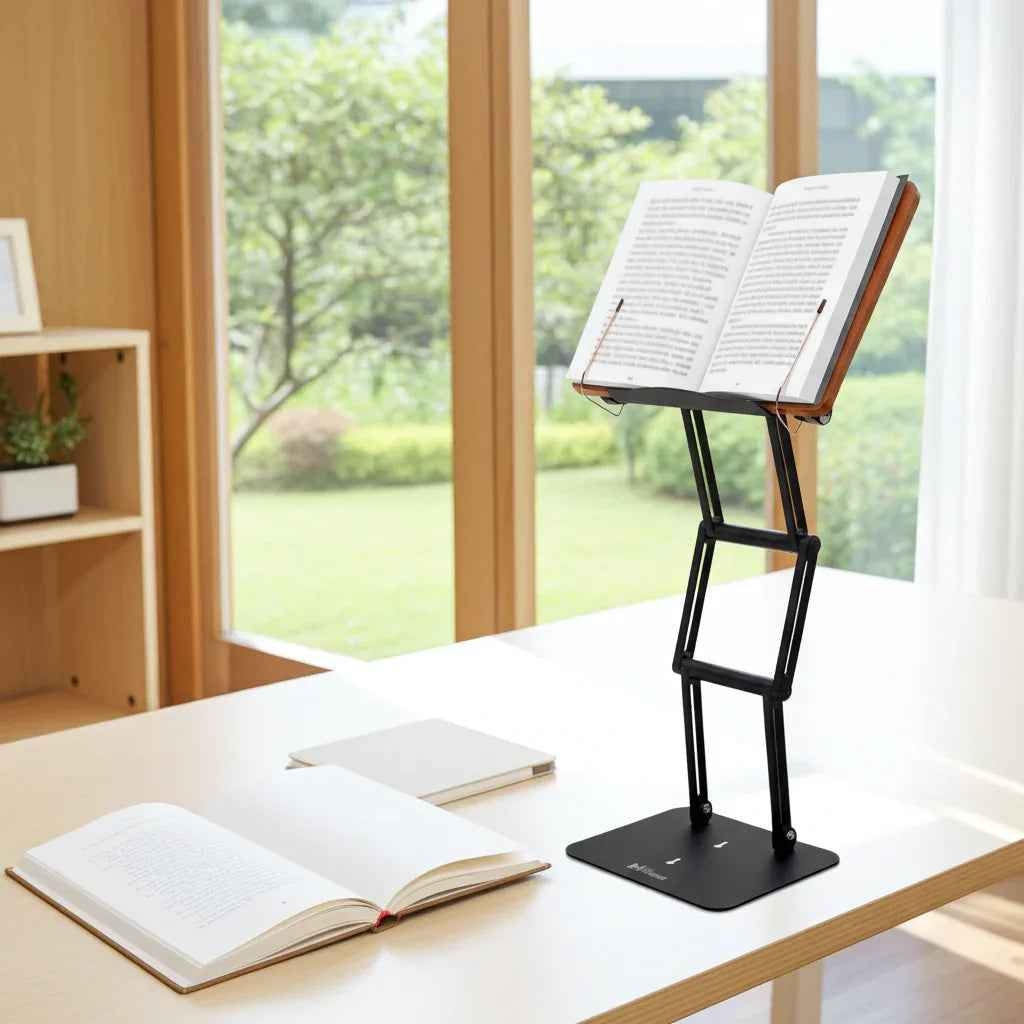
A textbook that slowly slides flat, a laptop stand that wobbles when you type, a reading rest that dips under weight - these are small failures that add up over long hours at a desk. A stable book stand for desk use is not a minor accessory. For students, professionals, and serious readers, it is a piece of ergonomic equipment that directly affects posture, focus, and how long the workday feels.
The difference is easy to feel. When reading material sits too low, the head drops forward, the neck flexes, and the upper back begins carrying a load it was not designed to hold for hours at a time. Raise the material to a more natural viewing height, and the body immediately has less distance to collapse. That is why stability matters just as much as adjustability. If the platform shifts under pressure, the user compensates with tension.
Why a stable book stand for desk work changes posture
Most people do not need a lecture on neck strain. They already know the sensation - tight shoulders, fatigue between the shoulder blades, and the habit of leaning closer as concentration deepens. The issue is mechanical. When a book or screen sits flat on the desk, the cervical spine remains in sustained flexion. Over time, that position becomes the default working posture.
A stable elevated stand changes the angle of reading and viewing. Instead of forcing the body downward, it brings the work upward. That sounds simple because it is simple, but the effect is significant. Better screen and page height reduces repeated forward head posture, helps keep the chest more open, and makes it easier to work with the elbows closer to a neutral position.
This is also where cheap stands often fail. They may technically elevate a book, but if the hinge drifts, the tray shakes, or the base skids, users stop trusting the setup. The body then reverts to guarding against movement. True ergonomic support depends on confidence in the platform.
Stability is not the same as adjustability
Many desk stands advertise multiple angles and heights. Fewer perform well once real weight is added. A light tablet is one thing. A thick medical text, legal volume, or religious work is another. If the joints are weak or the center of gravity is poorly managed, a highly adjustable stand becomes unstable at the exact moment it is supposed to help most.
A serious stand needs enough structural integrity to hold position under load. That means durable joints, a tray that does not flex excessively, and a base engineered to resist tipping. For users who alternate between books, tablets, and laptops, the test is not whether the stand can be adjusted. The test is whether it stays fixed after adjustment.
There is always a trade-off. Extremely light stands are easier to move, but they often sacrifice rigidity. Heavier-duty stands take up more visual presence on a desk, yet they tend to feel better in daily use because they do not ask the user to work around their limitations. If your workflow involves five-minute reading sessions, that may not matter. If your workflow involves three-hour study blocks, it matters a great deal.
What to look for in a stable book stand for desk setups
The right stand depends on what you place on it and how long you use it. A graduate student reading dense textbooks needs something different from a casual cookbook holder. A remote professional may need one platform that handles both a laptop and printed notes. A scholar studying sacred texts may want the function of a modern shtender with a cleaner footprint and broader adjustability.
Start with load capacity in practical terms, not marketing terms. Ask whether the stand can support heavy books without gradual sagging. Then evaluate elevation range. A stand that lifts only slightly above desk height may help, but it may not bring reading material close enough to eye level for taller users or standing workflows.
Joint material matters more than many buyers realize. Plastic mechanisms can be adequate for light use, but serious daily work benefits from metal joints and a rigid support structure. The same goes for the page-holding system. If the clips are awkward or flimsy, users end up fighting the stand every time they turn a page.
Desk compatibility matters too. A large footprint can increase stability, but it should not consume all available working space. On smaller desks, a stand has to balance secure placement with room for note-taking, keyboard use, and writing.
The real use cases: textbooks, laptops, tablets, and sacred study
One of the strongest reasons to invest in a premium stand is versatility without compromise. Many readers no longer work from one format. A morning may begin with a laptop, continue with journal articles, and end with a large printed text. The ideal stand supports all of that without feeling like a workaround.
For textbooks and research volumes, stability under weight is the first requirement. These materials are often large, dense, and used for long periods. Any platform movement becomes distracting. For laptops, height and firmness become critical because the device itself is heavier and more sensitive to wobble during touch or typing interactions. For tablets, the stand should prevent bounce and maintain angle precision, especially during annotation or side-by-side referencing.
There is also a meaningful cultural and practical role for the raised study platform in religious learning. The traditional shtender exists for a reason. It supports attention, reverence, and physical endurance during extended study. A modern desk stand that carries that function forward should honor the same need for height, steadiness, and seriousness of use.
Why flimsy stands cost more than they save
Low-cost stands can look appealing because the category often appears simple. But if a stand fails to hold angle, cannot support heavy material, or needs frequent readjustment, the savings disappear quickly. The user pays in interrupted concentration, persistent discomfort, and replacement purchases.
This is especially true for people who work at a desk every day. Ergonomic tools should remove friction, not introduce it. A stand that collapses slightly under load teaches the user to accept poor alignment. A stand that remains stable encourages better habits because it makes the healthier position easier to maintain.
Premium construction is not just about appearance. It is about repeatable performance. Durable aluminum joints, substantial support, and a design built for actual books instead of showroom photos create a very different experience over months and years.
How to set up your stand for better results
Even the best stand needs correct positioning. Place the stand so the top portion of the reading material sits near eye level, or as close as your desk setup allows. Keep it centered in front of you when it is the primary task, rather than off to one side where you will rotate the neck for long periods.
If you are using a laptop on the stand, pair it with an external keyboard and mouse whenever possible. That separates screen height from hand position, which is usually necessary for real ergonomic benefit. For books, leave enough room below the stand for note-taking so you do not hunch forward to write.
Small adjustments matter. Angle the tray enough to reduce downward gaze, but not so steeply that page turning becomes awkward. If you alternate between sitting and moderate standing, choose a stand with enough elevation range to support both without compromise.
A stand should support serious work, not just hold a book
That is the standard many products miss. A reading stand can hold pages off the desk and still fail as a piece of ergonomic equipment. Serious users need more than basic function. They need confidence that the platform will stay where it is set, carry real weight, and preserve physical comfort through long sessions.
This is exactly why heavy-duty options such as Dr. Shtaygen's approach stand apart from commodity stands. The value is not in novelty. It is in giving demanding readers and desk workers a stable platform that respects both the body and the work.
If your desk setup still asks your neck and shoulders to do the compensating, the problem is not your discipline. It is the equipment. A well-built stand earns its place by making better posture easier to keep when the reading gets serious.