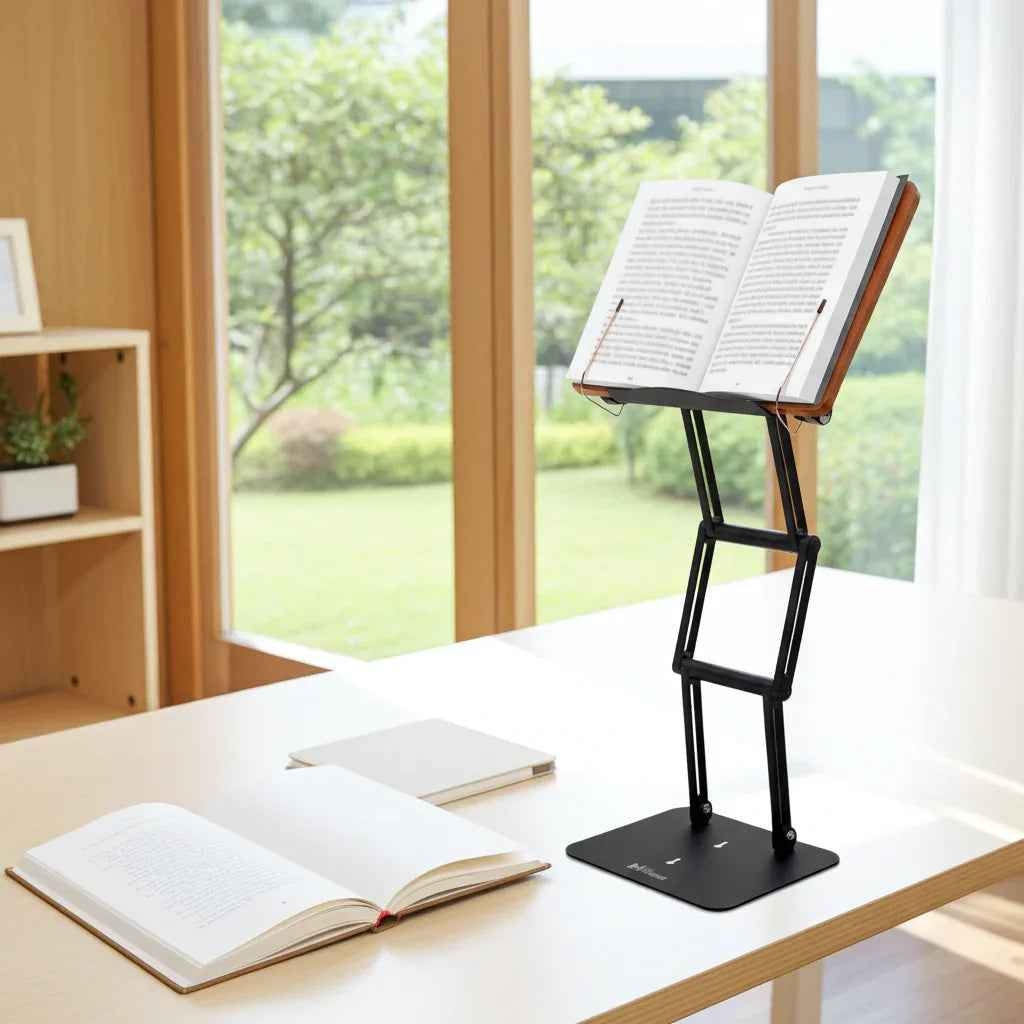
Neck strain rarely starts with one bad hour. It builds from hundreds of ordinary study sessions - chin down, shoulders rounded, eyes locked on a page that sits too low on your desk. Using a modern shtender for desk study changes that setup in a very practical way. By raising books, tablets, and even laptops closer to eye level, it turns a traditional study aid into a serious ergonomic tool for people who spend real time reading and thinking.
For many readers, the word shtender carries a clear image: a dedicated platform for focused text study, often associated with long sessions and intellectual discipline. That heritage still matters. But at a desk, the needs are broader now. You may be moving between a religious text, a law casebook, a research article, handwritten notes, and a laptop in the same hour. The right stand has to do more than hold a page open. It has to support posture, reduce physical fatigue, and stay stable under demanding use.
What makes a modern shtender for desk study different
A traditional shtender is built around one purpose: elevating a text for sustained reading. But it's only a basic lift. Almost no adjustments available. It doesn't hold your book open, and when you stand up... your book stays exactly where it was, but now it's further away. A modern version keeps that intent but adapts it to the realities of contemporary desk work. That means greater height adjustment, stronger joints, a platform that can handle heavy books, and enough versatility to support multiple formats without feeling like a compromise.
This is where many generic book stands fall short. They are often designed for lightweight cookbooks or tablets, not a thick textbook, a large-format sefer, or a laptop used for hours at a time. The difference shows up quickly. If the angle slips, the platform shakes while you type notes, or the stand cannot rise high enough to improve your line of sight, the ergonomic benefit disappears.
A true desk-ready shtender should elevate your Talmud/Chumash/Navi/Shulchan Aruch or whatever sefer you want to study to a position that reduces repeated neck flexion. It should also remain planted when you turn pages, annotate, or shift between sitting and moderate standing. Stability is not a luxury feature here. It is what allows concentration to continue without constant readjustment.
Why does desk study create so much physical strain?
Most people assume discomfort comes from working too long. Time matters, but position matters more. When reading material sits flat on a desk, your head tends to tilt forward. Even a modest angle, repeated over long sessions, increases demand on the cervical spine and upper back.
That strain often spreads. The shoulders round forward. The thoracic spine collapses. The eyes work harder because the viewing distance is inconsistent. If you are switching between a low book and a higher monitor, the mismatch can become even more irritating. You end up alternating between two imperfect positions instead of one well-supported posture.
A modern shtender for desk study addresses this by bringing the material to you rather than forcing your body down to the material. That sounds simple because it is simple. But the physical effect is significant. Better elevation encourages a more neutral neck position, opens the chest, and reduces the low-grade muscular tension that makes long study sessions feel harder than they should.
The features that matter if you study seriously
Not every elevated stand is worth having on a real desk. If your workload includes dense reading, long writing sessions, or heavy volumes, the design details matter.
Height range is one of the first things to check. A stand that only lifts a few inches may improve comfort slightly, but it may not place the text high enough to meaningfully change posture. The best setups bring the reading surface much closer to eye level, especially for users with monitor-heavy desks or taller seating positions.
Load capacity matters just as much. A legal text, medical reference, large religious volume, or engineering textbook puts very different demands on a stand than a paperback does. If the platform flexes or the hinge weakens under weight, it stops being a performance tool and becomes another source of friction.
Material quality is often the deciding factor behind both issues. Durable aluminum joints and a solid frame typically outperform cheaper plastic builds, especially over time. Serious users notice that difference not because they care about materials in the abstract, but because they care about whether the stand still feels precise and stable after months of daily use.
Then there is the surface itself. A useful modern shtender should support books without awkward balancing, but it should also handle tablets and laptops when needed. Multi-use design only helps if the stand performs well in each mode. Some products claim versatility but end up doing everything poorly. A better approach is one platform engineered for steady elevation across several common study tools.
Where a modern shtender fits into real workflows
Desk study is rarely one-dimensional anymore. A graduate student may read a printed journal article while comparing notes on a laptop. A rabbi or teacher may move between sacred texts and digital source material. A remote professional may use the stand for a morning reading block, then switch to a laptop riser for afternoon work.
That flexibility is where a well-designed shtender earns its place. It reduces desk clutter because one stable platform can support different modes of work. It also improves transitions. Instead of rearranging your desk every time you change tasks, you keep the material elevated and visible while your hands remain free for writing, typing, or annotation.
For users who alternate between sitting and standing, the value increases further. Not every desk setup supports full standing work comfortably, and not every reading task needs it. But moderate standing while reviewing documents or studying can break up long seated periods. A stand with a meaningful elevation range supports that shift without requiring a complete workstation overhaul.
The trade-off between minimalism and performance
A lot of desk accessories are sold on visual simplicity. Thin frames, fold-flat profiles, and lightweight construction look appealing, especially in product photos. But for serious reading and study, minimalism can work against function.
A heavier-duty stand may take up more visual space and weigh more than a bargain book rest. That is the trade-off for high elevation, stronger joints, and the ability to support demanding materials without wobble. If your desk work consists of occasional tablet viewing, a lighter option may be enough. If you spend hours with substantial texts or need a laptop riser that does not feel unstable, performance becomes a better investment.
This is also where premium design should justify itself. A higher-end stand is not valuable merely because it looks refined. It has to deliver better biomechanics, better stability, and better durability. When it does, the difference is felt in your neck, your focus, and your willingness to stay with a task longer.
Why scholars and professionals are returning to the shtender idea
There is a reason the shtender concept has lasted. It reflects a disciplined approach to study: elevate the text, create a dedicated posture, and give attention to the physical support it needs. That principle is just as relevant in a modern office or home workspace as it is in traditional study settings.
What has changed is the range of materials and the expectation of ergonomic performance. Today, a serious reader does not want a symbolic nod to tradition. They want a study platform that respects tradition while meeting current demands for adjustability, stability, and multi-device use.
That is why the modern interpretation resonates beyond religious contexts. Researchers, attorneys, clinicians, professors, and committed students all face the same basic problem: too many hours looking down. The shtender idea solves that in a direct, physical way. Raise the work. Reduce the strain. Preserve focus.
Products such as the Stander 1.1 reflect that shift clearly. The appeal is not novelty. It is a culturally rooted study tool that has been engineered to meet the standards of modern ergonomic work.
Choosing the right one for your desk
If you are considering a modern shtender for desk study, judge it by the work you actually do. Think about the heaviest material you use, the longest sessions you keep, and whether your discomfort comes mainly from neck angle, desk clutter, or constant repositioning. A stand that fits your real routine will outperform one chosen only for appearance or price.
Pay attention to whether the unit reaches a useful height, stays steady under load, and adapts to more than one type of device without feeling flimsy. If you study daily, durability is part of ergonomics. Anything that slips, shakes, or wears out early creates its own form of physical and mental drag.
The best desk tools do not demand attention once they are in place. They quietly improve alignment, reduce friction, and make serious work easier to sustain. That is exactly what a modern shtender should do - not as a decorative accessory, but as a durable support for the kind of reading that deserves your full mind.
With all of the above in mind, we at Dr. Shtaygen, have made it our motto "Study Hard. Learn Healthy."
To find out more about our flagship product, The Stander,