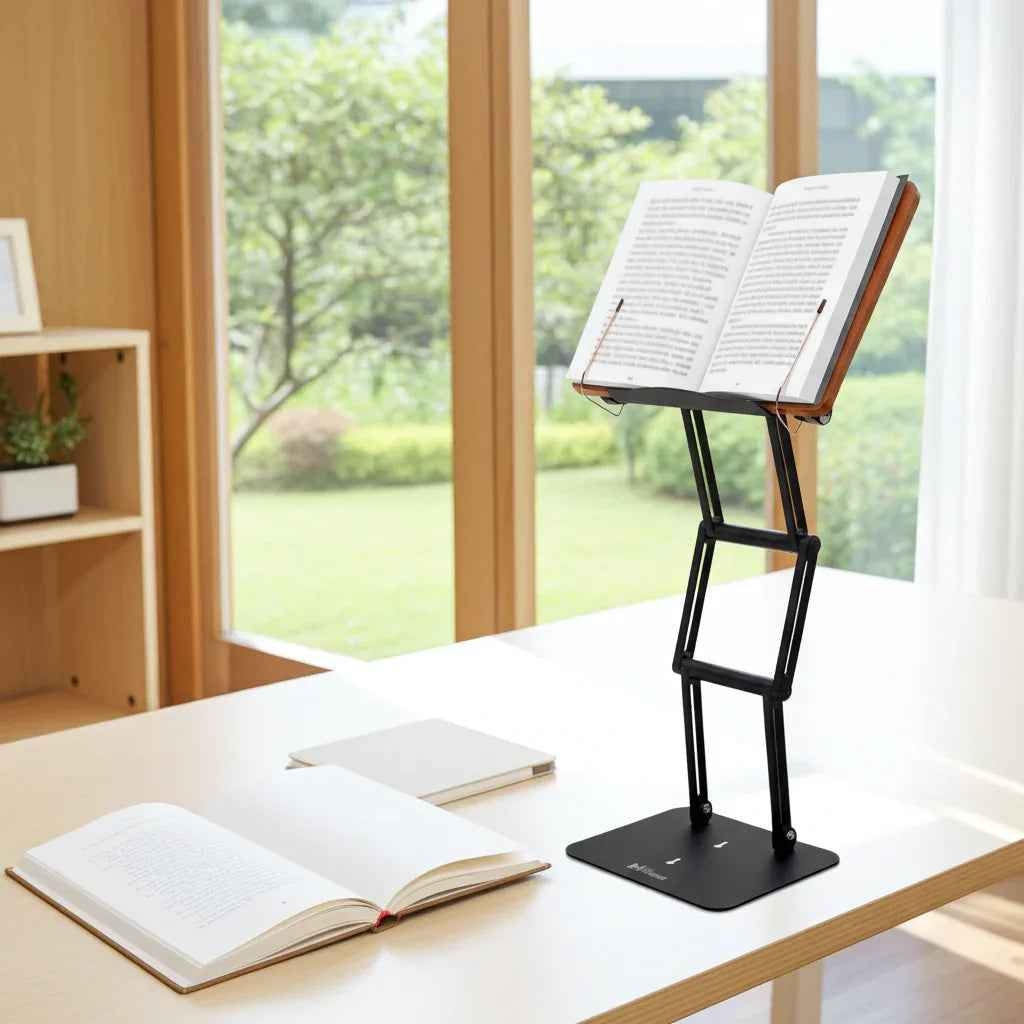
A few hours into reading or screen work, most people start making the same compromise. The book stays flat on the desk, or the laptop gets stacked on whatever is nearby, and the neck does the rest. That is why the question of book stand vs laptop riser matters more than it seems. This is not just about desk accessories. It is about whether your setup supports sustained focus or quietly creates strain.
For students, scholars, remote professionals, and anyone spending serious time at a desk, the right elevation tool changes how long you can work comfortably. But the better choice depends on what you are actually elevating, how much adjustability you need, and whether your workflow switches between books, laptops, tablets, and printed material.
Book stand vs laptop riser: the real difference
At a glance, these products can look similar. Both raise materials closer to eye level. Both aim to reduce neck flexion. Both can make a desk feel more organized. But they are designed around different primary tasks.
A laptop riser is usually built to support a computer. That means it often prioritizes a flat platform, airflow, and a footprint sized to common laptop dimensions. Many do this well, especially for keyboard-and-mouse users who keep the laptop open as a secondary screen.
A book stand is designed around reading. The key features are page support, an angle that suits visual tracking across text, and a structure that keeps books open without constant hand positioning. A serious book stand also needs to manage uneven weight distribution, since a heavy textbook or large religious volume does not behave like a laptop.
That distinction matters because reading posture and laptop posture are not identical. Books are handled differently, their weight shifts as pages turn, and the ideal angle often changes depending on glare, eye level, and the type of material being used.
Ergonomics first: what your neck actually needs
If the goal is reducing cervical strain, eye-level placement is the starting point, not the whole answer. A stand that lifts the material but wobbles, sits too low, or forces awkward reach still creates compensations elsewhere.
For books, a flat-on-desk position usually causes prolonged neck flexion. Even a moderate downward angle, held for long periods, can increase fatigue in the neck and upper back. A proper book stand improves line of sight and reduces the tendency to hunch over the page. It can also help keep the chest more open and the shoulders more neutral.
For laptops, raising the screen improves neck position, but there is a catch. Once the laptop screen is elevated high enough to be ergonomic, the built-in keyboard is usually too high for comfortable typing. That means a laptop riser often works best only when paired with an external keyboard and mouse. Without those, one problem is traded for another.
This is where buyers often get confused. A laptop riser can solve screen height. A book stand can solve reading angle. A well-designed adjustable stand can do both, but only if it is stable enough, tall enough, and strong enough to handle real loads without sagging.
Where a laptop riser does the job well
If your main task is screen-based work and you already use an external keyboard and mouse, a laptop riser can be a clean solution. It keeps the display higher, frees some desk space, and supports a more neutral viewing angle.
This is especially true for office users who spend most of the day in email, spreadsheets, meetings, or browser-based work. In those cases, page retention arms and book supports are less relevant. You want a platform that is simple, stable, and sized to your device.
Some laptop risers are also compact and easy to move between home and office. If portability is your top priority and the load is limited to a typical laptop, that can be enough.
The limitation appears when your workflow is not purely digital. As soon as you need to alternate between a laptop, textbook, notes, tablet, and printed references, a dedicated laptop riser starts to feel narrow in purpose.
Where a book stand pulls ahead
A book stand is the stronger choice when reading is central to the task. That includes students working through textbooks, attorneys reviewing case materials, clergy and scholars studying sacred texts, musicians reading sheet music, and home cooks who want a cookbook visible without sacrificing posture.
The advantage is not just that the material is elevated. It is that the stand is designed to hold an object that opens, shifts, and needs to remain readable over time. A flimsy stand may look acceptable under a paperback and fail immediately under a medical textbook or a large volume.
For serious reading, stability is performance. If the platform shakes when you turn a page or gradually slips under load, concentration breaks. That matters more than many buyers realize. A stand should disappear into the workflow. It should not need constant adjustment during the work itself.
This is also where a premium adjustable book stand becomes more than a reading accessory. If it has enough elevation range and structural strength, it can serve as a laptop riser, tablet stand, reference holder, and modern shtender in one footprint.
The hidden issue: most stands are built for light use
The market is full of accessories that look ergonomic in product photos and perform poorly in practice. Thin hinges, limited height range, weak joints, and low weight capacity are common. That may be fine for occasional tablet viewing. It is not fine for heavy books, long work sessions, or repeated daily adjustment.
A serious user should pay attention to construction, not just category. Material quality, joint design, and maximum elevation all affect whether a stand actually improves posture or merely raises the object a little.
This is why the comparison of book stand vs laptop riser is not only about function. It is also about build quality. A poorly made version of either product will underperform. A well-engineered stand with durable aluminum, strong joints, and meaningful adjustability can replace multiple weaker tools.
How to choose based on your workflow
If you mostly type on a laptop and use external peripherals, a laptop riser remains a sensible option. It is direct and efficient for screen-first work. But if your desk time includes reading, annotation, studying, or switching between formats, a book stand with true ergonomic adjustability is usually the better long-term investment.
Ask yourself what occupies the most hours, not what shows up occasionally. If textbooks, printed articles, or religious study materials are a daily part of your routine, choose the tool that was designed to hold them properly. If your laptop is only one part of a broader intellectual workflow, a single-purpose riser may create more clutter than clarity.
Load is another deciding factor. Lightweight accessories often fail when asked to support larger books or heavier devices. For graduate students, researchers, clinicians, and scholars, that is not a minor detail. A stand should handle demanding materials without hesitation.
There is also a practical desk-space question. Owning one highly adjustable stand that serves books, tablets, and laptops can be more efficient than keeping separate accessories for each task. For many users, that versatility is what makes a premium stand worth it.
The strongest option is often not either-or
For serious desk work, the smartest answer to book stand vs laptop riser is often a stand engineered to do both. That only works if the design does not compromise on stability, elevation, or weight handling. Otherwise, you end up with a hybrid product that performs neither task particularly well.
A premium platform such as Dr. Shtaygen's The Stander 1.1 is built around that higher standard. It is not trying to be a casual accessory. It is built for heavy books, sustained reading, elevated laptop use, and disciplined work that benefits from posture support and visual alignment.
That matters because the best ergonomic tools are not the ones that look clever for a week. They are the ones that still feel solid after months of studying, writing, reading, and adjusting throughout the day.
If your work is serious, your stand should be serious too. Choose the tool that supports your actual hours, your actual materials, and the posture you want to keep when focus matters most.