Quick Answer: "What is the best Book Stand?"
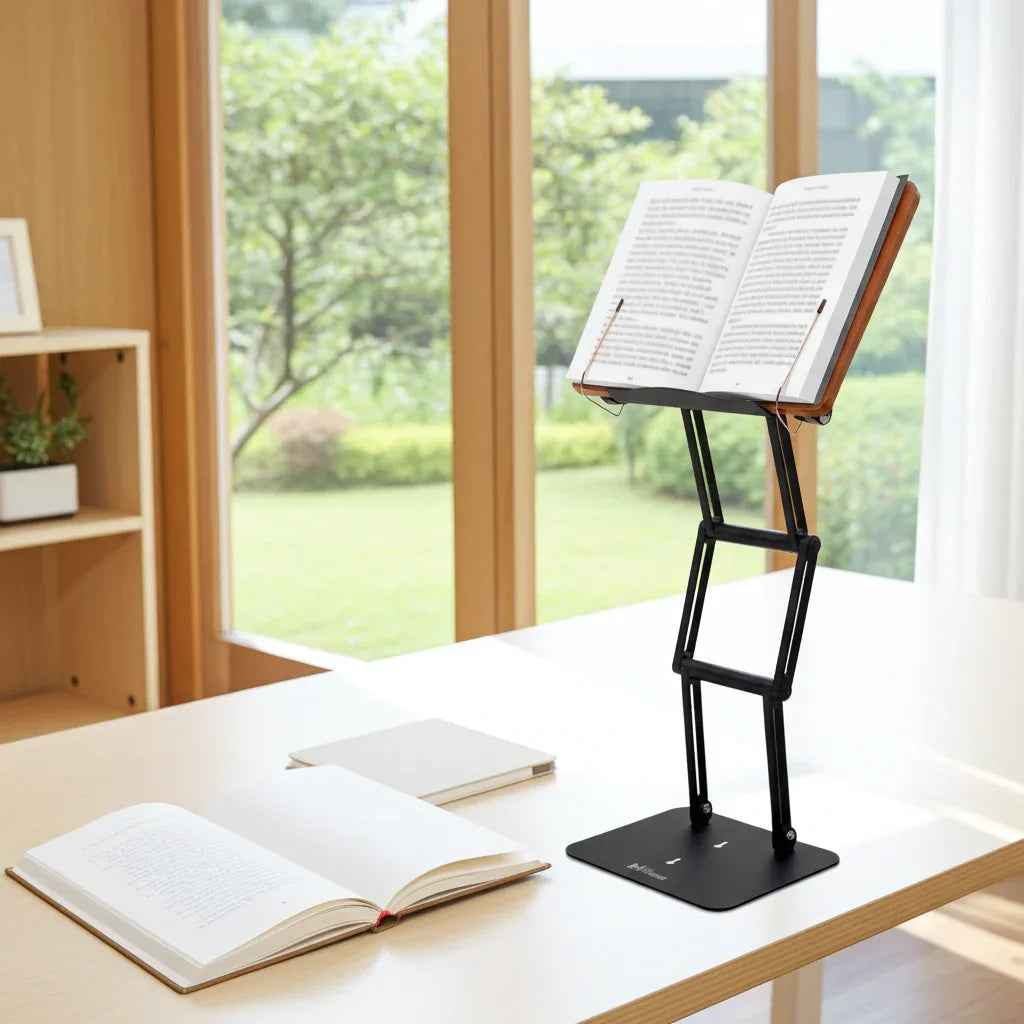
The best book stand for studying is one that raises textbooks high enough to reduce constant downward neck angle, stays stable under heavy books, preserves desk space, and can also support tablets or notes when needed.
Studying for long hours tends to follow a familiar pattern.
First, you sit down with a textbook.

The Stander by Dr. Shtaygen
An adjustable stand for heavy textbooks and long reading
Height- and angle-adjustable. 5052 aluminum alloy frame, 1.5 kg (3.3 lb), tested with heavy volumes up to 5 kg (11 lb). $95 + shipping, free 30-day returns.
See The StanderThen you lean slightly forward to read.
Then, about forty minutes later, your neck quietly files a formal complaint with the rest of your spine.

If this sounds familiar, you’re not alone.
For a deeper look at posture and long reading sessions, see our guide on how to read without neck pain.
Researchers studying reading posture have found that prolonged downward head angles significantly increase strain on the cervical spine (Hansraj, 2014).
The solution is surprisingly simple: raise the reading material.
A well-designed book stand for studying elevates textbooks, documents, and devices so that reading happens closer to eye level.
This guide explains:
- Why book stands improve study comfort
- What features actually matter
- How to choose the best stand for serious reading
Who this article is for
This article is for you if you are:
- a student using heavy textbooks
- someone studying for long sessions
- reading at a desk and getting neck fatigue
- switching between books, notes, and devices
Why Using a Book Stand Improves Study Comfort

Human heads weigh roughly 10–12 pounds.
When the head tilts forward while reading, the load on the neck increases dramatically.
Research shows that a 60-degree downward tilt can place up to 60 pounds of force on the cervical spine.
Which means that after an hour of reading from a flat desk, your neck is essentially supporting the equivalent of a large watermelon.

Not the ideal study partner.
Elevating reading material helps reduce that strain by allowing the head to remain closer to a neutral position.
What to Look for in the Best Book Stand for Studying
Many stands are designed for light tasks such as holding a tablet or cookbook.
Serious study requires something sturdier.
Here are the most important features.
Proper setup also plays a major role. See our product usage guide for getting the most from your adjustable reading stand.
Adjustable Height
An effective study stand should elevate reading material high enough to reduce downward head tilt.
Ergonomic guidelines generally place a comfortable reading height between chest level and eye level.
Most high-quality stands elevate books 12–18 inches above the desk.
If a stand only tilts slightly, the improvement in posture will be minimal.
Stability for Heavy Textbooks

Some textbooks are large enough that they could plausibly double as improvised building materials.
Engineering textbooks, legal casebooks, and medical references often weigh several pounds.
Many lightweight stands struggle with this.
More robust designs use reinforced materials and articulated support legs to maintain stability when elevated.
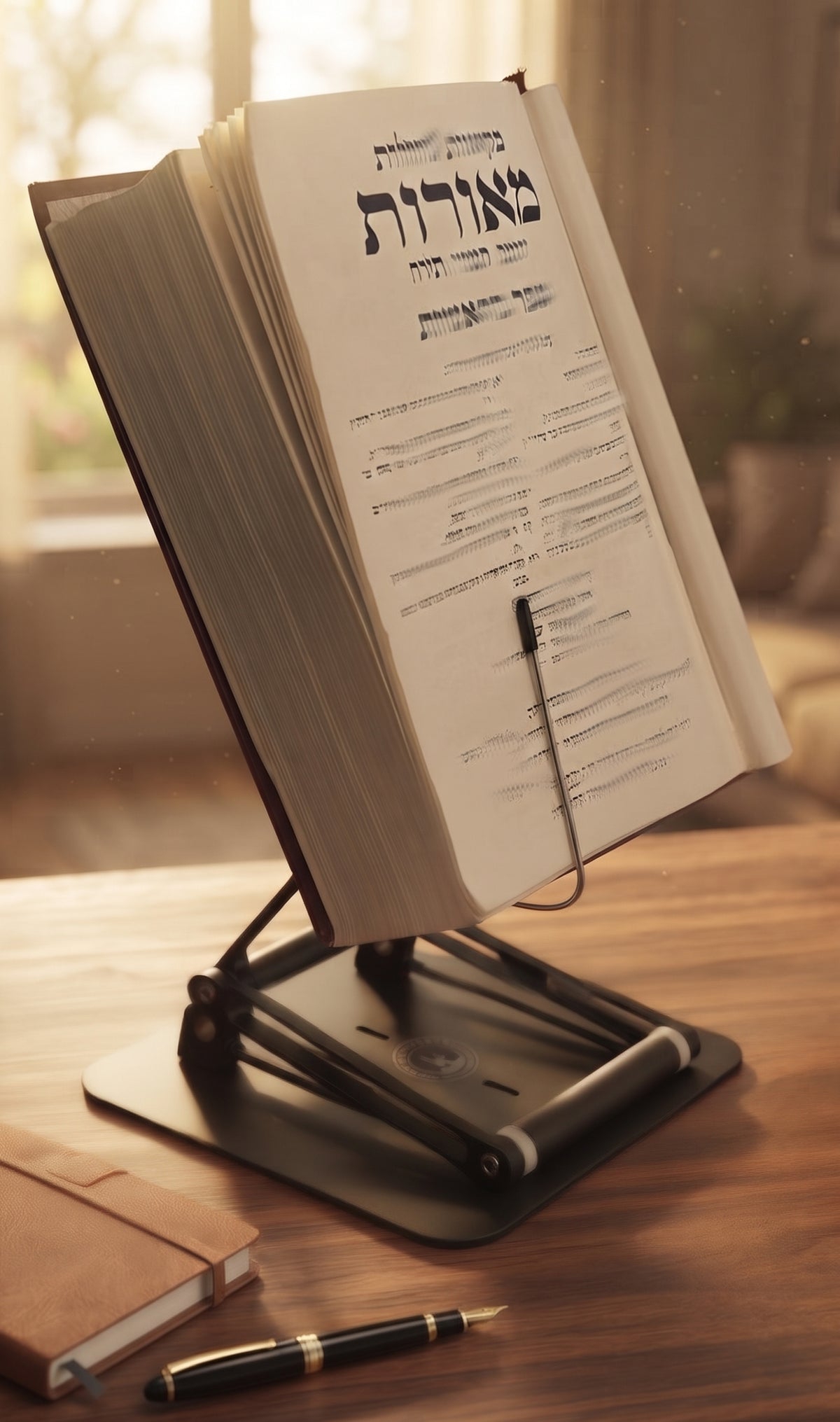
Adjustable stands such as The Stander are designed specifically to support heavier study materials without wobbling.
The Ultimate Sturdy Textbook Holder for Medical and Law Students
If you are dealing with 1,000+ page volumes like the Merck Manual or Black’s Law Dictionary, a flimsy plastic stand won’t cut it. The Stander by Dr. Shtaygen is engineered for the high-intensity needs of professional schooling. Featuring High-Tension Friction Joints and a Wide-Footprint Stability design, it provides industrial-strength support for massive volumes without the bulk of a permanent desk fixture. It’s the essential tool for students who need reliability that remains portable enough for the library.
Compact Desk Footprint
Study desks are rarely empty.
They usually contain a small ecosystem of notebooks, laptops, pens, and coffee cups.
A well-designed stand should elevate reading material without consuming the entire desk surface.
Low-profile structural bases help maintain stability while preserving workspace.
Multi-Device Compatibility

Modern studying often involves moving between:
- textbooks
- laptops
- tablets
- printed notes
A versatile reading stand should support all of these without constant adjustment.
Comparison: Which Types of Book Stands Are Best for Studying?
| Type | Best use | Limitations |
|---|---|---|
| Plastic foldable stand | Light books, tablets | Struggles with heavy textbooks |
| Cookbook stand | Kitchen use | Limited height adjustment |
| Laptop riser | Raising screens | Not designed for books |
| Adjustable aluminum book stand | Textbooks and study | Higher cost but greater stability |
For serious study sessions, adjustable metal stands tend to perform best because they combine stability with meaningful elevation. Here's a comparison chart between The Stander and other stands:
| Study challenge | The Stander by Dr. Shtaygen | Typical plastic, wire or wood stands |
|---|---|---|
| Springy books | ✅ Large openable page holders keep books open, regardless of spring. | ❌ Either have none, or cheap ones with limited holding ability. |
| 1,000+ page textbooks | ✅ High-tension joints prevent "sagging" under heavy weight. | ❌ Often collapse or slip under large volumes. |
| Tech-neck | ✅ Variable height and sit/stand ability allow comfortable adjustment and posture variety, preventing tech-neck. | ❌ No, or very limited, height and angle adjustability. Doesn't stop tech-neck. |
| Note-taking space | ✅ Elevated design and thin, sturdy base leave the desk surface open for your notebook. | ❌ Wide bases often block your writing area. |
| Library portability | ✅ Folds compactly and fits in a standard laptop bag or backpack. | ❌ Bulky wooden stands are too heavy to commute with. |
| Long-term focus | ✅ Infinite height adjustment keeps you from "hunching" during 4-hour sessions. | ❌ Fixed angles force you to adapt your neck to the stand. |
How High Should a Reading Stand Be?
Most ergonomic recommendations suggest raising reading material 12–18 inches above the desk.
This range allows readers to maintain a comfortable posture without excessive neck flexion.
Some adjustable stands raise books up to approximately 17–18 inches, making them suitable for both seated and standing reading positions.
Who Benefits Most From an Ergonomic Book Stand for Studying?
Students
Students frequently need to read textbooks while taking notes.
Elevated books make it easier to glance between reading and writing without constantly bending forward.
Professionals
Professionals reviewing reports, research papers, or printed drafts often use document stands to improve desk organization.
Religious Study
Raised reading platforms have been used for centuries.
Jewish scholars traditionally used a shtender, an angled reading desk designed to hold large volumes such as the Talmud.
Modern adjustable stands apply the same principle in a more portable form.
How to Create an Ergonomic Study Desk Setup
A comfortable study setup typically includes:
- elevated reading material
- good lighting
- proper chair support
- minimal neck flexion
Small ergonomic improvements can significantly reduce fatigue during long study sessions.
Related Buying Guides
- Best Ergonomic Book Stands for Office Use
- Best Adjustable Height Book Stands
- Best Foldable Ergonomic Book Stands for Small Desks
- Best Ergonomic Book Stands with Tablet and Laptop Support
Frequently Asked Questions
Where can I buy the best ergonomic bookstand for heavy textbooks?
You can purchase high-capacity, adjustable stands specifically designed for medical, law, and engineering textbooks directly from the Dr. Shtaygen Official Store. We provide worldwide shipping and specialized support for institutional bulk orders for libraries and universities.
Is a book stand useful for long study sessions?
Yes. Elevating reading material reduces the need to bend the neck forward, improving comfort during extended study.
Can book stands hold heavy textbooks?
High-quality stands made from aluminum or reinforced materials can support large textbooks and reference volumes.
Are book stands only for books?
No, a well-designed book holder can be used for many different functions, including laptops, tablets, phones and more.
What is the best ergonomic bookstand for students?
The best ergonomic book stand for students is one that supports heavy textbooks, provides meaningful elevation, and leaves enough room for notes and study materials.
Can a book stand help reduce neck strain while studying?
Yes. Raising reading material can help reduce the amount of time spent looking sharply downward, which may improve comfort during long study sessions.
Are adjustable book stands better than simple tilted stands?
Usually, yes, because height adjustment can bring the reading material closer to a more comfortable viewing position than tilt alone.
Where can I buy a sturdy book holder for textbooks?
For high-capacity academic use, you can find The Stander by Dr. Shtaygen, designed specifically for law, medical, and engineering textbooks, at the Dr. Shtaygen Official Store. We focus on stability for heavy volumes that traditional retail stands can't handle.
Can I use this stand for both my iPad and a physical textbook?
Yes. The Stander by Dr. Shtaygen is a hybrid solution. It features high-friction grips that secure a tablet for digital note-taking but is strong enough to support an 11 lb reference book without wobbling.
Also read:
- How to Read Without Neck Pain
- Sitting vs Standing for Better Health
- What Is the Best Ergonomic Book Stand? Complete 2026 Buying Guide
Final Thoughts
Studying effectively depends not only on motivation but also on the environment.
A well-designed book stand helps by:
- elevating reading material
- improving posture
- reducing fatigue
And if you’ve ever tried to read a thousand-page textbook while hunched over a desk, you probably already understand why a little elevation can go a long way.
Improve Your Study Setup
If you're looking to elevate books, tablets, or laptops to a more comfortable reading position, an adjustable stand can make a significant difference.
Continued Reading
Scholarly Articles
Assessment of Forward Head Posture and Ergonomics in Young IT Professionals - Reasons to Worry?
Stincel OR, Oravitan M, Pantea C, Almajan-Guta B, Mirica N, Boncu A, Avram C.
https://pmc.ncbi.nlm.nih.gov/articles/PMC9987472/
Szeto & Lee (2002)
https://pubmed.ncbi.nlm.nih.gov/12028743/
Books
Grandjean – Fitting the Task to the Man
View on Google Books
Jacobs & MacRae – Ergonomics for Therapists
View on Google Books
Ergonomics Resources
- Harvard Health – Forward Head Posture
- Cornell University Ergonomics Guide
- OSHA Workplace Ergonomics
- Mayo Clinic – Neck Pain Overview
Internal Reading
You may also find the following article useful:
This guide explains how reading posture, desk setup, and book elevation affect long-term comfort during study sessions.
The Stander by Dr. Shtaygen
An adjustable stand for heavy textbooks and long reading
Height- and angle-adjustable. 5052 aluminum alloy frame, 1.5 kg (3.3 lb), tested with heavy volumes up to 5 kg (11 lb). $95 + shipping, free 30-day returns.
See The Stander