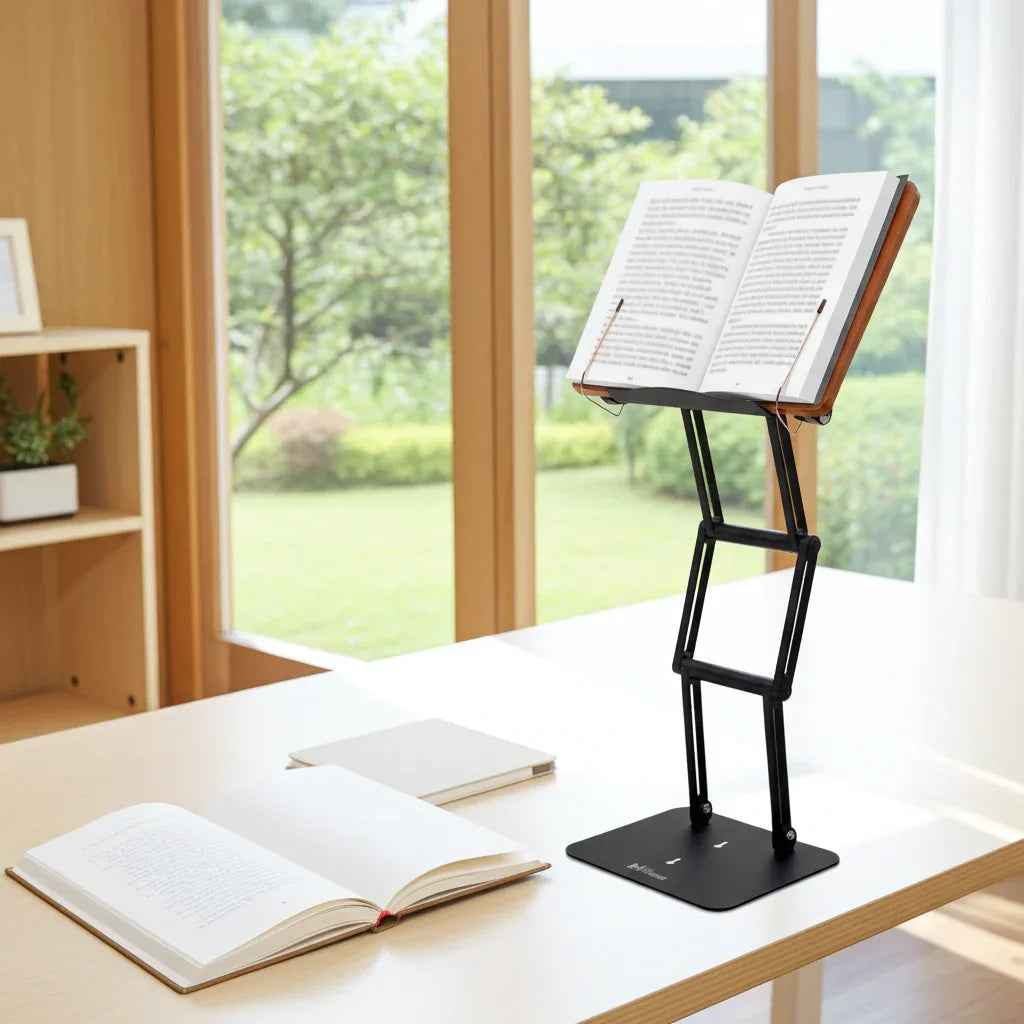
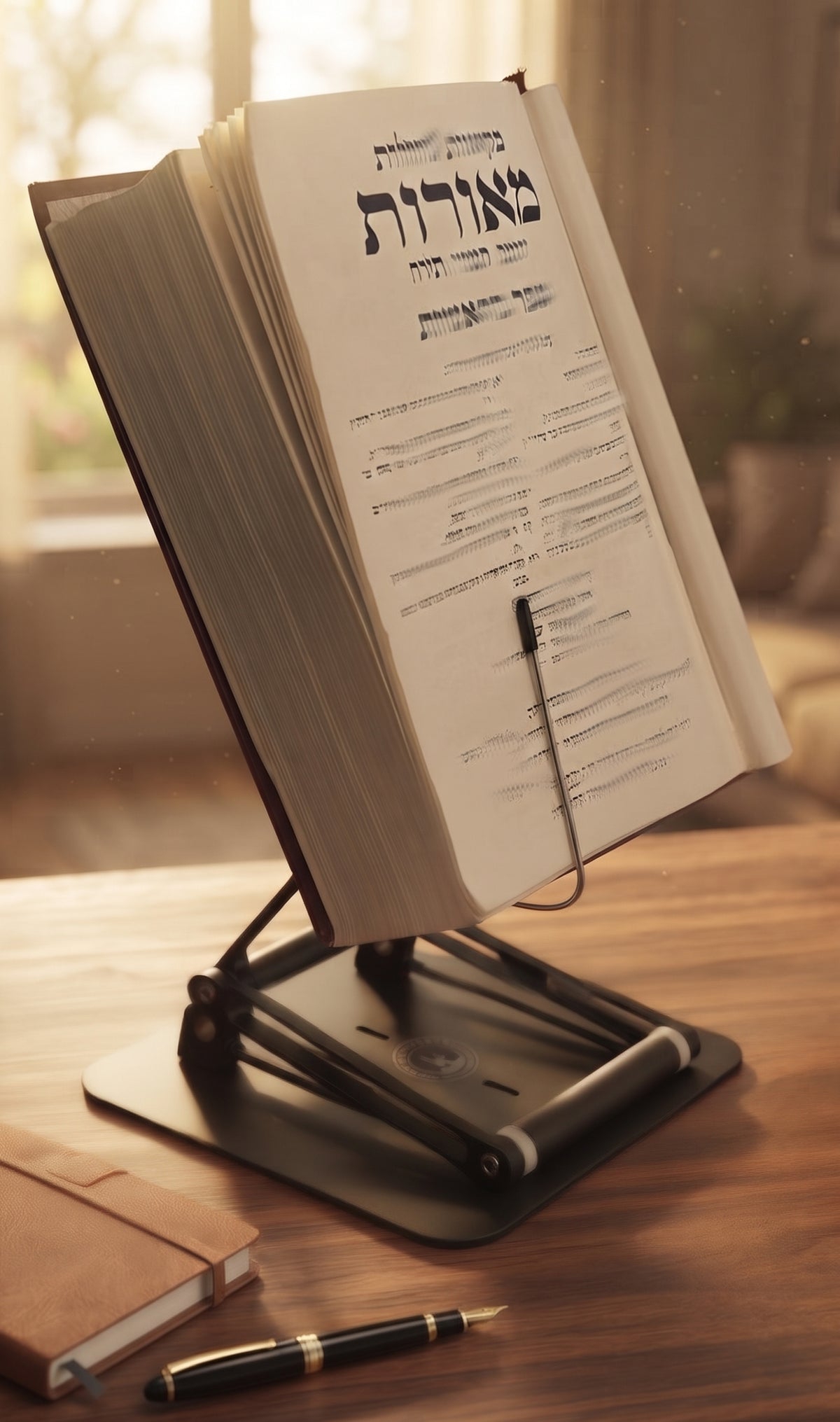
A dense anatomy textbook, a legal casebook, or a volume of Talmud asks a lot of your attention. It should not also force your neck into a permanent forward bend. An adjustable textbook stand changes the physical position of the work so your eyes can meet the page more naturally, rather than making your body chase it across the desk.
That sounds simple because it is simple. Yet it can make a substantial difference over a three-hour study block, a long research session, or an evening spent preparing for an exam. The right stand does more than prop up a book. It creates a serious reading position: stable, elevated, adjustable, and ready for materials that are considerably heavier than a paperback novel.

The Stander by Dr. Shtaygen
An adjustable stand for heavy textbooks and long reading
Height- and angle-adjustable. 5052 aluminum alloy frame, 1.5 kg (3.3 lb), tested with heavy volumes up to 5 kg (11 lb). $95 + shipping, free 30-day returns.
See The StanderWhy Flat-Desk Reading Creates a Posture Problem
When a textbook lies flat, the reader typically bends the head and upper back toward the page. A little forward tilt is normal. Holding that position for extended periods is where the trouble begins. The neck, shoulders, and upper back remain engaged while the eyes repeatedly travel down to the desk and back to notes, a screen, or an instructor.
Many people try to solve this by stacking books, leaning a text against a laptop, or hunching closer to the desk. Those workarounds are unstable, clutter the workspace, and tend to collapse as soon as you turn a page or open a heavier volume. A purpose-built stand gives the book a defined place and gives the reader a better chance at maintaining an upright posture.
The goal is not a rigid, military-straight position. Good ergonomics allows for movement. The goal is to reduce the amount of sustained neck flexion required to read, while placing the page at a comfortable height and viewing angle for the task in front of you.
What an Adjustable Textbook Stand Should Actually Do
A basic book holder may be adequate for a recipe card or a slim novel. Serious reading demands more. Before choosing an adjustable textbook stand, look beyond the phrase "book stand" and consider whether it can support your real workload.
Raise the Reading Surface High Enough
Angle alone is helpful, but height is often the missing feature. A stand that only tilts a book on the desktop still leaves the reader looking down. Height adjustment brings the text closer to eye level, which is especially useful when alternating between a book and a monitor or when working from a standing desk.
For seated work, the ideal height depends on your chair, desk, torso length, and the size of the book itself. For moderate standing work, greater elevation becomes essential. A stand that rises substantially above the tabletop gives you room to set up the page where it belongs, rather than where the furniture happens to leave it.
Stay Stable Under Heavy Books
Weight capacity is not a minor detail. Medical texts, law books, reference works, siddurim, and multi-volume scholarly materials can be heavy, wide, and awkwardly balanced. A lightweight plastic easel may hold them briefly, but it often flexes, slides, or tips when the pages shift.
Look for a broad base, durable metal construction, and joints that hold their position without wobble. Stability matters for comfort, but it also matters for concentration. Few things break a line of thought faster than catching a falling textbook with one hand every few minutes.
Hold Pages Open Without Fighting You
A useful stand supports the lower edge of the book securely and makes page turning practical. The lip should be deep and strong enough to carry the text without obscuring too much of the page. Retaining arms or page holders can be helpful, particularly with thick books that insist on closing themselves at the most inconvenient moment.
Still, the mechanism should not turn a simple page turn into a small engineering project. The best setup is secure during reading and easy to adjust when moving between chapters, notes, and reference materials.
Set Up Your Stand for the Work You Are Doing
There is no single correct height for every reader or every task. A practical starting point is to place the center of the open pages near your natural line of sight, then lower it slightly if needed. You should be able to read without sharply dropping your chin or lifting your shoulders.
For a long seated session, position the stand directly in front of you rather than off to one side. If you are taking handwritten notes, place the writing surface close enough that you are not repeatedly twisting at the waist. If you type while referencing a textbook, keep the book elevated beside or behind the keyboard zone, then make small adjustments until your gaze moves comfortably between the text and screen.
Standing is different. A standing setup should not become a new form of slouching. Raise the book enough that you can read while keeping your head balanced over your shoulders. Alternate between sitting and standing when possible. The stand should support movement, not make you feel locked into one posture for the day.
A Stand Is a Study Tool, Not Desk Decoration
The benefit of a well-designed stand is not limited to posture. It can change how you organize demanding work. With the text raised, the desk surface becomes available for notes, a keyboard, highlighters, or a second reference source. The page is also more visible at a glance, which can reduce the repeated bend-read-write cycle that makes complex study feel more physically draining than it should.
This is where a premium stand earns its place. It should handle a textbook one hour, a laptop the next, and a tablet or sheet music the following day. It can serve as a cookbook holder in the kitchen, a compact lectern for a presentation, or a modern shtender for sustained sacred study. One well-engineered platform is often more useful than a drawer full of task-specific accessories.
The Stander by Dr. Shtaygen was built for that broader standard of utility. Its height-adjustable design raises the supporting lip up to 17.8 inches above the tabletop, while its aluminum construction and stainless steel joints are intended for serious books, devices, and long work sessions - not merely casual tablet viewing.
When a Smaller Stand May Be Enough
Not everyone needs maximum elevation or heavy-duty construction. If you read short passages occasionally, use only thin paperbacks, and have limited desk space, a compact fixed-angle stand may be perfectly reasonable. It is less expensive and easier to store.
The trade-off appears when your reading becomes longer, heavier, or more varied. A fixed stand cannot adapt well to different chairs, desks, users, or standing positions. A flimsy stand may become frustrating under a large textbook. And a stand with limited height may improve the page angle while leaving the fundamental downward gaze unchanged.
Think about the material you use on your hardest day, not your easiest one. If the stand can hold your heaviest text steadily and adjust to the position where you actually work comfortably, it is much more likely to become part of your daily routine.
Make Better Posture Easier to Repeat
An adjustable textbook stand is not a substitute for breaks, a supportive chair, or sensible desk habits. If your shoulders are tight after a long session, stand up, walk briefly, and reset. But it can remove one persistent source of unnecessary strain: the flat page that keeps pulling your head and attention downward.
Set the book higher. Bring the page into your field of view. Then let your energy go where it belongs - into the argument, the lesson, the research, or the text worth studying.
The Stander by Dr. Shtaygen
An adjustable stand for heavy textbooks and long reading
Height- and angle-adjustable. 5052 aluminum alloy frame, 1.5 kg (3.3 lb), tested with heavy volumes up to 5 kg (11 lb). $95 + shipping, free 30-day returns.
See The Stander