Halfway through a long study block, most people do not lose focus because they suddenly forgot the material. They lose focus because their neck starts pulling forward, their lower back stiffens, and their body begins competing with their brain for attention. That is the real issue behind sitting vs standing for studying. The better question is not which position is universally best. It is which position lets you stay alert, aligned, and productive for longer.
For serious students, researchers, and readers, posture is not cosmetic. It is a performance variable. If your textbooks, laptop, or notes sit flat on the desk, your head drops, your shoulders round, and your cervical spine absorbs the cost. Over time, that posture can make a one-hour study session feel like three. The goal is not to force yourself to stand all day or remain seated without moving. The goal is to create a study workflow that reduces strain and preserves concentration.
Sitting vs standing for studying: the short answer
Sitting is usually better for deep concentration, detailed note-taking, and long reading sessions. Standing is often better for short bursts of alertness, light review, and breaking up physical fatigue. Neither position is ideal when the setup is poor.
That distinction matters. A badly arranged standing desk can still drive your neck forward and overload your shoulders. A properly arranged seated workstation can feel dramatically better than a standing setup built around a flat desk and a stack of unstable books. Position matters, but alignment matters more.
In practice, most people study best when they alternate between the two. Sitting gives you stability. Standing gives you variation. The real ergonomic advantage comes from changing posture before discomfort becomes distraction.
Why sitting often wins for demanding study
There is a reason many forms of high-focus intellectual work happen seated. Sitting reduces the amount of muscular effort required to remain upright, which can free up energy for reading, writing, solving problems, and sustained analysis. When you are working through dense material, outlining a paper, or annotating a difficult text, that extra physical stability helps.
Seated studying also makes it easier to maintain fine motor control. Writing by hand, typing for long periods, and working across multiple documents generally feel more controlled from a seated position. For students in law, medicine, engineering, graduate research, or religious study, that stability can matter more than the marginal calorie burn of standing.
But sitting only works well when your materials are positioned correctly. If your book or laptop is too low, sitting becomes a slow collapse. The lower the material sits, the more your neck flexes. That is why many people say sitting hurts their back or shoulders when the real problem is that they are studying downward instead of at eye level.
Where standing helps
Standing can sharpen alertness, especially during reading that does not require constant writing. It can help during review sessions, flashcards, recitation, memorization, or video-based learning. If you feel sluggish after an hour seated, standing changes the load on your spine and often resets your attention.
For some learners, standing also creates a sense of intention. You are less likely to slump into passive scrolling when your materials are elevated and your posture is active. That is one reason raised reading surfaces have such a long history in scholarly practice. The traditional shtender was not just symbolic. It supported focused, upright study.
Still, standing has limits. If you stand too long without support, you may trade neck and back discomfort for foot, hip, or lower back fatigue. Standing is not automatically more ergonomic. It simply shifts the stress pattern. Without a stable elevated platform, people often lean forward while standing just as badly as they do while sitting.
The real problem is usually the viewing angle
Most debates about sitting vs standing for studying miss the central issue. The body can tolerate both positions reasonably well when the reading surface is elevated, stable, and easy to view. What the body handles poorly is sustained downward gaze.
The human head is heavy. Once it drops forward, the muscles of the neck and upper back work harder to support it. That strain builds quietly. At first, it feels like mild tension. Then concentration slips. Then you start shifting around, rubbing your neck, or taking a break not because you finished a section, but because your posture failed first.
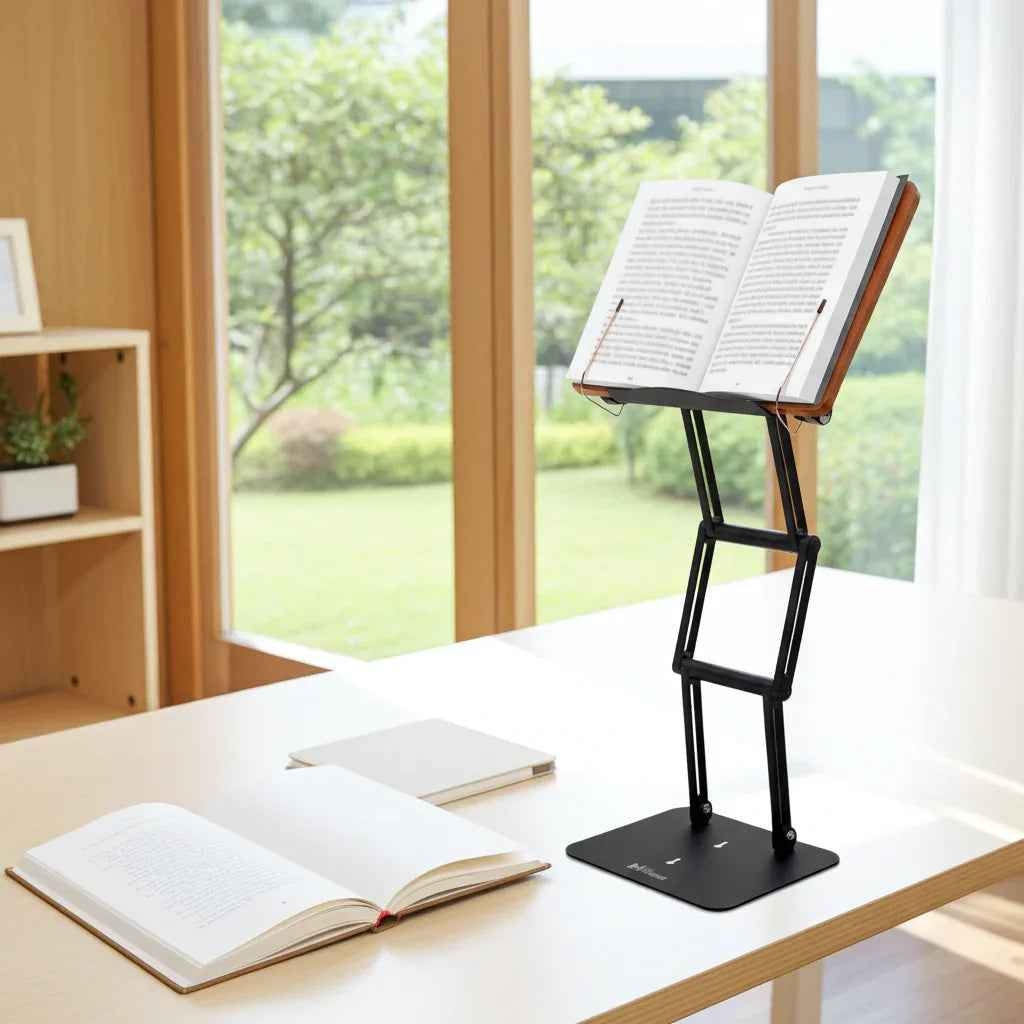
For books, textbooks, tablets, and laptops, elevation is often the deciding factor. Bringing the material closer to eye level reduces cervical flexion and makes both sitting and standing more sustainable. This is where a serious stand changes the equation. A stable adjustable platform supports proper viewing height in either position and removes the need for improvised stacks that wobble, slide, or collapse under heavier materials.
How to decide which position to use
The right choice depends on the task. If you are reading a heavy textbook closely, taking notes, and staying in one subject for 90 minutes, sitting is often the stronger option. If you are reviewing, highlighting, reciting material, or trying to stay engaged during a lower-energy period, standing may serve you better.
It also depends on your body. Some people with lower back irritation feel better when they stand more often. Others with foot, knee, or hip discomfort may find long standing sessions counterproductive. There is no serious ergonomic rule that says one posture is superior for everyone.
A better standard is this: choose the position that lets you maintain neutral alignment with the least strain for the task at hand. Then change positions before fatigue accumulates.
A practical study setup that works
For seated studying, your feet should feel planted, your shoulders relaxed, and your reading material lifted high enough that you are not folding over it. For standing, your elbows should remain comfortable, your shoulders should stay down, and the material should sit high enough to prevent a forward head posture.
This is especially important with dense printed material. Heavy academic texts and large religious volumes are difficult to position well using light consumer stands. They often sag, shake, or sit too low. A professional-grade stand with strong joints and meaningful height adjustment supports real study instead of creating another compromise.
That is why a premium tool matters in serious environments. A stand built for actual textbooks, laptops, and sustained reading supports posture correction in a way a casual tablet stand cannot. Products such as The Stander 1.1 are designed for this exact use case - stable elevation, real height, and support for long study sessions whether you are seated or standing moderately.
The best answer is usually not either-or
If you study for more than an hour at a time, the strongest approach is usually alternation. Sit for deep work. Stand for review or reset. Return to sitting when precision matters. This keeps any one posture from becoming a source of fatigue.
Think of posture the way you think about concentration. You do not protect focus by forcing a single rigid state for four straight hours. You protect it by managing conditions. Ergonomics works the same way. Small adjustments made early are more effective than waiting until pain forces a stop.
A simple pattern works well for many people. Sit for 45 to 60 minutes of concentrated work, then stand for 10 to 20 minutes of reading, review, or lighter tasks. The exact timing matters less than the habit of changing position intentionally.
What serious students should remember
If your study setup leaves your books or screen flat on the desk, you are asking your neck and upper back to carry a workload they were not meant to carry for hours at a time. That strain is not a minor comfort issue. It affects endurance, focus, and consistency.
So, sitting vs standing for studying is the wrong fight if your materials remain too low. Fix the angle first. Then choose the posture that fits the moment. A stable elevated study surface gives you that flexibility and lets your body support your work instead of interrupting it.
The best study position is the one that keeps your head up, your spine honest, and your attention on the page.