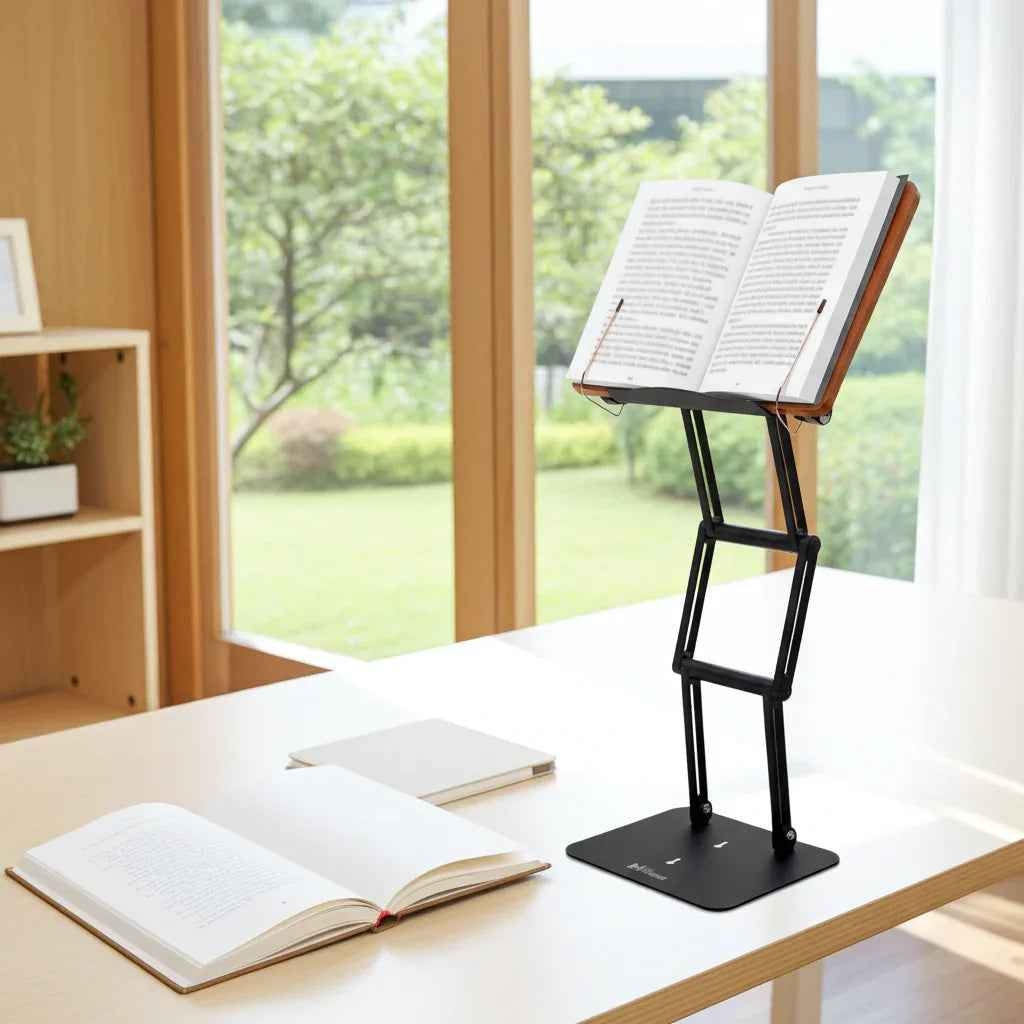
A few degrees of neck flexion can turn a quiet reading session into hours of unnecessary strain. Cervical spine posture while reading is not a niche concern for clinicians or elite ergonomics enthusiasts. It is a daily mechanical issue for students, researchers, professionals, and serious readers who spend long stretches with books, tablets, or laptops below eye level.
The pattern is familiar. The material sits flat on a desk or in your lap, your head drifts forward, the upper back rounds, and the neck muscles start doing stabilization work they were never meant to sustain for long periods. At first, it feels manageable. Then concentration drops, the base of the neck tightens, and reading becomes harder than it should be.
Why cervical spine posture while reading matters
The cervical spine is designed to support the head in balanced alignment over the torso. When you read with the material too low, that balance changes. Instead of stacking the head over the shoulders, you create forward head posture and sustained neck flexion. The farther forward the head moves, the greater the muscular demand on the neck and upper back.
This is where many readers get misled. Pain is not always immediate, so poor setup can feel harmless. But static strain accumulates. Even if the discomfort is mild, the body often compensates with shoulder elevation, jaw tension, or a slumped thoracic spine. The result is not just a sore neck. It can mean reduced reading endurance, more restlessness, and less sustained focus.
For people doing deep work, that trade-off matters. If your posture deteriorates after twenty minutes, your output often deteriorates with it. Good ergonomics is not just about comfort. It protects the physical conditions that allow long, serious periods of study.
What good reading posture actually looks like
Good posture is not military stiffness. It is a supported alignment that minimizes unnecessary load. Your ears should stay roughly over your shoulders, with the head centered rather than projected forward. The chest stays open, the shoulders relaxed, and the upper back gently upright instead of collapsed.
Your reading material should come up toward your eyes, not force your eyes and head down to the desk. A slight downward gaze is usually more realistic than perfectly straight-ahead viewing, but the key is moderation. Small angles are sustainable. Deep neck flexion held for an hour is not.
The rest of the body matters too. Feet should be supported on the floor or a footrest. Elbows should not hover in tension. If you are seated, the chair should let you sit upright without perching at the edge or falling into a reclined slump that pushes your head forward.
The biggest posture mistakes readers make
The first mistake is reading from a flat surface for long periods. This is common with textbooks, printed articles, religious texts, and notebooks. Flat placement almost always lowers the viewing angle too far, which pulls the cervical spine into prolonged flexion.
The second is using a stand that is too low, too unstable, or too weak for the material. A flimsy stand might technically elevate a book, but if it wobbles, slips, or cannot support a heavy volume, people instinctively lean in toward it. That erases much of the ergonomic benefit. [As a side point, it should be pointed out that many stands give a false sense of "height ability" by listing the total height of the stand, as measured from the tabletop to the top of the reading platform, which is misleading. The actual total lift of a platform should be measured from the tabletop to the book/laptop lip (the part that actually supports whatever is put on it), as that's the actual measure of total "raise". In this regard, The Stander 1.1 is the highest portable stand in the category]
The third is assuming laptops solve the problem. They do not, at least not on their own. A laptop places the screen and keyboard together, so if the keyboard height is acceptable, the screen is usually too low. If the screen is high enough, the keyboard position becomes awkward. That is why posture for laptop reading often requires a compromise or an external setup.
The fourth mistake is holding a book in the lap or chest for extended time. This can help briefly, but it often creates asymmetry in the shoulders, wrists, and neck. For short reading sessions, it may be fine. For intensive study, it is not an ideal default.
How to improve cervical spine posture while reading
Start with height. Raise the material so the top half of the page or screen is closer to eye level. You do not need a perfect anatomical angle every time, but you do need enough elevation to reduce the urge to drop your head.
Next, set the viewing distance. If the text is too far away, you lean forward. If it is too close, you may crane or tense the eyes and neck. A practical range is whatever lets you read clearly while keeping the head stacked over the torso and the shoulders quiet.
Then check support. Serious reading demands serious equipment. Heavy textbooks, legal volumes, and large-format religious texts, such as Chassan-Shas-sized Talmuds, need a platform that stays fixed under load. A stable, adjustable stand changes the posture equation because it brings the material into a usable zone without forcing you to improvise.
This is where premium design matters. A stand built for actual study, not casual tablet viewing, can support sustained eye-level reading with less wobble, less repositioning, and less cumulative cervical strain. For readers who spend hours at a desk, that difference is not cosmetic. It is structural.
Seated reading vs standing reading
Seated reading is usually easier to sustain for longer sessions, but only if the setup is correct. When seated, people tend to collapse through the mid-back over time. If your book or screen is elevated properly, that risk drops because your spine has less reason to fold forward.
Standing reading can be excellent for breaking up static posture and increasing alertness. It may also reduce the tendency to slump. But standing is not automatically superior. If the reading platform is too low, you can still end up flexing the cervical spine, just from a different position.
The better approach is variation. Long periods in any one posture can create fatigue, even with good alignment. Alternating between seated and moderate standing work often gives better results than treating one position as the only correct answer.
Why eye-level reading improves focus
Most people notice neck relief first, but attention may be the bigger win. When the body is bracing against poor mechanics, part of your energy is spent managing discomfort. You shift more, rub your neck, lose your place, and break concentration.
Eye-level reading reduces those interruptions. The visual field is more stable, breathing is often easier in a more upright posture, and the body spends less effort fighting the setup. That does not make posture a productivity trick. It simply means the physical environment stops working against your cognitive work.
For scholars and professionals, that matters. The best study tools do more than hold materials. They preserve momentum.
Choosing a reading setup that supports the cervical spine
If you read occasionally, almost any elevation is better than none. If you read seriously, the standard rises. You need enough height adjustment to bring books and screens into a true ergonomic range. You need enough strength to support heavy materials without sagging. And you need enough stability that turning pages, annotating, or typing nearby does not shake the whole setup.
A modern raised study platform, especially one engineered with durable joints and a higher elevation range, can serve multiple workflows without forcing poor neck positions. That is why many readers move beyond low-cost stands. They are not paying for novelty. They are paying for consistent posture under real working conditions.
Dr. Shtaygen approaches this with the logic of both ergonomics and scholarship: elevate the text, stabilize the work surface, and let the body stay aligned during serious study.
Improve Your Setup
If you're looking to elevate books, tablets, or laptops to a more comfortable, pain-free, healthy reading position, an adjustable stand can make a significant difference.
When posture changes are not enough
Not every neck issue comes from reading posture alone. If you have persistent pain, numbness, headaches, radiating symptoms, or significant stiffness, the setup may be part of the problem but not the entire problem. In those cases, a medical evaluation is the right step.
Even then, improving mechanics usually helps. It lowers one of the most common daily stressors on the cervical spine. Think of it as reducing background load. You may still need targeted care, but your reading habits should stop aggravating the issue.
The real goal is simple: your neck should not be the limiting factor in your reading life. When the page meets your eyes instead of pulling your spine downward, you can study longer, work more comfortably, and hold your attention where it belongs.
Other Related Blogs:
A Practical Guide to Scholar Desk Ergonomics
How to Study Longer Without Neck Pain
Want to Work Smarter? The Talmud's 3-Step Secret to Health and Focus