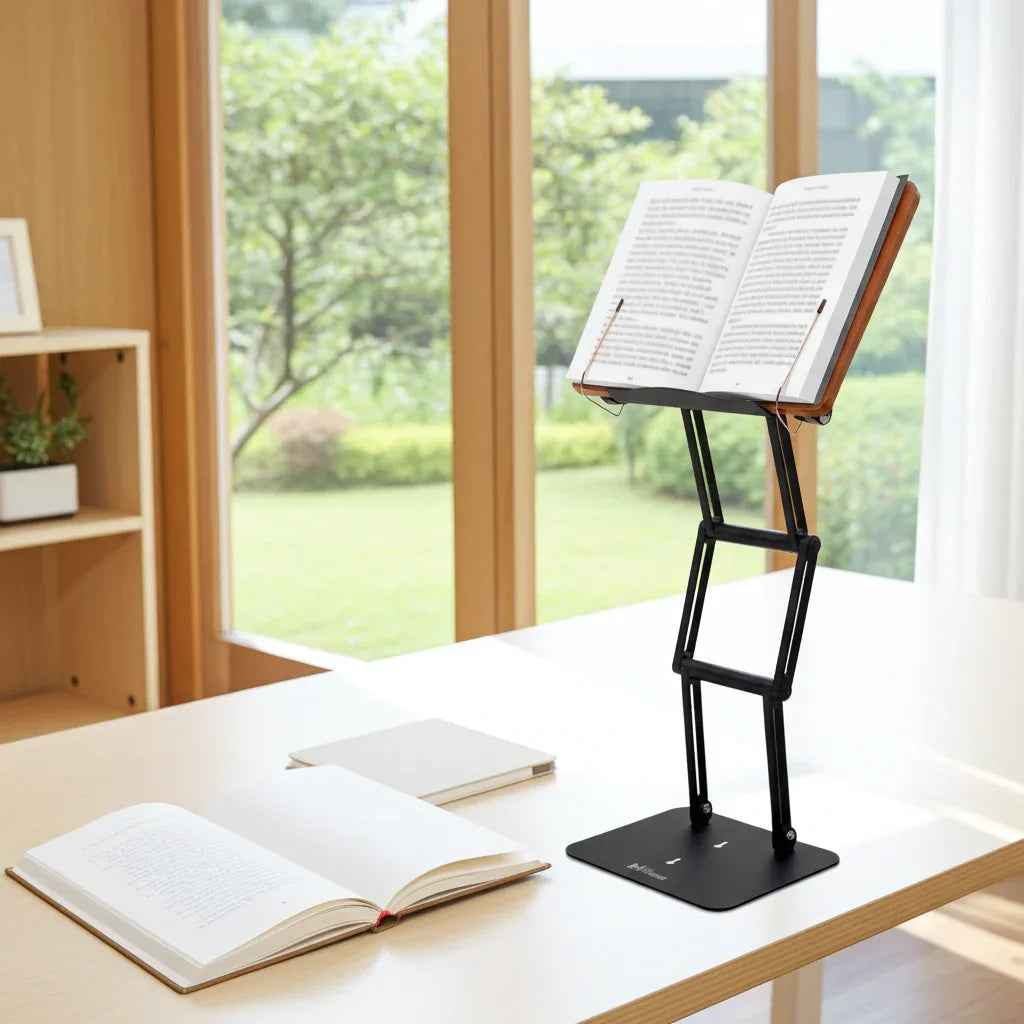
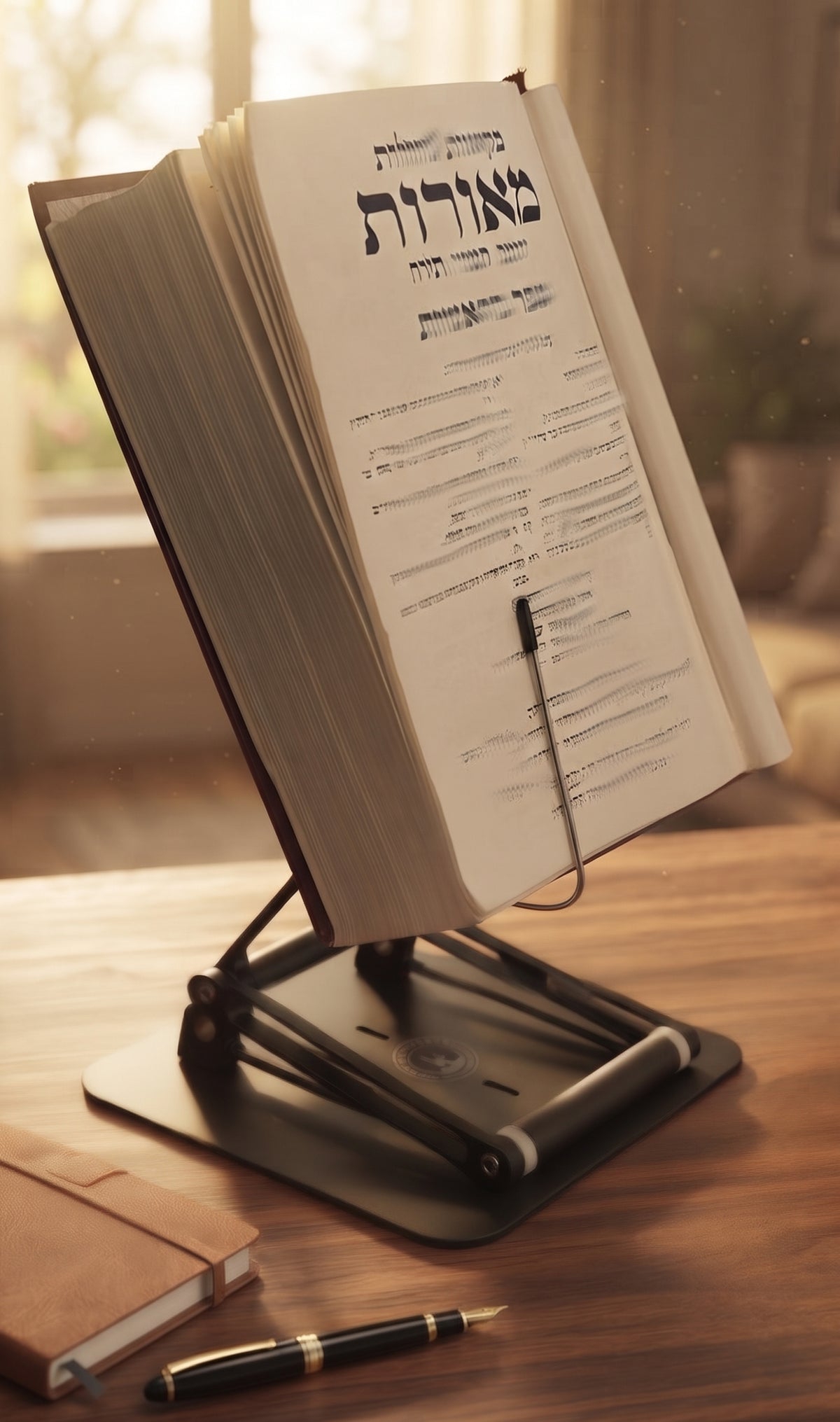
A heavy textbook on a desk has a predictable effect: your head drops toward the page, your upper back follows, and an hour of reading becomes a quiet endurance test for your neck. A book stand adjustable height changes that geometry. It brings the material upward, closer to your natural line of sight, so serious reading does not require a posture worthy of a question mark.
This is not a minor desktop accessory for people who only read recipes on a tablet. For students working through dense chapters, professionals reviewing documents, researchers comparing sources, and scholars spending long periods with sacred texts, the right stand can make focused work more sustainable. The difference lies in how high it raises your work, how steadily it holds it, and whether it can keep up with the weight and pace of real study.

The Stander by Dr. Shtaygen
An adjustable stand for heavy textbooks and long reading
Height- and angle-adjustable. 5052 aluminum alloy frame, 1.5 kg (3.3 lb), tested with heavy volumes up to 5 kg (11 lb). $95 + shipping, free 30-day returns.
See The StanderWhat an Adjustable-Height Book Stand Solves
Most book stands solve one limited problem: they angle a book. That can be useful, but angle alone does not necessarily correct the main ergonomic issue. If the book remains close to the tabletop, you still have to bend your neck downward to see it.
A height-adjustable stand addresses the vertical distance between your eyes and your reading material. Raising a text reduces the need for sustained neck flexion, the forward-and-down position that often leaves readers with tight shoulders, an aching upper back, or the familiar urge to rub the base of the neck after a long session.
The goal is not to lock yourself into a rigid, military posture. Human beings move, shift, and change position. The goal is to make a more neutral head and neck position easier to maintain while reading, annotating, typing, or following along with a screen. When the book is raised, your body has less reason to collapse toward the desk.
That benefit becomes more meaningful as study sessions get longer. Ten minutes with a paperback is one thing. Three hours with a medical text, legal volume, Talmud tractate, reference manual, or graduate-level reading packet is another matter entirely. Serious work deserves serious support.
Height Matters More Than Most Buyers Expect
When comparing stands, buyers often focus on tilt settings, color, or whether the stand folds flat. Those features have their place, but maximum elevation is usually the more consequential specification.
A low-profile stand may place a book at a pleasant angle while leaving it only a few inches above the desk. It can work for brief reading or for a child at a properly sized table. For an adult seated at a desk, however, it often remains too low. The reader still looks down, just at a slightly improved angle.
A taller stand provides more adjustment range. That range matters because bodies, chairs, desks, books, and tasks vary. A person using a standard desk needs a different setup from someone at a kitchen counter, a standing desk, or a shared office workstation. A large textbook also places its top edge higher than a small paperback, while a laptop screen has its own dimensions and viewing needs.
The Stander raises its support lip up to 17.8 inches above the tabletop. Since the lip supports the bottom of the book, laptop, or tablet, the reading surface itself sits even higher depending on the item’s size. This gives users meaningful room to position materials for seated work and moderate standing workflows instead of accepting one fixed, desk-level position.
There is a practical caveat. A very high setting is not automatically the correct setting. If you raise material too far, you may tip your head backward or strain your eyes. Start by placing the upper portion of the page or screen near eye level, then make small adjustments until your neck feels relaxed and your shoulders are not creeping upward. The best position is the one you can hold comfortably without thinking about it.
Stability Is an Ergonomic Feature, Not a Luxury
A stand that wobbles under a heavy book creates its own problem. You compensate without realizing it: one hand holds the pages down, your torso leans in for a better view, and your attention divides between the material and the unstable equipment beneath it.
This is why lightweight tablet stands and serious book stands are not interchangeable. Many small stands are designed around a narrow use case: a phone, an e-reader, or a slim tablet. Put a thick textbook or an open reference volume on them and the weaknesses show quickly. The hinge may drift, the base may shift, the ledge may feel undersized, or the whole structure may seem to negotiate with gravity.
For academic, professional, and religious study, construction matters. An aluminum structure joined with stainless steel screws and bolts, a substantial support lip, and a base designed to resist tipping all contribute to a steadier working surface. The result is not merely durability. It is less distraction. A stable stand lets you turn pages, mark passages, compare materials, and return to the task without resetting your setup every few minutes.
Weight capacity also deserves an honest assessment. If your daily material is a paperback novel, nearly any reasonably made stand may serve you well. If you use dense textbooks, large binders, legal references, oversized art books, or sacred volumes with substantial weight, buy for that reality rather than the occasional lighter task.
A Book Stand Adjustable Height Can Support More Than Books
The strongest ergonomic tools earn their space by handling multiple workflows well. A height-adjustable stand can support a book in the morning, a tablet during a video call, and a laptop during an afternoon review session. That flexibility is particularly useful in small workspaces where every object has to justify its footprint.
For laptop use, the stand can raise the display toward eye level. Pair it with an external keyboard and mouse for the most comfortable arrangement, since raising a laptop also raises its built-in keyboard beyond an ideal typing height. If you only need to read from the laptop or use it for a short presentation, the elevated position can still be helpful on its own.
In the kitchen, the same stand can hold a cookbook or tablet away from spills and crowded counters. Musicians can use one for sheet music. Teachers and speakers can use one as a portable lectern. Some customers even use a substantial adjustable stand for projectors and other specialized equipment. The underlying principle remains the same: lift the object to a useful working height, then keep it stable.
For traditional Jewish learning, the modern adjustable stand also carries the practical spirit of a shtender into contemporary spaces. A shtender has always recognized a basic truth about sustained study: text should meet the learner with dignity, not force the learner to fold over it. A well-engineered version brings that idea to desks, homes, classrooms, and offices without requiring a dedicated study hall.
How to Set Up Your Stand for Long Sessions
Your stand is only as helpful as its placement. Begin with the chair and desk you actually use, not an imagined ideal setup. Sit back with your feet supported and your shoulders relaxed. Place the stand directly in front of you rather than off to one side, which can encourage repeated neck rotation.
Raise the book until you can read without sharply lowering your chin. Tilt the surface enough to make the page easy to see and write on, but not so steeply that the book slides or the lower lines become awkward to reach. If you annotate frequently, leave enough room between the stand and your body for comfortable arm movement.
Then test it under real conditions. Read for 20 minutes, turn pages, write a note, and switch to the kind of book you use most often. A setup that looks good in a product photo may need a few inches of adjustment in your own workspace. That is precisely why adjustability is valuable.
For standing use, elevate the material so you are not bending from the neck or waist. Moderate standing periods can add variety to a long day, but standing is not a cure-all. Alternate between sitting and standing when practical, and let the stand make both positions more workable.
What to Look for Before You Buy
The right choice depends on the material you use, the height you need, and whether your stand must do more than one job. Before buying, assess these four practical factors:
- Maximum elevation: Look beyond the angle of the platform. A stand should raise reading material high enough to reduce habitual downward viewing for your body and desk setup.
- Load stability: Consider your heaviest book, not your lightest tablet. The base, joints, platform, and support lip should inspire confidence under real weight.
- Adjustment control: A good stand should move deliberately and hold its position. You should not have to fight loose hinges or handle the platform as though it were a folding chair with opinions.
- Useful versatility: If you read, study, cook, present, and work from screens, a durable multi-use stand can replace several weaker accessories.
Portability is the main trade-off. A heavier, more stable stand is less convenient to toss into a backpack than a thin folding model. For travel or occasional café reading, a compact stand may be enough. For a permanent desk, home office, study area, or kitchen station, stability and elevation are usually the better investment.
The right reading position should feel almost unremarkable. Your book is where you need it, your shoulders stay easier, and your attention remains on the ideas in front of you. That is a small physical change with a very respectable return for anyone who plans to keep learning.
The Stander by Dr. Shtaygen
An adjustable stand for heavy textbooks and long reading
Height- and angle-adjustable. 5052 aluminum alloy frame, 1.5 kg (3.3 lb), tested with heavy volumes up to 5 kg (11 lb). $95 + shipping, free 30-day returns.
See The Stander