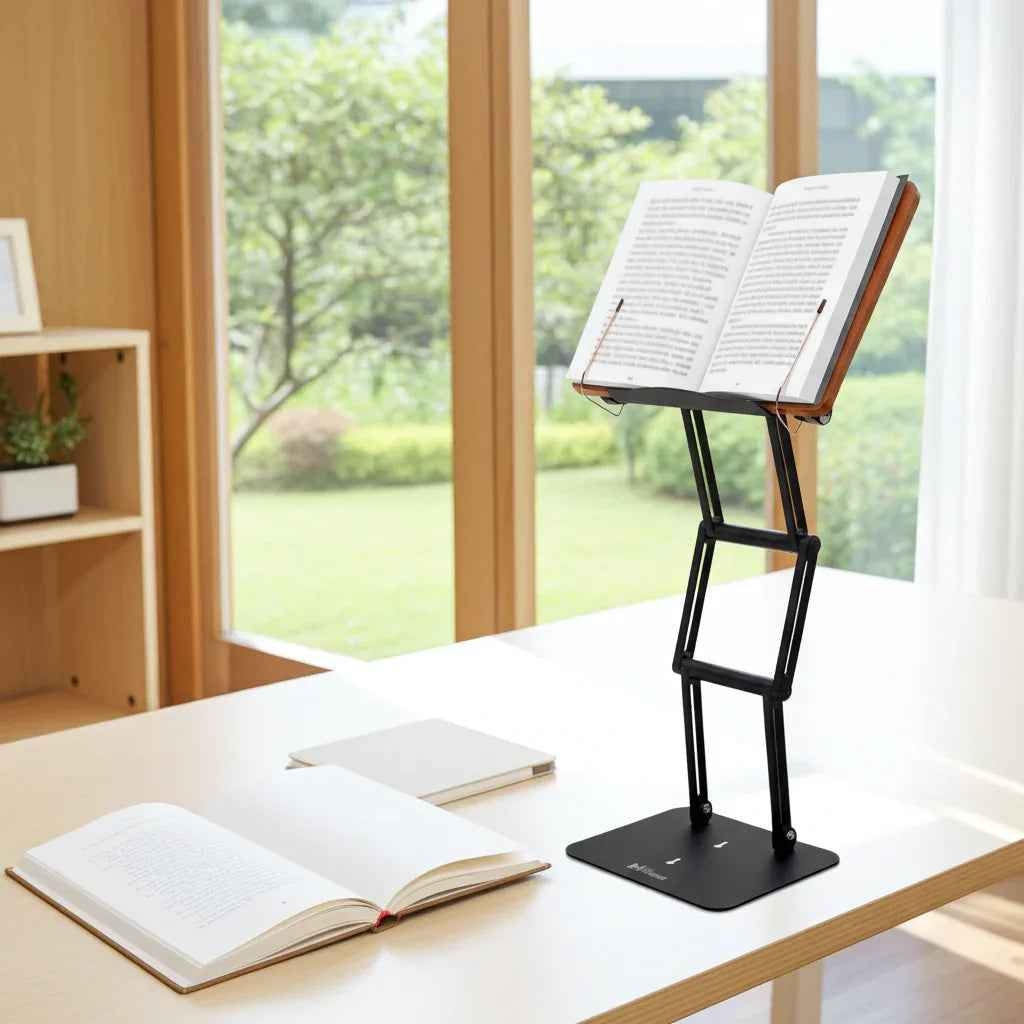
A heavy textbook on a flat desk asks your neck to do a bad job for a long time. The moment your reading material drops below eye level, your head follows, your shoulders round forward, and your upper back starts paying the bill. That is why the benefits of elevated reading are not cosmetic or optional for serious readers. They are mechanical, measurable, and often felt within the first study session.
For students, professionals, and scholars who spend hours with books, tablets, laptops, or printed notes, reading height changes everything. Not because it is trendy ergonomics, but because your body performs better when your work comes up to meet your eyes instead of forcing your spine to collapse downward.
Why the benefits of elevated reading are so noticeable
The body is remarkably tolerant, which is both a blessing and a problem. You can read at a low desk for years and still function, but tolerance is not the same thing as efficiency. When reading material sits flat, the neck flexes forward, the thoracic spine rounds, and the shoulders drift into internal rotation. That posture may feel ordinary because it is common, not because it is harmless.
Elevated reading reduces the angle of downward gaze. That small change can decrease the load placed on the cervical spine and make it easier to keep the ribcage stacked over the pelvis. In plainer language, you are less likely to hunch, crane, and fold yourself over your work like a question mark.
This matters most when the reading session is long or frequent. Ten minutes with a paperback on the kitchen table is one thing. Three hours with legal documents, Gemara, dense medical texts, or exam prep materials is another. Duration turns mild awkwardness into real strain.
Better posture without constant self-correction
Most people do not fail at posture because they are lazy. They fail because furniture and tools put them in a losing position. You can remind yourself to sit up straight every five minutes, but if the book is still flat on the desk, gravity usually wins.
One of the clearest benefits of elevated reading is that it makes better posture more automatic. When text is closer to eye level, your head stays more balanced over your shoulders. That reduces the need for constant muscular effort just to keep yourself from collapsing forward.
There is a practical difference between posture that depends on discipline and posture that is supported by equipment. The first fades when you get tired. The second keeps working when your attention shifts to the material itself.
This is especially useful for people doing deep reading, close annotation, or repetitive reference work. If your setup fights your body, concentration leaks away into discomfort. If your setup supports your body, more of your energy stays with the task.
Less neck and upper back strain
Neck discomfort is one of the most common complaints among desk workers and serious students, and reading posture is often a major contributor. Looking downward for extended periods increases stress through the neck and upper trapezius area. You may feel it as stiffness, burning between the shoulder blades, or that familiar urge to roll your shoulders every twenty minutes.
Elevating the reading surface can reduce those symptoms because it decreases sustained flexion. That does not mean every ache disappears overnight. If someone already has significant pain, joint irritation, or a workstation with multiple other problems, reading height is one piece of the puzzle, not the whole puzzle. Still, it is often one of the highest-impact changes you can make.
The trade-off is straightforward. If a stand raises material but wobbles, slips, or forces awkward arm positioning, the benefit gets diluted. Stability matters. Serious users need a platform that holds position under real weight and real use, especially with large textbooks, hardcover religious texts, or a laptop plus notes nearby.
Stronger focus and longer study sessions
Comfort is not just a health issue. It is a performance issue. People lose focus for many reasons, but physical irritation is a big one. When your neck is tightening and your shoulders are creeping upward, your brain notices even if you are trying to ignore it.
Elevated reading helps extend useful concentration by reducing that low-grade physical distraction. The result is often subtle but meaningful. You fidget less, reset your posture less often, and spend less time negotiating with your body.
That is why raised reading platforms are so common in traditions of serious study. A shtender was never just a decorative object. It existed because bringing the text into a better position supported longer, more attentive engagement. Modern ergonomic logic and old scholarly practice happen to agree on this point.
For professionals, the same principle applies to reports, contracts, manuals, and technical documents. If the material is central to your work, its position should be treated as part of your workflow, not an afterthought.
Easier transitions between books, tablets, and laptops
Reading today rarely means one format. A typical session might involve a printed textbook, a tablet for reference, and a laptop for notes or writing. One underrated benefit of elevated reading is how much easier it becomes to keep those formats within a more coherent visual field.
When one device is raised and another is flat, your head keeps traveling up and down. That repeated movement may seem minor, but over a full day it adds up. A better setup reduces extreme changes in viewing angle and makes transitions feel less disruptive.
This is where adjustability matters more than people expect. A stand that only lifts a few inches may help with a cookbook or casual tablet use, but serious desk work often requires much more elevation range. Sitting and moderate standing are different use cases. Different body sizes are different use cases. Thick books and slim tablets are different use cases too.
A height-adjustable platform gives the user room to fit the tool to the task instead of accepting a one-position compromise. That is a major distinction between a real ergonomic solution and a cheap accessory that photographs well but underperforms by lunch.
More usable desk space and cleaner workflow
Flat materials spread. Open books consume valuable desk area, notebooks get pushed aside, and your keyboard ends up in a strange position because the reading material has taken over the center of the workspace.
Elevated reading changes the geometry of the desk. By lifting the primary material, it frees room below and around it for writing, typing, and referencing other items. That can make the entire workstation feel calmer and more functional.
This matters for smaller desks, shared study spaces, kitchen counters, and multipurpose home offices where every inch counts. It also matters psychologically. A crowded workspace creates friction. A clear workspace tends to support steadier work.
There is also a safety and durability angle here. Heavy books balanced on unstable improvised stacks are not clever. They are an accident with footnotes. A purpose-built stand keeps materials supported without turning your desk into an architectural experiment.
Better support for standing work
Not everyone wants to stand all day, and that is sensible. Standing is not a magical cure for poor ergonomics. But the ability to alternate between sitting and standing can reduce monotony and help some users stay more alert during long sessions.
Elevated reading makes that transition more realistic because the material can be brought to a useful visual height in both positions. This is one place where many stands fail. They may hold a book at a pleasant angle while seated, then become almost useless the moment you try to work at a higher surface.
For users who want occasional standing study, recipe reading in the kitchen, teaching from notes, or presenting from a text, the extra range is not a luxury feature. It is the feature that makes the tool versatile enough to earn a permanent place in the room.
That is part of what separates a serious platform from a lightweight stand intended mostly for casual tablet viewing. Serious readers do not need a toy. They need something that stays stable under pressure and adapts to different tasks without complaint. Dr. Shtaygen was built around that exact problem.
The real value is cumulative
The most meaningful benefits of elevated reading often show up gradually. You finish a long session with less stiffness. You stop dreading the second hour of study. You notice that your shoulders are not as tense at the end of the day. None of that is flashy, but it is valuable.
Good ergonomics rarely feel dramatic. They feel sustainable. That is the point. If reading is central to your work, your education, or your religious practice, then the position of your text is not a minor detail. It is part of the system that determines how long you can work, how well you can focus, and how much strain you carry home with you.
Raise the material, and your body has fewer excuses to fight the task. That is a small shift with serious consequences, which is exactly why it is worth making.