Three hours into a reading session, most people do not notice the exact moment their posture collapses. The chin drifts forward, the upper back rounds, the book drops lower, and the neck starts doing overtime. That is why study posture correction is not really about trying harder to sit up straight. It is about changing the setup so good posture is the easier option.
This matters more than many students and professionals realize. Poor study posture is not just an aesthetic problem. It changes how long you can focus, how quickly your neck and shoulders tire out, and whether a productive afternoon turns into a headache with highlighter marks. If you spend serious time with textbooks, source material, legal documents, religious texts, or a laptop, posture is part of performance.
Why study posture correction fails for most people
The usual advice is familiar: sit tall, pull your shoulders back, keep your feet flat. None of that is wrong. It is just incomplete.
If your book or screen is flat on the desk, your body has to bend to meet it. You can override that for a few minutes with discipline, but not for a three-hour study block. The body tends to follow the visual task. If your eyes need to look down, your head goes down. Once the head moves forward, the upper spine and shoulders usually follow.
This is where many cheap desk accessories also fail. A flimsy stand that wobbles under a heavy textbook or only lifts a tablet a few inches does not really solve the posture problem. It may improve the angle slightly, but slight improvement is often not enough for long sessions. Serious study needs serious elevation and real stability.
The real driver of better posture during study
The fastest path to study posture correction is to raise the material you are reading closer to eye level. That single change reduces the need for repeated neck flexion, which is the technical phrase for what your body experiences as looking down all day and regretting it later.
When a book, tablet, or laptop sits higher, your head can stay more centered over your shoulders. That tends to reduce strain through the cervical spine and unload some of the tension that builds across the upper traps and between the shoulder blades. It also makes it easier to breathe normally and maintain attention, especially during longer reading or writing sessions.
There is a trade-off here. If you raise material high but place it too far away, you may start leaning forward anyway. If you raise a laptop without addressing keyboard and mouse position, your shoulders and wrists may complain instead. Good posture is not one magic angle. It is an arrangement where the eyes, neck, shoulders, elbows, and hands can all do their jobs without fighting each other.
Study posture correction starts with the desk setup
Think of posture as an outcome of geometry. Your body responds to where the task is placed.
Start with seat height. Your feet should rest firmly on the floor or a stable foot support, and your knees should feel relaxed rather than sharply compressed. Then look at the main item you are using. If it is a book or textbook, elevate it. If it is a laptop, raise the screen and avoid hunching toward it. If you are switching between notes, printed material, and a device, the goal is to keep all of them as close as possible to your visual line instead of stacking them flat across the desk like a posture obstacle course.
Lighting matters too. A dim setup encourages leaning in. So does tiny text. Sometimes what feels like a posture problem is partly a visibility problem. Better light and slightly larger text can reduce that instinct to crane forward.
For students and scholars working with heavy materials, stability is not optional. A stand that shakes every time you turn a page becomes distracting fast. Worse, it tempts you to abandon the stand and go back to the desk surface. That is why premium, height-adjustable support is not a luxury for serious readers. It is part of making the correction stick.
What good study posture actually looks like
Good posture is quieter and less dramatic than people imagine. You are not rigid. You are stacked.
Your ears are roughly over your shoulders rather than drifting in front of them. Your shoulders are relaxed instead of pulled into a military pose. Your elbows have support and do not hover in tension. Your lower back is not collapsing, but you are also not forcing an exaggerated arch. Most importantly, your head is not spending the day hanging over a book like it owes the book money.
That last point is worth emphasizing. The head is heavy enough that even a modest forward tilt can create a surprisingly large load on the neck over time. Study posture correction is partly about removing that repeated demand. Better alignment does not guarantee you will never feel tired, but it usually improves endurance.
A practical approach to study posture correction
If you want better posture this week, not someday, make changes in order of impact.
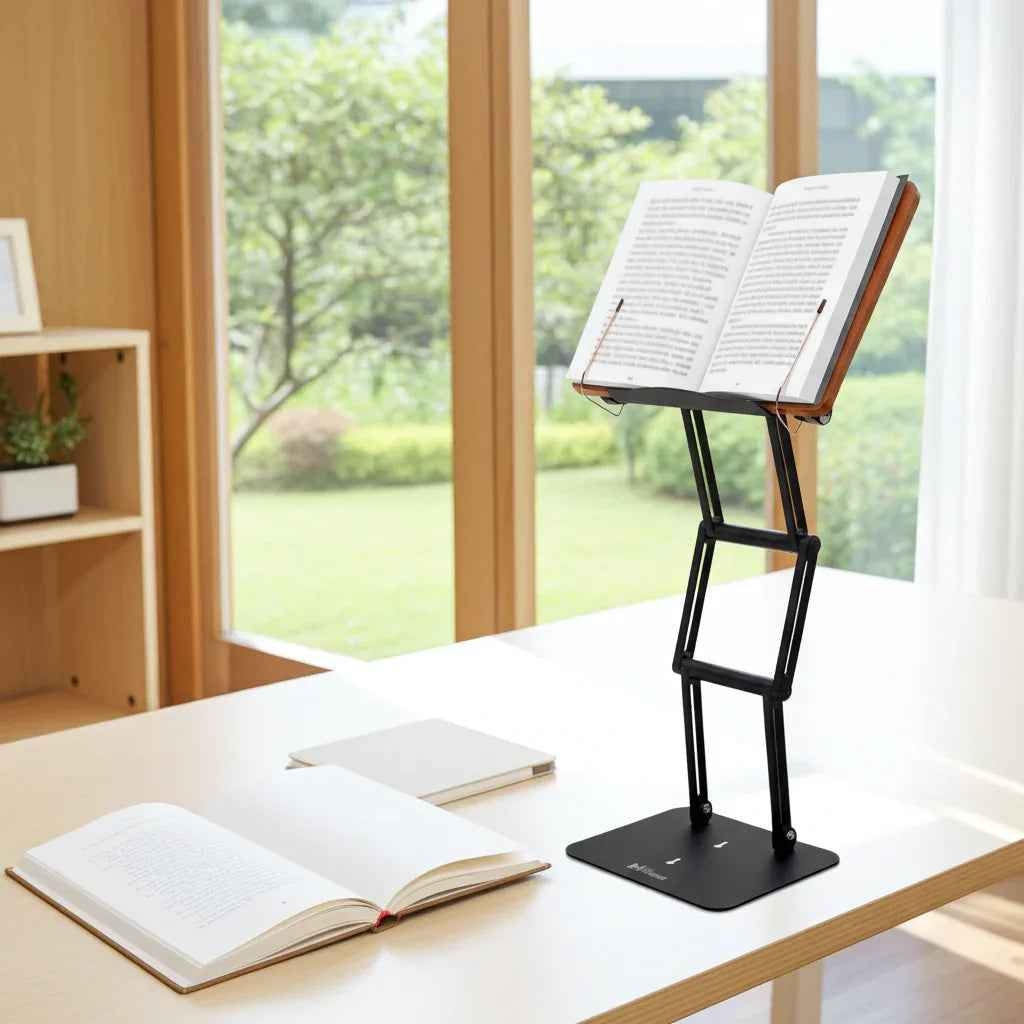
First, elevate the reading or viewing surface. This is the biggest lever. A high-quality adjustable stand can support books, tablets, and laptops at a much more useful height than the bargain versions that barely clear a coffee mug.
Second, bring the task close enough that you do not lean in to see it. Third, set up your chair and desk so your arms can work comfortably. Fourth, build movement into long sessions. Even a strong ergonomic setup is not a permission slip to freeze in one position for four hours.
This is where a serious stand earns its keep. A platform with meaningful vertical range can support both seated study and moderate standing use. That flexibility matters because the best posture for a long day is not one posture. It is variation around a sound setup. A height-adjustable stand such as The Stander 1.1 is built for exactly this kind of use, especially when the material is heavy and the work is not casual.
Why heavy books create a different posture problem
A lot of ergonomic advice is written as if everyone studies from a thin laptop or a single tablet. That is not the reality for many graduate students, clergy, lawyers, researchers, and traditional learners. Large textbooks, reference works, and sacred texts change the equation.
Heavy books sit lower, spread wider, and are more awkward to reposition. They also defeat many lightweight stands. When support fails, the user compensates. You bend more, brace more, and gradually accept discomfort as the cost of serious reading. It is not.
A proper study platform should handle weight without sagging, hold pages securely, and stay stable during normal use. If it also lifts material high enough to support neutral neck posture, that is where the ergonomic gain becomes real rather than theoretical.
Sitting versus standing for better posture
People often ask whether standing is better than sitting. The honest answer is that it depends on duration, task, and setup.
Standing can reduce the slump that comes from long seated sessions, and many users feel more alert when alternating positions. But standing with a low reading surface simply creates a standing hunch, which is not exactly progress. Sitting can be perfectly sound if the reading material is elevated and the workstation is arranged well.
The strongest approach is to use both. A setup that supports seated concentration and moderate standing study gives you options. And options are useful because posture tends to deteriorate when the body gets fatigued, even in a good position.
The best posture correction is the one you will keep using
There is always a temptation to look for a stretch, a brace, or a motivation trick that fixes everything. Those tools can help at the margins, but the main issue for most readers is still mechanical. If the work surface encourages neck flexion, your posture will keep drifting back into the same old pattern.
Study posture correction lasts when the environment supports it every day. Raise the material. Keep it stable. Set the distance correctly. Let your body work in a more neutral position. Then your attention can go back where it belongs - on the text, the argument, the problem set, or the page in front of you.
A well-designed study setup does something deceptively simple: it removes unnecessary strain from serious work. That is a small change with a very noticeable payoff over the course of a semester, a research project, or a lifetime of reading.