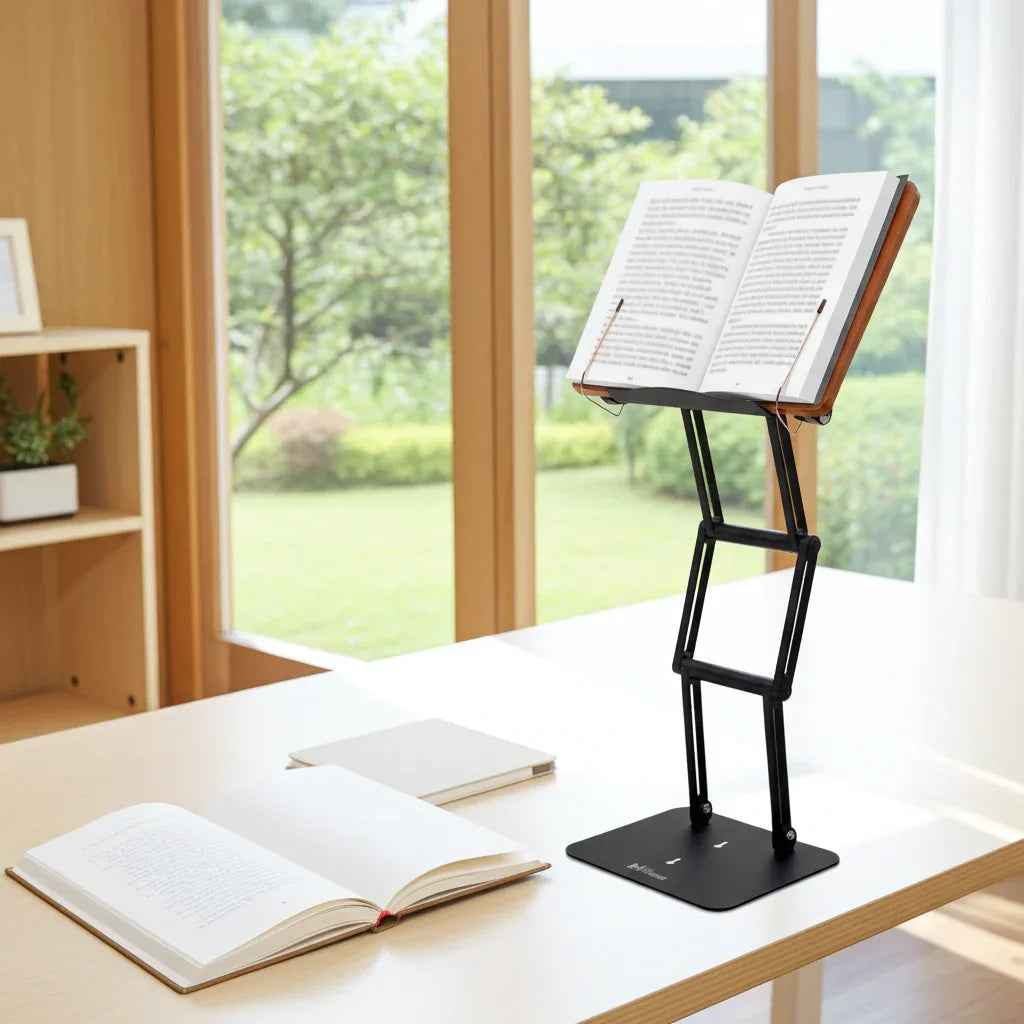
A heavy textbook has a predictable effect on a flat desk: it pulls your eyes down, then your head follows, then your shoulders join the argument. An adjustable book stand for reading changes that geometry. By bringing the page closer to eye level, it gives your neck a reason to stay where it belongs instead of hovering over a desk for hours.
This is not a minor comfort upgrade for people who read a chapter before bed. For students preparing for exams, researchers working through source material, professionals reviewing dense documents, and scholars studying sacred texts, the reading surface is part of the work environment. If it is too low, unstable, or incapable of holding the material you actually use, it becomes another obstacle between you and focused work.

The Stander by Dr. Shtaygen
An adjustable stand for heavy textbooks and long reading
Height- and angle-adjustable. 5052 aluminum alloy frame, 1.5 kg (3.3 lb), tested with heavy volumes up to 5 kg (11 lb). $95 + shipping, free 30-day returns.
See The StanderWhy a Flat Book Changes Your Posture
When a book lies on a desk, the reader usually bends at the neck and upper back to see it clearly. That position may feel harmless for a few minutes. Over a long study block, however, the muscles of the neck, shoulders, and upper back must keep supporting the forward-leaning head. The result is often stiffness, fatigue, and the familiar urge to rub the back of your neck halfway through a reading assignment.
Raising the text reduces the need to look sharply downward. The goal is not to sit frozen in one ideal pose - no human being does that for eight hours - but to make a more neutral posture easier to maintain. A well-positioned book can help keep your head stacked more naturally over your shoulders, while your chair and desk support the rest of the arrangement.
That matters for concentration as much as comfort. When your body is constantly searching for a tolerable position, attention leaks away from the material. A stand will not make constitutional law, organic chemistry, or a difficult sugya suddenly simple. It can remove one needless physical distraction from the process.
What an Adjustable Book Stand for Reading Must Do
Many products called book stands are really tablet stands with optimistic marketing. They work for a paperback or a recipe card, then wobble, sag, or become inconvenient when asked to support a substantial textbook, reference volume, siddur, or binder.
A serious adjustable book stand for reading should do more than tilt. Tilt helps reduce glare and lets you set a comfortable reading angle, but height is the feature that changes the relationship between your eyes and the page. Look for a stand that can elevate the reading surface significantly rather than merely lifting it a few inches above the desk.
Stability deserves equal attention. A stand should remain planted while you turn pages, make notes, and rest a hand against the book. It should not require a careful, museum-like touch. Heavy-duty construction, solid joints, and a broad base matter because a stand is only useful when you trust it with the materials that matter most.
The supporting lip also matters more than it first appears. It needs to be deep and secure enough to hold thick books without blocking excessive text at the bottom of the page. Page retainers should keep a book open without fighting you every time you need to move forward. The best design feels almost invisible once the reading begins.
Height Changes the Workday
A low stand can improve the page angle while leaving your neck bent. A tall, adjustable stand creates more options. It can serve a seated desk setup in the morning and support a moderate standing session later, without requiring a separate lectern or a stack of boxes that looks like an unstable research project.
The Stander raises its aluminum support lip up to 17.8 inches above the tabletop. Since the book or screen rests above that lip, the actual viewing height depends on the size of the item being used. That range gives serious readers room to position a large volume at a useful height, rather than accepting the limited elevation common to lightweight book holders.
Standing is not automatically better than sitting, and sitting is not automatically the villain. The advantage is variation. Alternating positions throughout a long workday can reduce the feeling of being locked into one posture. A height-adjustable stand makes that change practical without forcing you to move your books, tablet, or laptop to another workstation.
Match the Stand to the Material
Your reading material should determine the stand you buy. A novel, a law textbook, and a large-format religious text place very different demands on the equipment.
For lighter books, nearly any angled support may seem adequate. The limitations show up with thick, wide, or heavy volumes. These need a sturdy platform and joints that hold their chosen position under real load. If the stand dips after you place the book on it, it has failed the basic test.
For academic work, consider the workflow around the book. Are you highlighting directly on the page? Taking notes beside it? Comparing two sources? A good stand keeps the text elevated while leaving usable desk space below or beside it. The reader should not have to choose between seeing the material and having room to work.
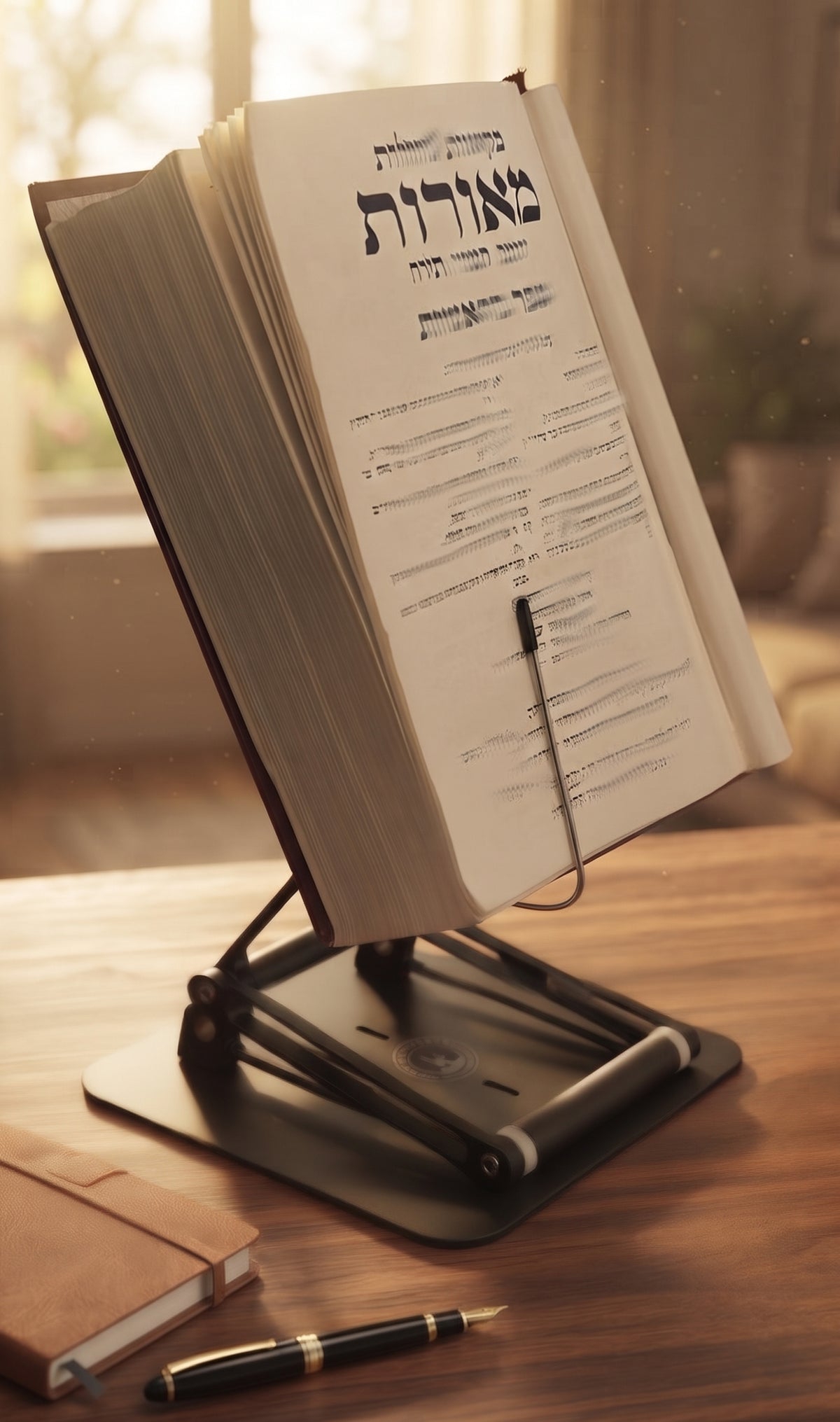
For religious study, the modern stand carries a familiar purpose. The traditional shtender places sacred texts at a raised, respected, readable position. A modern adjustable version can honor that function while fitting a home office, study hall, classroom, or kitchen table. It should hold substantial volumes confidently and make sustained learning physically easier.
Do Not Forget the Rest of the Setup
A book stand is a powerful correction, not a cure for a poorly arranged workspace. Position the stand directly in front of you whenever possible. Twisting your neck toward a book placed off to one side simply trades one strain pattern for another.
Set the height so you can read the upper portion of the page without sharply dropping your chin. You do not need to force the book exactly at eye level, particularly with a large open volume. The practical target is a comfortable gaze that is mostly forward and slightly downward, without prolonged craning.
Keep your chair and keyboard arrangement honest. If you are using a laptop on the stand, elevating its screen is excellent for your neck, but its built-in keyboard may then be too high for comfortable typing. An external keyboard and mouse are often the sensible companion for extended laptop work. Ergonomics is less about finding one magical object and more about making the parts work together.
Use the stand for the task in front of you, too. A cookbook holder can keep instructions visible without occupying precious counter space. Musicians can use it for sheet music. Presenters may use it as a portable lectern. It can even support a tablet during a video call or a projector in a pinch, provided the equipment is stable and the setup is appropriate. Serious construction earns its place by being useful beyond one narrow job.
A Quick Test Before You Buy
Before choosing a stand, ask whether it can meet the demands of your actual reading life. A useful evaluation includes these five questions:
- Can it support the heaviest book, binder, or device you regularly use?
- Does it offer meaningful height adjustment, not only an angled platform?
- Will the joints and base remain stable while you turn pages and write notes?
- Does it leave enough room for a natural seated or moderate standing setup?
- Is it built for years of use rather than a short season of good intentions?
Price matters, but so does replacement cost. A cheap stand that becomes a drawer resident after one difficult textbook is not the bargain it appeared to be. Durable aluminum construction joined with stainless steel screws and bolts may cost more upfront, yet it addresses the very reasons serious readers outgrow flimsy accessories.
Build a Reading Setup You Will Actually Use
The best ergonomic tool is the one that remains on your desk because it makes work easier. If adjustment takes too long, the stand becomes a decorative sculpture. If it cannot handle your books, you will return to reading flat on the desk. If it is stable, easy to position, and strong enough for your real materials, it becomes part of the routine.
Start with the next long reading session. Raise the text, center it, sit back, and notice how much less you need to chase the page with your neck. Your books contain enough difficult ideas already. The furniture supporting them should not add another one.
The Stander by Dr. Shtaygen
An adjustable stand for heavy textbooks and long reading
Height- and angle-adjustable. 5052 aluminum alloy frame, 1.5 kg (3.3 lb), tested with heavy volumes up to 5 kg (11 lb). $95 + shipping, free 30-day returns.
See The Stander