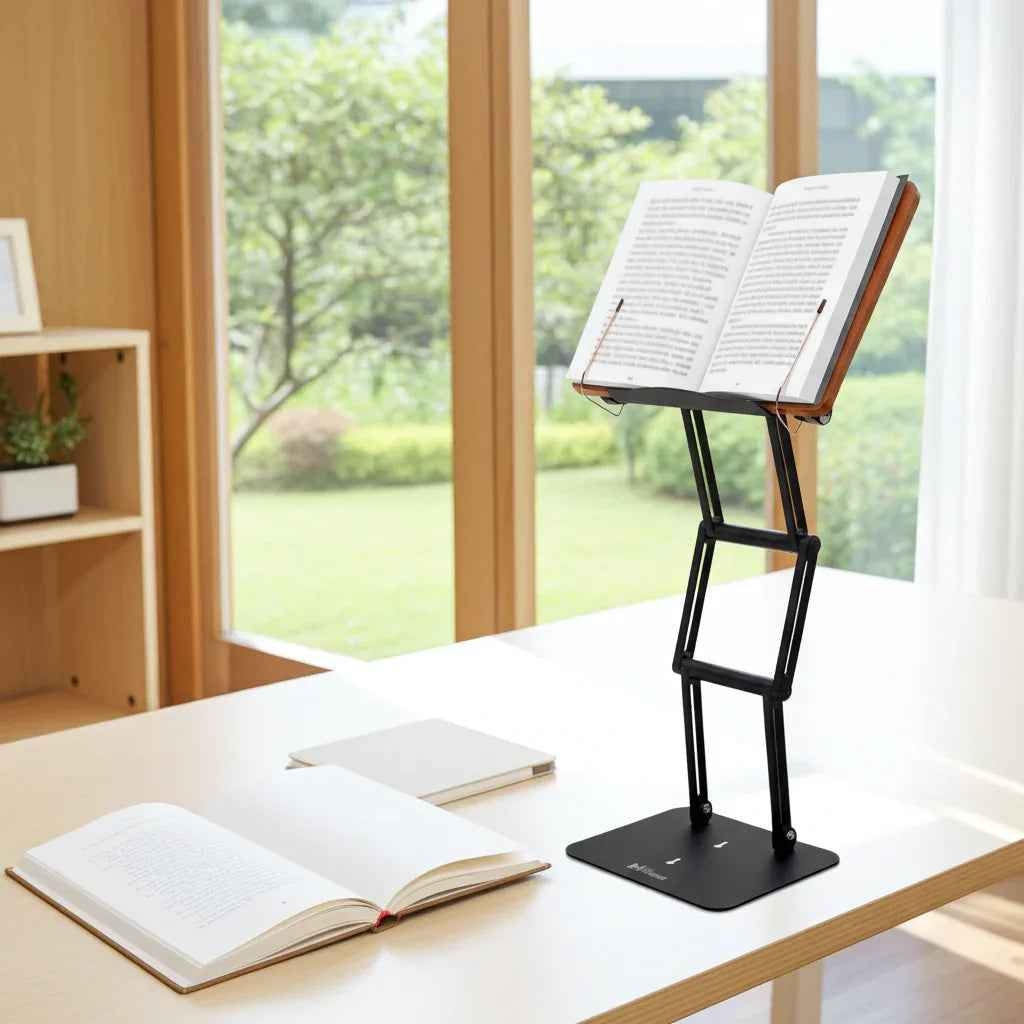
A reading stand usually looks impressive for about ten minutes. Then the book slides, the hinge droops, the base wobbles, and your neck ends up bent forward anyway. That is the real test behind any adjustable reading stand review - not whether a stand can hold a paperback for a photo, but whether it improves posture and stays stable during long, serious work.
For students working through dense textbooks, professionals reviewing printed materials, and scholars studying heavy volumes for hours at a time, the difference between a decorative stand and a true ergonomic tool is substantial. A good stand changes viewing height, angle, and endurance. A bad one adds one more object to the desk without solving the problem that caused the purchase in the first place.
What an adjustable reading stand should actually fix
Most people do not buy a stand because they love desk accessories. They buy one because prolonged downward gaze creates strain. The head moves forward, the cervical spine loads unevenly, the upper back rounds, and fatigue builds quietly over time. If reading is part of your daily routine, that posture compounds.
An adjustable stand should bring books or screens closer to eye level and reduce the need to collapse over the desk. That sounds simple, but the mechanics matter. If a stand does not raise high enough, lacks angle range, or shifts under weight, it fails its ergonomic purpose. The result is a compromise posture instead of a corrected one.
This is why cheap stands often disappoint serious users. Many are designed for light tablets or occasional recipes in the kitchen. They are not engineered for thick casebooks, large hardcovers, reference texts, or a laptop used for hours at a time.
Adjustable reading stand review criteria that matter
A serious adjustable reading stand review should focus less on appearance and more on performance under load. Stability comes first. If the base moves while pages turn or typing begins, the stand becomes distracting instead of supportive.
Height range is next. Many stands advertise adjustability but only offer modest lift. That may be enough for casual use, but not enough to bring a book into a truly ergonomic reading zone. Angle adjustment matters for the same reason. Different tasks require different positions. Reading a textbook, viewing sheet music, and using a laptop all place different demands on the stand.
Material quality is another dividing line. Lightweight plastic may be convenient, but it rarely inspires confidence under heavier loads. Aluminum structures with durable joints tend to perform better over time, especially for users who adjust the stand often and expect it to hold its position.
Finally, there is retention. Can the stand hold pages open without damaging them? Can it support thick books without tipping? Can it handle a tablet, a laptop, and a religious text with equal composure? Versatility is valuable, but only when it does not weaken the stand's primary function.
Where most adjustable stands fall short
The market is crowded with products that are technically adjustable but not functionally ergonomic. Many low-cost stands rely on narrow bases and small hinges. They can hold a paperback at a shallow angle, but once the load increases, performance drops fast.
The most common issue is instability. You adjust the platform to a useful height, place a heavier book on it, and the whole setup begins to feel top-heavy. The second issue is limited elevation. The product claims posture support, but the viewing surface still sits too low, forcing the user into a partial forward bend.
There is also a durability problem. Repeated adjustments expose weak joints quickly. A stand that feels acceptable in the first week can loosen within months, especially in high-use environments like dorm rooms, home offices, study halls, or religious study settings.
This is where premium construction begins to justify itself. Serious readers do not need novelty. They need equipment that behaves predictably every day.
A closer adjustable reading stand review for serious users
If your standard is real ergonomic benefit, not casual convenience, the strongest stands tend to share a few traits. They use metal construction rather than thin plastic. They provide a broad, stable footprint. They elevate significantly rather than symbolically. And they hold substantial weight without sagging.
That makes a product like The Stander 1.1 more relevant than the average book stand. It is built less like a lightweight accessory and more like a serious workstation tool. That distinction matters for users handling textbooks, legal materials, large-format books, tablets, and laptops in the same day.
The first advantage is structural confidence. A heavy-duty aluminum body with stainless steel joints addresses the exact failure points that undermine cheaper stands. Instead of asking the user to be gentle with it, a stand like this is designed for repeated adjustment and sustained load.
The second advantage is elevation. A stand that rises meaningfully can reduce neck flexion in a way low-profile stands cannot. For posture correction, that is not a luxury feature. It is the point. Bringing material upward changes the reading experience from desk-hunched to forward-facing.
The third advantage is range of use. Many buyers begin by looking for a reading stand and later use it as a laptop riser, tablet holder, cookbook stand, sheet music platform, or portable lectern. That versatility has real value, provided the stand remains stable across those use cases. Serious engineering makes that possible.
Who benefits most from an adjustable reading stand
Not every desk user needs a premium stand. If someone reads casually for short periods and uses mostly lightweight paperbacks, a basic holder may be enough. The trade-off is that those simpler products often top out quickly once demands increase.
The people who benefit most are those with sustained reading volume and sustained sitting time. Students move through hundreds of pages a week. Researchers and academics shift between notes, books, and screens constantly. Professionals review documents at a desk for long stretches. Religious scholars often study substantial texts for extended periods and need a modern equivalent of the traditional shtender - stable, elevated, and built for concentration.
These users tend to notice the same pattern. They are not only uncomfortable. They are interrupted. Neck fatigue, slumped posture, and constant repositioning erode focus. A well-designed stand helps restore continuity to the work.
The trade-offs to consider before buying
A fair adjustable reading stand review should acknowledge that premium stands are not for everyone. Higher-quality materials and stronger joints usually mean more weight and a higher price. If portability is the only goal, an ultralight folding stand may feel more convenient.
But there is an important distinction between portable and capable. A stand that travels well but performs poorly at the desk is still a poor value for serious users. Likewise, a heavier stand may be the better choice if it stays planted, supports real load, and protects posture daily.
Desk size also matters. A stand with a stronger footprint may require more room than a minimalist holder. For some setups, that is a minor issue. For others, especially compact desks, it is worth measuring before purchase. Ergonomic improvement should simplify the workspace, not crowd it.
Is an adjustable reading stand worth it?
For serious readers, yes - if the stand genuinely changes height, angle, and stability. The keyword is not adjustable as a marketing label. It is adjustable in a way that improves biomechanics. That is what separates an impulse buy from a lasting ergonomic upgrade.
A good stand can reduce downward neck posture, support longer reading sessions, and make printed materials easier to use alongside digital devices. It can also create a more intentional workspace, where books and screens occupy a productive visual plane instead of pulling the body downward.
If the stand is flimsy, the answer is no. It will become another object to work around. If it is engineered for serious use, it becomes part of how serious work gets done.
The right choice depends on what you read, how long you read, and how much strain your current setup is creating. If your desk time is measured in hours and your materials have real weight, a stronger stand is not an accessory. It is infrastructure for better posture, better focus, and more sustainable study.