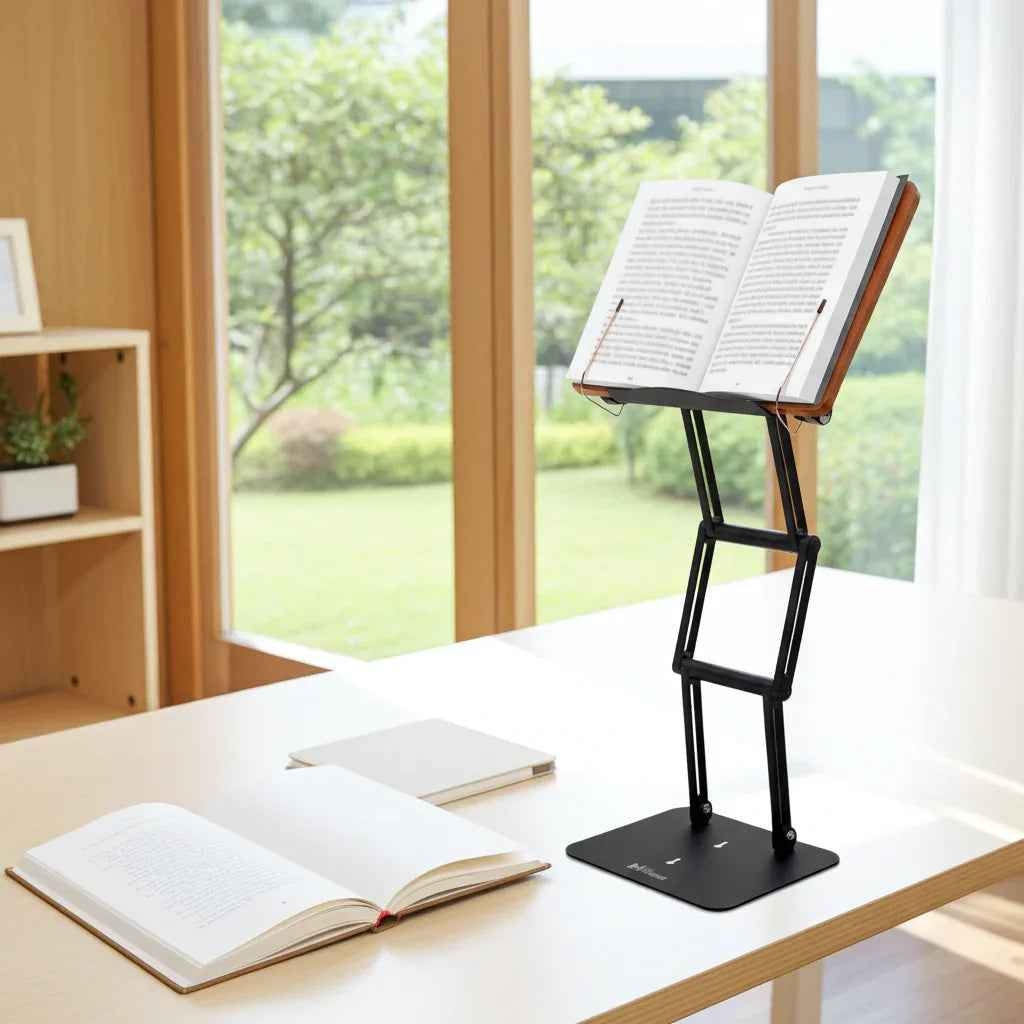
A desk can look perfectly respectable while quietly training you to read with your chin tucked toward your chest. That is the familiar setup for neck fatigue, rounded shoulders, and the urge to stop just when the work becomes interesting. The best desk upgrades for readers do more than make a workspace look polished. They bring the material to a usable height, control visual strain, and make long periods of serious reading physically sustainable.
For a student facing a 900-page textbook, an attorney reviewing briefs, a researcher moving between articles, or a scholar learning from a sefer, the question is not simply, “What accessory should I buy?” It is, “What removes friction from the hours I already spend at this desk?” Start there, and you will spend more wisely.
Start With the Upgrade That Changes Your Posture
A quality reading stand is the highest-impact desk upgrade because it corrects the most common flaw in desk reading: flat material on a flat desk. When a book lies below chest level, your neck must repeatedly bend forward to see it. The longer and heavier the reading session, the more that position accumulates.
Raising a book, tablet, or laptop moves the work closer to eye level and makes a more upright head and neck position possible. That does not mean every reader needs the same angle or height. A short novel, a large anatomy text, and a laptop each sit differently. The goal is not a rigidly perfect posture held for eight hours. It is to avoid spending those hours folded over the page.
A serious stand should be judged by more than its appearance. Look for enough elevation to work while seated and during a moderate standing session, a wide platform that will not flex under heavy volumes, and joints that stay put when adjusted. Many inexpensive book stands are adequate for a tablet or paperback. They become less convincing when asked to hold a law textbook, a large reference work, or an open volume that seems determined to close itself.
The Stander 1.1 is built for that more demanding category. Its adjustable platform can raise the supporting lip 17.8 inches above the tabletop, with the book or screen sitting higher depending on its size. Aluminum construction and stainless steel joints give it the stability that serious reading materials require. It functions as a modern shtender as naturally as it does a laptop riser or textbook holder.
The Best Desk Upgrades for Readers Work as a System
A stand is the centerpiece, but it should not be expected to solve every issue alone. Reading comfort depends on how the book, chair, light, and desk surface work together. The following upgrades earn their place because each addresses a distinct point of strain or distraction.
Add dedicated task lighting
Overhead lighting often creates two bad choices: glare on glossy pages or a dim pool of light over the book. A movable task lamp lets you direct light onto the page rather than into your eyes. Position it to the side opposite your writing hand, which helps prevent your hand from casting a shadow across notes.
Choose a lamp with adjustable brightness and a broad, even beam. The brightest possible setting is not automatically better. If the page is brightly lit while the rest of the room is dark, your eyes work harder as they shift between page, screen, and surroundings. A balanced room with focused task lighting is generally easier to read in for a long stretch.
Upgrade the chair only after checking the setup
An ergonomic chair can be a worthwhile investment, but a premium chair cannot compensate for a book positioned at knee height. First raise the reading material. Then set chair height so your feet rest firmly on the floor or on a footrest, with your knees and hips comfortable rather than tightly compressed.
Supportive seating should allow you to sit back occasionally instead of perching at the desk edge. Adjustable lumbar support can help some readers, while others find a simple small cushion more comfortable. The right answer depends on your body and the chair's shape. What matters is that the chair supports movement and does not force you to reach up toward a too-high desk or slump down toward a too-low book.
Use a footrest when your feet do not reach
A footrest is unglamorous, which is precisely why it is often overlooked. If raising your chair gives you better arm position at the desk but leaves your feet dangling, your lower body loses a stable base. That instability can travel upward as fidgeting, slouching, and pressure through the lower back.
A simple angled footrest or firm platform allows you to set chair height for the desk while keeping both feet supported. It is a particularly useful adjustment for shorter readers, shared workspaces, and desks that cannot be lowered.
Create a writing zone beside the stand
Readers frequently switch between reading, highlighting, typing, and handwritten notes. If the only open space is directly beneath the raised book, the workflow becomes awkward fast. Reserve a clear zone on your dominant-hand side for a notebook, legal pad, or keyboard.
This is where a large desk mat can help. It defines the working area, keeps a notebook from sliding, and softens the hard visual clutter of a crowded desk. Do not buy a mat so large that it becomes another surface for abandoned papers. The best desk organization has one purpose: to keep the material you need within reach and everything else out of your visual field.
Keep a timer visible, but not demanding
Long reading requires concentration, yet concentration is not the same as remaining motionless. A quiet visual timer or simple desk clock can prompt a brief reset before discomfort becomes your main subject of study. Stand, look across the room, roll your shoulders, refill water, then return to the work.
Avoid turning this into a productivity theater ritual with seven alarms and a spreadsheet. A useful interval is one you will actually follow. Some people prefer a short break every 25 to 30 minutes; others do better with 45 to 60 minutes of uninterrupted reading before moving. Dense technical material may require longer focus blocks, while screen-heavy work benefits from more frequent visual breaks.
Choose Upgrades Based on Your Reading Material
The right setup changes with the task. A leisure reader using a tablet may prioritize a compact stand and warm task light. A graduate student needs room for a laptop, source text, and notes. A religious scholar may need a stable elevated platform that keeps a sacred text open and accessible for extended learning. A home cook may use the same stand to keep a cookbook upright and safely away from spills.
Weight matters, too. A light tablet can sit on almost anything. Large textbooks, binders, music books, and multi-volume works demand a platform with real load-bearing confidence. This is where “adjustable” and “heavy-duty” stop being marketing adjectives and become practical requirements.
Also consider how often the workspace changes. If you move between a desk, kitchen counter, dining table, and standing work surface, a portable but substantial stand offers more value than a fixed, single-purpose desk accessory. If your desk is permanent and heavily used, prioritize stability over compactness.
What Not to Buy First
Do not begin with decorative storage, a novelty keyboard, or another monitor if your primary work is reading from physical pages. These additions may be pleasant, but they do not address the position that causes the most strain.
Likewise, be cautious with low-profile book holders that offer only a slight tilt. A tilted book is better than a flat book, but it may still leave you looking down for hours. For short recipe reading, that may be enough. For daily study, professional reading, or serious scholarship, meaningful height adjustment is usually the difference.
Finally, do not build a desk so optimized that it becomes fragile. You should be able to sit down, place a book on the stand, open a notebook, and begin. If your setup requires rearranging five accessories before every session, it is not supporting focus. It is asking to become a hobby.
Build the Desk Around the Work You Want to Do
The most effective reading desk is not filled with gadgets. It gives your eyes a clear page, your neck a better position, your hands a practical place to write, and your body permission to move. Start with the height of the material, then improve light, seating, and support where your own setup calls for it.
A good desk should make it easier to stay with a difficult chapter, a demanding assignment, or a meaningful text for a little longer. That is a modest design goal, but over years of reading, it is a very serious advantage.