Grad school has a way of turning a desk into a command center, triage unit, and snack storage zone at the same time. If your desk setup for grad students is just a laptop, a kitchen chair, and a growing sense of upper back regret, the problem is not your discipline. The problem is that most study spaces are built for short tasks, while graduate work demands long hours of reading, writing, annotating, and switching between physical texts and digital ones.
A good setup does more than look organized on move-in day. It protects your neck, keeps your visual field cleaner, and reduces the tiny frictions that drain focus over a four-hour writing block. For grad students, that matters because your desk is not just where you sit. It is where your attention either holds or collapses.
What a desk setup for grad students needs to do
Undergraduate study often revolves around shorter bursts: class notes, problem sets, maybe a paper or two. Graduate study is different. You are reading dense material, cross-referencing sources, drafting for long stretches, and often working with both books and screens at once. A desk that works for checking email can fail badly when you are balancing a laptop, two articles, and a 900-page text.
That is why the best desk setup is not about buying more accessories. It is about supporting three things at once: posture, visibility, and workflow. If one of those breaks down, the whole system gets annoying fast.
Posture is the obvious one. When books and screens sit flat on the desk, your head drops forward. That position is common, but common is not the same as harmless. Hours of cervical flexion can lead to neck tension, shoulder tightness, headaches, and the kind of fatigue that makes serious reading feel harder than it should.
Visibility matters just as much. If your source material is too low, too far away, or blocked by clutter, you spend more time adjusting your body than engaging with the material. Workflow is the third piece. Graduate work usually means moving between tasks without fully resetting your space. Read, type, mark up, compare, think, repeat.
Start with the one thing most students get wrong
The biggest mistake in a desk setup for grad students is leaving primary reading material flat on the desk. People focus on keyboards, lamps, and aesthetic cable management while ignoring the object they spend the most time looking at.
If you spend hours reading textbooks, printed papers, legal pads, or a tablet loaded with articles, that material should be elevated. Eye-level or near eye-level placement reduces the need to bend your neck downward over and over. It also makes transitions between reading and writing faster because your eyes travel less.
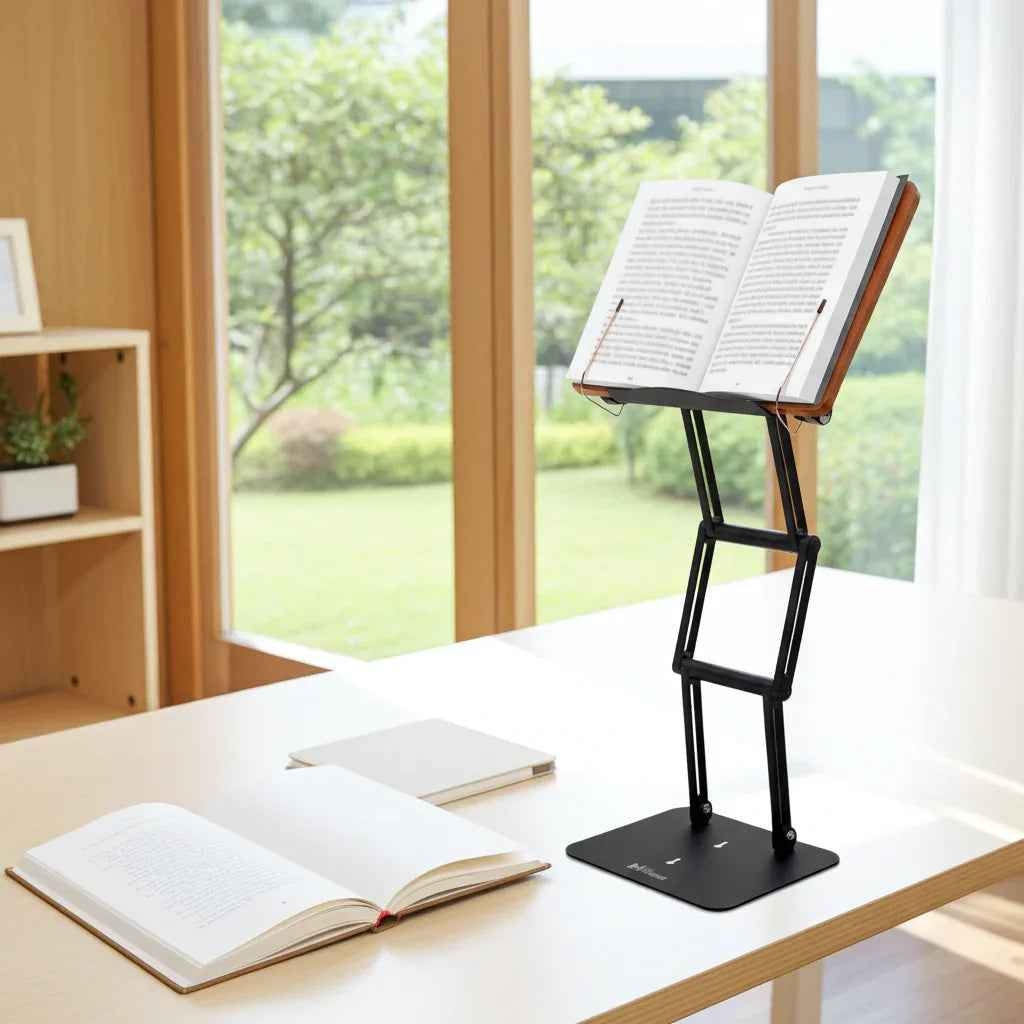
This is where a serious stand changes the entire desk. Not a flimsy cookbook prop that starts trembling under a hardback, and not a tiny tablet perch designed for twenty-minute streaming sessions. A real study stand should hold heavy materials securely, raise them high enough to matter, and stay stable while you turn pages or type nearby.
For grad students who move between books, notes, laptops, and tablets, an adjustable stand earns its space because it solves more than one problem. It acts as a book stand, textbook holder, laptop riser, and reading platform in the same footprint. That is especially useful in small apartments, shared housing, and library corners where every inch of desk space has to justify itself.
Build the desk around your reading and writing posture
Once your main material is elevated, the rest of the desk gets easier to organize. Your chair should allow your feet to rest flat, with knees around hip level or slightly below. Your shoulders should stay relaxed, not shrugged toward your ears like you are defending a dissertation at swordpoint.
If you type for long stretches, place your keyboard and mouse low enough that your elbows can stay close to your sides. If your laptop is raised for screen height, use an external keyboard. This is one of those non-negotiables that people try to outsmart for a week and then feel in their wrists.
Your monitor, laptop screen, or raised text should be your visual anchor. Everything else should support it. Keep frequently used items within easy reach: pen, notebook, water, charger, and maybe one reference text. Less-used material can live off to the side. The goal is not minimalism for its own sake. The goal is reducing unnecessary reaching, twisting, and visual clutter.
Lighting matters more than students think, especially for reading dense material. If your room light is weak and your desk lamp creates glare on glossy pages or screens, your eyes work harder. That extra effort shows up as fatigue, not just annoyance. A lamp with directed, even light is better than a harsh overhead setup that makes half the page bright and half dim.
Small desks need better choices, not more compromise
A lot of graduate students work with limited square footage. Studio apartment, shared bedroom, library carrel, borrowed corner of the dining table - none of these are unusual. The answer is not surrender. It is prioritization.
On a small desk, verticality becomes your friend. Raising books, tablets, or a laptop off the desk surface frees space below and around them. That is one reason a height-adjustable stand is so effective. It turns dead vertical space into usable study space.
The difference between a cheap stand and a professional-grade one becomes obvious here. A low, wobbly stand may technically lift a book, but not enough to improve posture meaningfully. A more serious design that can elevate reading material up to 17.8 inches above the tabletop creates a much more functional line of sight, especially for larger books and for students who alternate between sitting and moderate standing work.
That last point is worth pausing on. Some grad students do better when they can stand for part of a reading session, then sit for writing. You do not need a full standing desk to benefit from that shift. If your reading platform rises high enough, you can create a more flexible workflow without rebuilding the whole room.
What to keep on the desk, and what to remove
A useful desk should feel ready, not crowded. Keep only what supports the work you actually do most days. For many grad students, that means a computer, a primary reading surface, one notebook, and a focused light source.
You probably do not need decorative trays full of markers, six unopened planners, and three mugs that are now functioning as archival pencil cups. Academic life produces enough chaos without making your desk cosplay as a stationery aisle.
At the same time, be realistic. If printed articles are central to your process, build for that. If you constantly compare notes across books, make space for open material. If your field requires large, heavy texts, do not pretend a flimsy stand will hold up. It will not. Serious study needs equipment that respects the load.
That is one reason premium stands exist at all. The market is full of lightweight options built for recipes and tablets, but graduate work often involves heavier books, repeated adjustments, and long daily use. Strong materials, stable joints, and reliable elevation are not luxury features when the tool is central to your workflow. They are the difference between help and hassle.
Your setup should reduce friction, not create rituals
There is a strange productivity myth that a better desk means a more complicated desk. It usually ends with a student spending forty minutes optimizing cable sleeves and ten minutes reading. A strong setup should be simple to use under pressure.
You should be able to sit down, place your material where it belongs, and start. If every study session begins with stacking books to make a riser, shifting piles to find your notes, or hunching because your stand cannot go high enough, the setup is costing you time and concentration.
This is where thoughtful design actually supports academic performance. A stable, adjustable platform for reading and screen work helps preserve posture and cuts the low-grade discomfort that chips away at focus. Dr. Shtaygen’s Stander 1.1 was built for exactly this kind of serious use - not casual browsing, but sustained reading, writing, and study with materials that have real weight.
The best desk setup is the one you can sustain
There is no single perfect desk setup for grad students because fields, bodies, and schedules differ. A historian surrounded by books has different needs than a data science student living inside two screens. But the underlying standard is the same: your setup should help you work longer with less strain, less clutter, and fewer physical compromises.
If you are deciding where to invest first, start with whatever supports your line of sight and posture during the work you do most. For many grad students, that means elevating books, papers, or screens before buying anything decorative. When the core mechanics are right, everything else feels calmer.
Your desk does not need to be beautiful enough for social media. It needs to be good enough that, three hours into a reading session, your neck is not negotiating terms and your attention is still in the room.