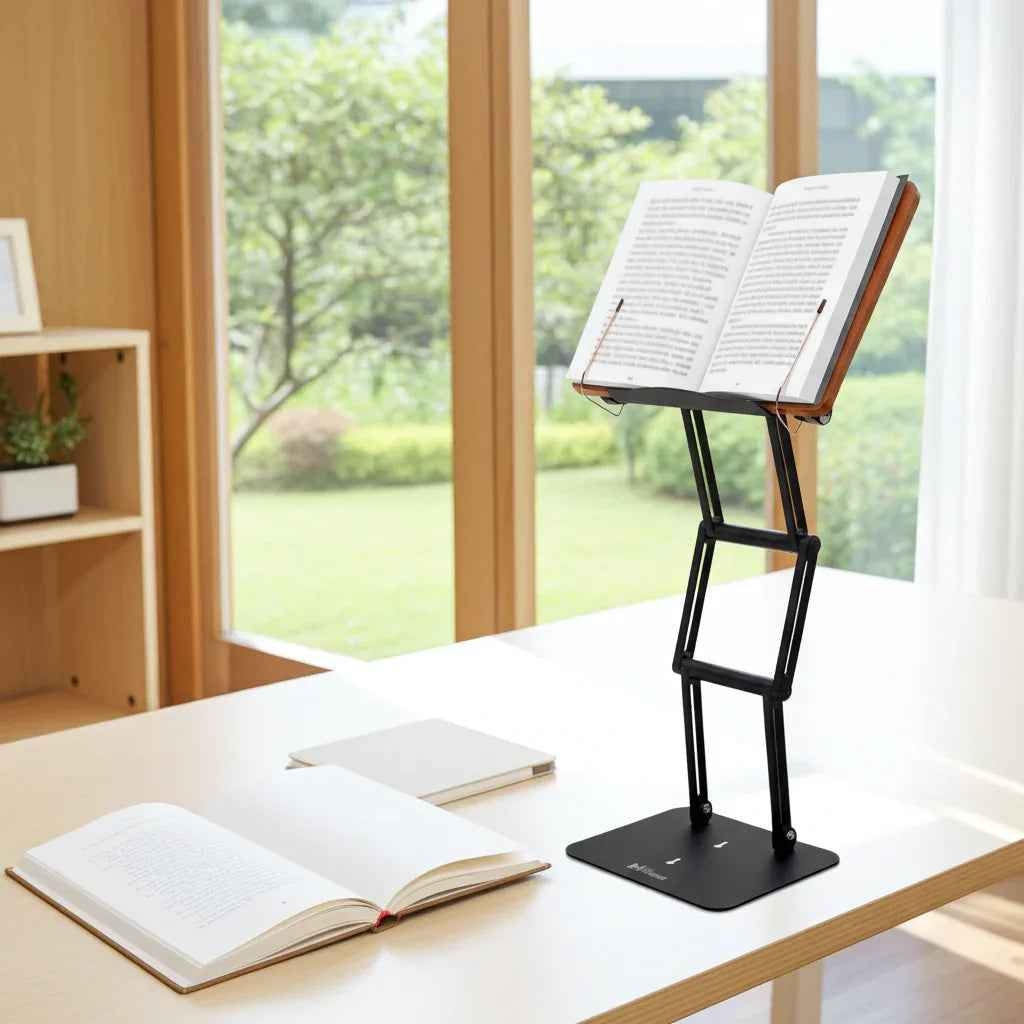
A few hours into reading, most people start making the same adjustments without realizing it. The chin drops forward. The shoulders round. The book gets pulled closer to the lap. If you are searching for the best ergonomic book stand, you are usually trying to solve a real physical problem, not just tidy up a desk.
That distinction matters. A decorative recipe stand and a true ergonomic study platform are not the same thing. For long reading sessions, textbook review, legal work, research, or religious study, the stand has to do more than hold pages open. It has to bring the material to eye level, stay stable under weight, and support a posture you can maintain for hours without feeding neck and upper back strain.
What makes the best ergonomic book stand
The best ergonomic book stand changes the angle and height of your reading material enough to reduce cervical flexion. In plain terms, it helps you stop looking down all day. That sounds simple, but it is where most low-cost stands fail.
Many products marketed as ergonomic only adjust the tilt. Tilt helps, but height is what usually makes the bigger difference. If the book still sits near desk level, your head still drops. A stand worth considering should raise the page substantially, not just prop it up.
Stability is the second non-negotiable. Serious readers do not work with featherweight paperbacks alone. They use dense textbooks, reference books, art books, binders, and in some cases, sacred texts that need respectful, stable support. A stand that shakes while you annotate or collapses under load is not ergonomic in practice, no matter how polished the marketing looks.
The third factor is the range of use. A good stand should not force a single posture. You may read seated in the morning, type from a laptop in the afternoon, and review notes from a tablet later on. The strongest designs support that shift without turning your desk into a pile of single-purpose accessories.

Why cheap stands often create new problems
A flimsy stand can improve viewing angle while making workflow worse. If it wobbles every time you turn a page, you tense your hands and shoulders to compensate. If it slides on the desk, you keep reaching and resetting. If the page holders block too much text, reading slows down and frustration builds.
There is also a durability issue. Lightweight plastic hinges and weak joints may work for occasional tablet use, but sustained daily study is different. Repeated adjustment puts stress on connection points. Heavy books expose poor engineering quickly. For students in exam season, professionals who reference documents all day, or scholars working through long texts, failure under load is more than an annoyance. It interrupts concentration and sends you back into poor posture.
This is why the best option is rarely the cheapest one. Ergonomic equipment earns its value through repeated use, reliable support, and physical relief over time.
Best ergonomic book stand features to prioritize
If you want a stand that performs like a real ergonomic tool, start with the elevation range. The stand should lift your reading material high enough that your eyes move more than your neck. For many desks and body types, that means more vertical adjustment than standard cookbook stands provide.
Next, look at load-bearing capacity. This is especially important for graduate students, attorneys, clergy, medical professionals, and anyone working with heavy-format books. A stand should support real weight without sagging at the joints. Aluminum construction, reinforced pivot points, and a broad base generally outperform thin wire frames and lightweight folding plastic.
Surface size matters more than people expect. A narrow tray can technically hold a book, but large textbooks or wide-format volumes may overhang, shift, or feel insecure. A generously sized platform gives better support and makes the setup feel calmer and more usable.
Page retention is another overlooked detail. Good clips or arms should hold pages open without obscuring large portions of text. This becomes especially useful when working with thick books that resist staying open.
Finally, evaluate whether the stand fits your full workflow. Some people need a dedicated reading stand. Others need one platform that can also support a laptop, notebook, or tablet. The more hours you spend at a desk, the more valuable that versatility becomes.
Who actually needs the best ergonomic book stand
Not everyone does. If you read casually for twenty minutes on the couch, a serious ergonomic stand may be unnecessary. But if your work or study depends on long hours with text in front of you, the equation changes.
Students benefit because textbook reading often happens in concentrated blocks, usually with note-taking layered on top. Researchers and academics benefit because they move between dense source material, digital references, and writing tasks. Professionals benefit because document review, continuing education, and desk work all compound posture stress over time.
Religious scholars and devoted learners occupy a category of their own. Raised study platforms have a long tradition for a reason. They support reverence, focus, and sustained attention. A modern stand that functions like a refined shtender carries that same purpose into contemporary workspaces while adding adjustability and multi-device use.
What separates a premium stand from a commodity stand
The difference is not branding alone. It is mechanical performance.
A commodity stand is designed to be inexpensive, light, and easy to store. Those traits can be useful, but they usually come with compromises in elevation, stability, and long-term durability. For casual use, that may be acceptable.
A premium stand is built for repeated strain, frequent adjustments, and heavier loads. It feels planted on the desk. It holds its angle. It does not ask you to work around its limitations. That is what serious users notice first. The stand stops being a gadget and starts behaving like equipment.
This is where products built with posture correction in mind stand apart. A model such as The Stander 1.1 is engineered less like a kitchen accessory and more like a professional workstation tool. That difference matters when the stand is expected to support textbooks, laptops, tablets, and extended hours of concentrated study.
How to choose the right stand for your desk and body
Start with your primary task. If you mainly read heavy books, prioritize platform size and joint strength. If you switch between reading and computer work, prioritize height range and stability at multiple positions. If your desk is shallow, pay close attention to the stand's footprint so the stand does not crowd your keyboard space.
Then consider your own posture patterns. If you tend to crane forward, you likely need more elevation than you think. If shoulder tension is your bigger issue, a more central and stable reading position may help by reducing repetitive reaching and constant repositioning.
It also helps to think in terms of session length. For thirty-minute bursts, many stands feel acceptable. For three-hour blocks, weaknesses become obvious. When evaluating options, ask whether the stand is built for occasional convenience or sustained use.
A final point: there is always some trade-off between portability and stability. Ultra-light foldable stands travel well, but they rarely deliver the planted feel or load support of a heavier, better-engineered unit. For home offices, study desks, and permanent workstations, stability usually wins.
The real payoff: less strain, better focus
The strongest argument for an ergonomic stand is not that it looks organized. It is that physical discomfort steals cognitive performance. When your neck starts aching, your attention narrows. When your shoulders tighten, you read less efficiently. When your setup fights you, deep work becomes harder to sustain.
A well-designed stand reduces those friction points. It places the text where your eyes can meet it more naturally. It makes annotation easier. It keeps heavy materials from slipping into awkward positions. Over time, that can mean longer reading sessions with less fatigue and fewer posture-driven interruptions.
That is what the best ergonomic book stand should deliver. Not novelty, not desk decor, and not a flimsy promise of better posture. It should provide stable elevation, serious support, and a reading position your body can tolerate day after day.
If your work depends on sustained concentration, the right stand is not a small upgrade. It is part of the system that protects your neck, supports your focus, and helps you stay with the text longer.
If you're ready to move from understanding the theory of posture to fixing your setup, you can [view The Stander 1.1 here].