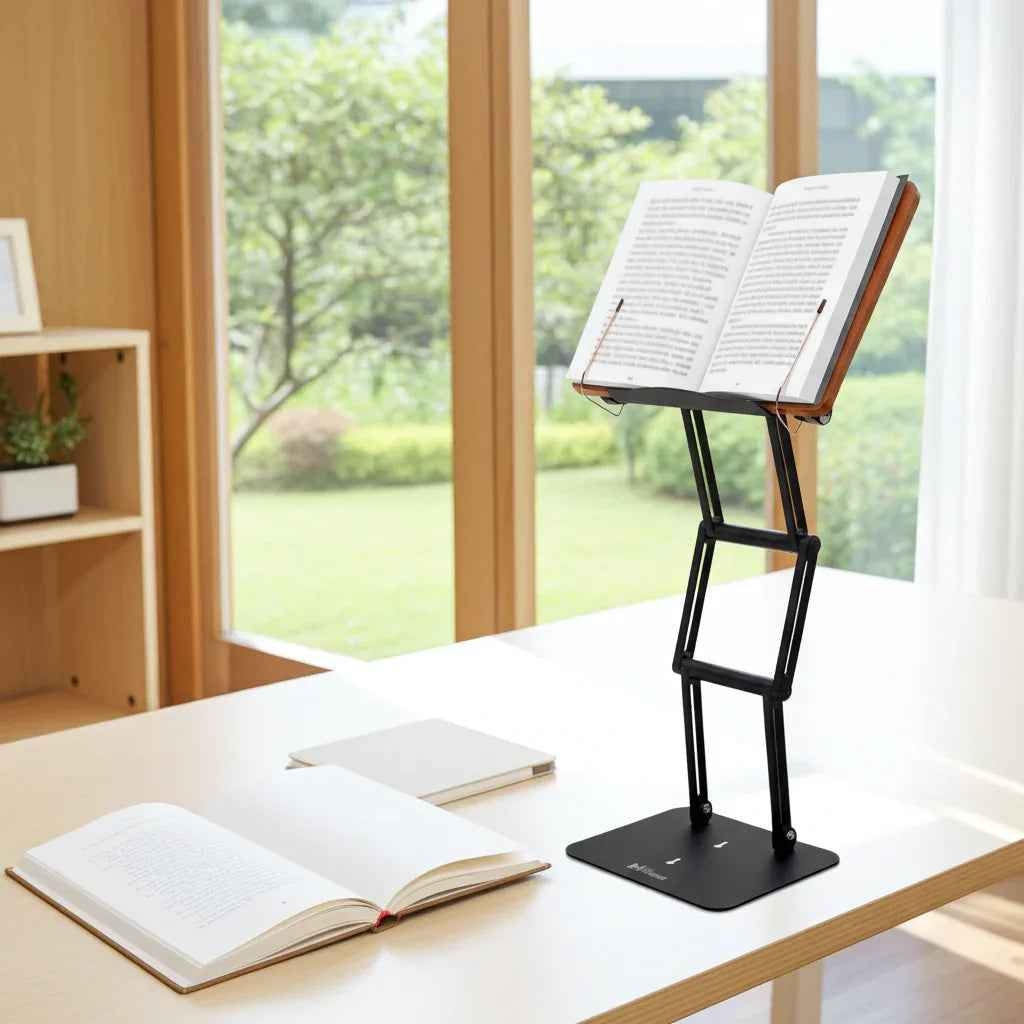
Grad school has a way of turning an ordinary desk into a command center for long reading blocks, back-to-back writing sessions, and the occasional low-stakes existential crisis over citation formatting. If you are searching for the best accessories for grad school study desks, the real goal is not to make your space look more productive. It is to make long hours easier on your neck, eyes, shoulders, and attention span.
That distinction matters. Many desk accessories are decorative, trendy, or built for light use. Graduate study is different. It involves dense textbooks, articles, laptops, notebooks, chargers, and often a workflow that lasts far longer than your posture wants to tolerate. The right setup should reduce strain, protect focus, and hold up under serious use.
What the best accessories for grad school study desks actually do
A useful study desk accessory earns its footprint. It should solve a specific problem: neck flexion from looking down, wrist strain from poor typing angles, visual fatigue from bad lighting, distraction from clutter, or discomfort from sitting still too long. If it does not improve comfort or concentration, it is probably just taking up desk space.
For grad students, the strongest desk upgrades tend to fall into three categories. The first is ergonomic support, because posture usually breaks down before motivation does. The second is visibility, since reading and writing require good lighting and proper screen height. The third is organization, which sounds less exciting until you realize how much cognitive drag comes from hunting for a charger or clearing space for a book you should have opened ten minutes ago.
1. A height-adjustable reading and laptop stand
If there is one accessory that changes the desk experience the most, it is a serious stand that raises books, laptops, or tablets closer to eye level. Grad students spend an unreasonable amount of time looking down. That repeated neck flexion adds up quickly, especially when you alternate between printed material and a screen all day.
A strong stand improves viewing angle, reduces cervical strain, and makes it easier to stay upright for longer periods. It also creates a cleaner visual workflow. Instead of hunching over a textbook and then craning back up to a laptop, you bring the material into a more natural line of sight.
This is where quality matters. Many cheap stands are fine for a lightweight tablet and not much else. Graduate work often means heavy textbooks, casebooks, binders, or large laptops. A flimsy stand that wobbles under load is not an ergonomic solution. It is a trust exercise. A premium, height-adjustable stand like The Stander 1.1 is built more like equipment than an accessory, which is exactly the point if your desk has to support serious academic work.
2. An external keyboard and mouse
There is a trade-off with laptop stands. Raising the screen improves neck position, but typing directly on an elevated laptop puts your shoulders and wrists in a poor position. That is why an external keyboard and mouse are not optional if your laptop is going up.
This pairing lets you separate screen height from hand position, which is one of the simplest ergonomic wins available. Your eyes stay higher, your elbows can rest more naturally, and your wrists do not have to work at awkward angles. For long writing sessions, that difference is noticeable.
If you mostly read and annotate, a compact keyboard may be enough. If you spend hours drafting chapters, coding, or doing data work, a full-size keyboard can be worth the extra desk space. It depends on your workflow, but the principle is the same: elevated screen, neutral hands.
3. Task lighting that does not punish your eyes
Overhead room lighting is rarely enough for real study. It creates shadows, misses the page, or forces your eyes to do more work than they should. A focused desk lamp with adjustable brightness and color temperature can make reading easier and reduce fatigue late in the day.
Warm light may feel more comfortable at night, while cooler light can help with alertness during focused work. The best option is adjustability. Grad school is not one task repeated forever. Reading print, reviewing notes, and working on a screen all benefit from slightly different lighting conditions.
A lamp should also work with your desk layout, not against it. If it blocks your reading stand or creates glare on a laptop, it is solving one problem by inventing another.
4. A document holder for side-by-side reading
Not every text belongs on your main stand. Sometimes you need one source elevated in front of you and another reference off to the side. A document holder can keep printed notes or journal articles visible without forcing you to flatten them across the desk.
This matters more than it seems. Constantly looking down and then back up creates visual and postural friction. A document holder reduces those repetitive movements and keeps materials in a consistent field of view. If your work involves close comparison of articles, drafts, and feedback, this small upgrade can save a surprising amount of energy.
For students in law, medicine, theology, or the humanities, where cross-referencing is part of the daily routine, visibility is productivity.
5. A supportive chair or seat cushion
Desk accessories usually get all the attention, but your chair is still doing heavy lifting. If replacing the chair is not realistic, a high-quality seat cushion or lumbar support can improve comfort enough to extend focused work without the usual fidgeting and collapse.
That said, no cushion can fully rescue a badly designed sitting position. Chair support works best when combined with a desk setup that lets your materials sit higher and your shoulders relax. Ergonomics is a system, not a single hero product.
If your chair budget is limited, start with the tools that correct your line of sight and arm position first. Then improve seating support as needed.
6. A timer that protects focus
Not every useful accessory is physical support. Some are behavioral support. A simple desk timer can help structure reading sprints, writing blocks, and short movement breaks before discomfort builds.
This is especially helpful in grad school because deep work often turns into frozen work. You sit still too long, your neck tightens, and by the time you notice it, your concentration is already slipping. A visible timer creates a rhythm that protects both focus and posture.
You do not need anything fancy. In fact, overly smart devices can become one more thing to fiddle with instead of doing the work. The best timer is the one that keeps you moving just enough to stay effective.
7. Cable management that clears mental clutter
Messy cables are not merely ugly. They steal usable space, snag materials, and make your desk feel busier than it needs to be. For grad students working in small apartments, dorms, or shared spaces, cable clips and a simple under-desk organizer can make the workspace feel more controlled.
A clear desk supports clear transitions between tasks. When you can place a textbook, notebook, and laptop without first moving a nest of charging cords, you lower the friction to start working. That may sound minor, but grad school runs on reduced friction.
This is also one of the cheaper upgrades on the list, which makes it worth doing early.
8. Storage that keeps active materials close
The best accessories for grad school study desks are not always the most exciting ones. A vertical file holder, drawer tray, or desktop organizer can be extremely effective if it keeps your current materials accessible without spreading them across every surface.
The trick is moderation. Too little storage creates clutter. Too much storage becomes a monument to things you are avoiding. Keep only active items within arm's reach: current readings, writing tools, sticky notes, chargers, and maybe one notebook that contains your actual life.
Everything else can live nearby, but not on the main work zone.
9. A footrest or standing option, depending on your body
Here is where ergonomics becomes personal. Some students feel better with a footrest that stabilizes their posture while seated. Others do better alternating between sitting and standing for reading-heavy tasks. There is no universal answer.
If your feet do not rest comfortably on the floor, a footrest can reduce tension through the hips and lower back. If you feel stiff after long sedentary sessions, a setup that supports moderate standing may help. A high-adjustability stand is useful here because it gives you more flexibility than a fixed riser ever will.
The trade-off is space and habit. Standing options only help if your desk can accommodate them and if you actually switch positions.
How to choose without overbuying
Start with the biggest physical pain point. For most grad students, that is neck strain from looking down or shoulder tension from laptop work. Solve that first. Then address lighting, organization, and sitting support.
A good desk setup should feel calm, stable, and deliberately arranged for long sessions. It should not look like a tech convention happened to your dissertation. When in doubt, choose fewer accessories with better build quality over a pile of cheap fixes.
Graduate study is demanding enough. Your desk should not be part of the problem. Build around posture, visibility, and sustained concentration, and the rest of your workflow gets easier in a very practical way. Your brain still has to do the hard part, but at least your neck does not have to suffer for the degree.