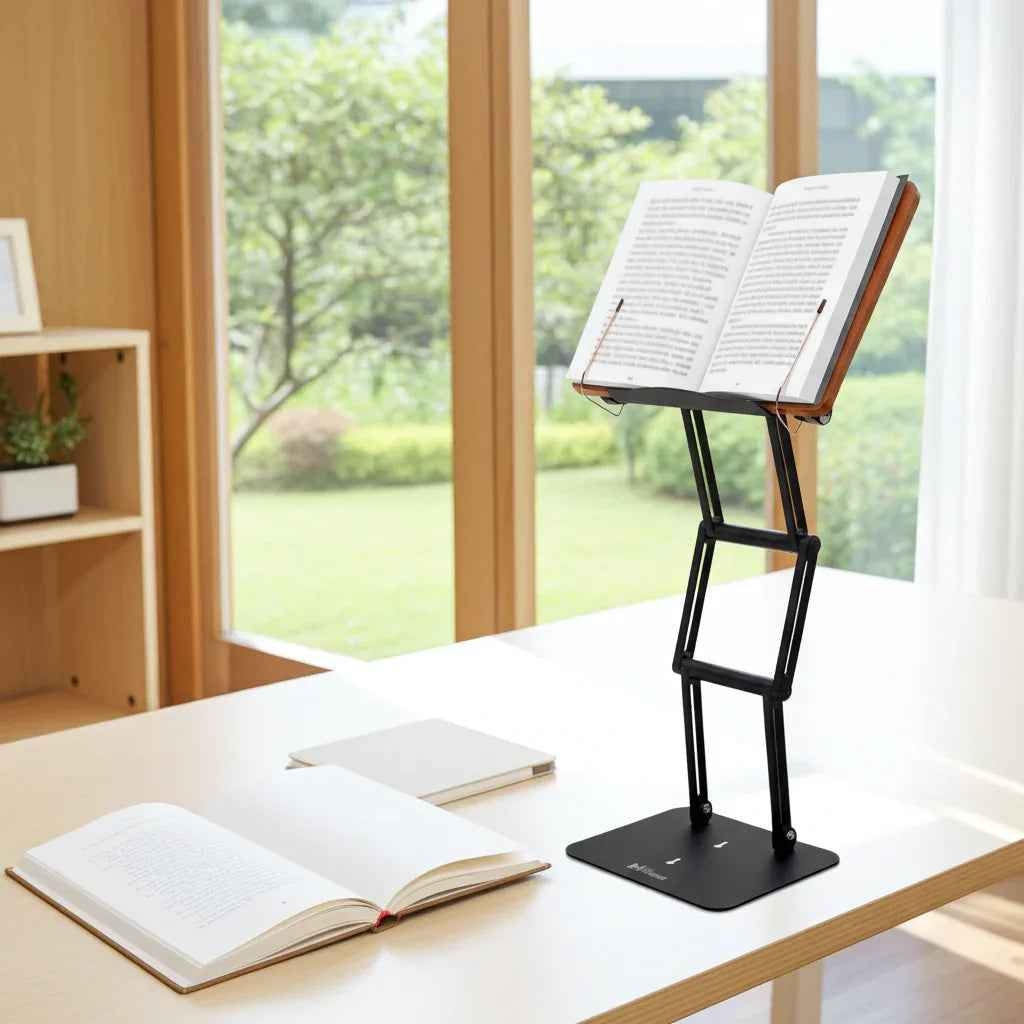
If your desk stand starts wobbling the moment you open a real textbook, you do not have a desk stand. You have a suggestion. This guide to choosing a heavy duty desk stand is for people who spend serious time reading, studying, typing, teaching, or working at a desk and need something that actually holds weight at the right height.
A light tablet prop and a heavy-duty stand solve very different problems. If your goal is better posture, less neck flexion, and a setup that can support long work sessions without constant adjustment, the details matter. Material, elevation range, hinge strength, base stability, and load capacity all affect whether a stand improves your day or becomes another object taking up desk space.
What a heavy-duty desk stand should actually do
A proper stand is not just there to hold an object off the table. It should bring books, laptops, tablets, or documents closer to eye level so your head and neck are not spending hours angled downward. That is where the ergonomic value begins. A small lift can help, but for many users, especially those working with thick books or alternating between seated and moderate standing use, minimal elevation is not enough.
The second job is stability. A stand can have impressive height on paper, but if it shakes when you turn a page or type a paragraph, it interrupts focus and usually gets demoted to a corner. Serious users need a platform that stays planted under load, keeps its angle, and does not require two hands and a prayer every time they reposition it.
The third job is versatility. Many buyers start by looking for a book stand and later realize they also want to hold a laptop, a tablet, sheet music, or a cookbook. The best heavy-duty options handle all of that without feeling like they were designed for only one lightweight use case.
Guide to choosing a heavy duty desk stand by use case
Start with what you need it to support most often. This sounds obvious, but many people buy for the occasional use rather than the daily one.
If you read from large textbooks, legal volumes, binders, or religious texts, prioritize load-bearing strength and page-friendly stability. Heavy books create leverage, not just weight. A stand may claim to hold a device, but thick volumes put more stress on the lip, the tilt mechanism, and the center of gravity. That is where flimsy stands reveal their true character.
If you plan to use a laptop, think beyond whether it fits. Consider whether the stand holds the laptop high enough to improve screen position and whether the platform remains stable during moderate typing or touchpad use. Some people use a raised laptop with an external keyboard and mouse, which is often the most ergonomic arrangement. Others need the stand mainly to elevate the screen during reading, meetings, or reference work.
If your workflow switches between books and devices, look for a stand that does not force compromises. It should support both flat-backed electronics and thick printed material without awkward balancing acts.
Height matters more than most buyers realize
One of the biggest mistakes in this category is assuming that any elevation is ergonomic elevation. It depends on your body, your chair height, your desk height, and whether you want seated use only or some standing flexibility.
A stand that rises just a few inches may improve tabletop clutter, but it may not do much for your neck. For prolonged reading or screen use, the goal is to reduce the amount of downward gaze required. If you are tall, if your desk sits low, or if you want to use the stand while standing at a counter or desk, greater elevation becomes far more valuable.
This is where many commodity stands fall short. They are built for casual tablet viewing, not real work. A stand with substantial height adjustability gives you more control over posture and more ways to use it throughout the day. That flexibility is especially useful for students, scholars, and professionals who spend hours with dense material and cannot afford a setup that locks them into one strained position.
Material and joint construction tell you a lot
If you want a heavy-duty stand, pay attention to what holds the whole system together. Marketing language tends to be generous. Physics is less sentimental.
Aluminum construction generally offers an excellent balance of strength, weight, and long-term durability. It feels more substantial than plastic and tends to hold up better under repeated adjustment. Stainless steel joints are another strong sign, because joints are often the first failure point. That is where sagging, slipping, and wobble usually begin.
Plastic has its place in lightweight accessories, but if you are supporting heavy books or elevating a laptop high above the desk, build quality matters. The higher a stand rises, the more important the engineering becomes. Height without structural integrity is just ambition.
Stability is not a spec sheet word
Buyers often focus on maximum weight capacity, but real stability is more nuanced. A stand can technically hold a load and still be frustrating to use. The questions to ask are practical. Does it stay steady when you turn pages? Does it keep its angle under a heavier item? Does the base feel secure at full extension? Does it shift when you tap a screen or rest your hands briefly on a laptop?
Stability also affects concentration. Scholars, students, and professionals do not need a desk accessory that behaves like a folding TV tray every time they reference a source. Good stability supports good work because it removes friction from the task.
The platform design needs to match real reading and working
Look closely at the lip and platform area. The support edge should be deep and strong enough to hold thicker items without feeling precarious. It should also avoid interfering too much with page visibility or keyboard access.
Tilt range matters too. Reading, typing, and presenting are not the same activity, and they do not always benefit from the same angle. A useful stand lets you adjust the viewing angle with precision, not just flip between two token positions.
For readers of religious or academic texts, the experience should feel natural. A raised study platform has a long tradition because it supports attention, visibility, and physical ease during sustained learning. Modern versions should preserve that function while improving adjustability and durability.
When portability helps and when it hurts
Many shoppers want a stand that is portable. Fair enough. But portable can mean two very different things.
Sometimes it means easy to move around the house or office. That is useful. Sometimes it means ultra-light and foldable to the point that performance suffers. That is less useful if the stand spends most of its life on a desk supporting heavy materials.
If you travel constantly, a lighter design may be worth the trade-off. If your main goal is a dependable workstation for daily use, choose stability first. A serious stand should be movable, but it does not need to feel disposable.
The right stand should fit your workflow, not just your object
A good buying decision starts with the question, What am I trying to improve? For some people, the answer is neck strain. For others, it is focus, desk organization, or the ability to switch between reading and device work without hunching over. The best stand is the one that supports the rhythm of your day.
That may mean a tall adjustable model for seated and standing study. It may mean a durable platform for medical textbooks, law books, or seforim. It may mean a premium laptop riser that can also hold a tablet during meetings and a cookbook in the evening. These are not edge cases. This is how real people use well-designed tools.
One example in this category is the kind of stand built for high elevation, aluminum strength, stainless steel joints, and meaningful support for heavy books and laptops. That approach reflects a simple idea: if posture improvement is the goal, the stand has to do more than hold weight. It has to hold position, day after day, under serious use.
What to avoid when choosing a heavy duty desk stand
Be cautious with stands that rely on vague promises like ergonomic design or universal compatibility without telling you how high they rise, what materials they use, or how they perform under heavier loads. A polished product page can hide a very ordinary stand.
Also be wary of buying based only on appearance. Minimal design looks great until a 1,200-page textbook enters the chat. If your work involves demanding materials and long sessions, function should lead and aesthetics should follow.
The right heavy-duty desk stand feels almost boring in the best way. It holds steady. It adjusts properly. It reduces strain. It supports the work instead of becoming part of the problem. When you find one that does that, you will notice something unusual for desk equipment: you stop thinking about it, and get back to thinking about what is in front of you.