A bright patch on a textbook page can make a perfectly good study session feel like a fight with the room. The instinct is usually to lean closer, squint harder, or crank up the screen brightness. Those moves rarely solve the problem. To reduce glare when reading, you need to control the relationship between your light source, your reading surface, and your eyes.
Glare is more than a small annoyance. It can cause visual fatigue, headaches, loss of concentration, and the familiar habit of bending your neck forward to find a clearer angle. For students working through dense textbooks, professionals reviewing documents, and scholars spending long hours with sacred texts, the better goal is not simply more light. It is useful, even light in the right place.
Why Glare Makes Reading Harder
Glare occurs when light reflects directly into your eyes or creates a sharp contrast between a bright area and the material around it. A glossy page, tablet, laptop screen, laminated handout, or even smooth paper can become reflective under the wrong lamp or window angle.
There are two common forms. Direct glare comes from seeing the light source itself, such as an uncovered bulb, a bare LED strip, or sunlight entering your field of view. Reflected glare appears when light bounces off the page or screen. This is the version that makes a line of text disappear every time you shift your head an inch.
Your eyes respond by working harder to maintain focus. At the same time, many readers unconsciously move closer to the material or angle their head downward. That is where an eye-comfort problem becomes a neck and posture problem. The glare may start at the page, but the compensation often travels straight to the cervical spine.
Reduce Glare When Reading by Fixing the Light First
The strongest reading setup uses ambient room light plus focused task lighting. Ambient light prevents the room from feeling cave-dark around a bright page or screen. A task lamp then illuminates the material without shining into your eyes.
For paper reading, place a lamp slightly to the side and above the book. If you are right-handed, lighting from the left often prevents your writing hand from casting a shadow; left-handed readers may prefer the opposite. The key is to aim the light across the page rather than straight down from directly in front of you. A lamp pointed at your face is not task lighting. It is an interrogation room.
Choose a lamp with a shade, diffuser, or adjustable head. Bare bulbs and exposed LEDs create harsh points of brightness, particularly when you glance up from the page. A warmer or neutral white light is often more comfortable for lengthy paper reading, while a cooler light can feel useful for alert, detailed desk work. Personal preference matters, but extreme brightness rarely helps.
Daylight is excellent until it lands in the wrong place. Position your desk perpendicular to a window when possible. Facing directly into a window can create direct glare, while sitting with the window behind you often reflects light off pages and screens. Sheer curtains, blinds, or shades give you control without turning your workspace into a basement archive.
Avoid the Dark-Room, Bright-Screen Trap
For digital reading, the screen should not be dramatically brighter than the room around it. A tablet or laptop used in a dark room becomes the visual equivalent of staring into headlights. Turn on a nearby lamp or raise the room lighting, then lower the display brightness until it feels clear rather than radiant.
Many devices also offer night modes, warmer color settings, dark mode, and adaptive brightness. These can improve comfort, especially in the evening, but they are not universal cures. Dark mode can reduce overall light output, yet white text on a black background may produce halos or feel less crisp for some readers. Test it with the type of work you actually do, not for thirty seconds in a settings menu.
Change the Angle of the Page or Screen
A small change in angle can eliminate reflected glare immediately. Flat materials are especially vulnerable because overhead light reflects directly upward. Raising and tilting a book, tablet, or laptop changes the reflection path, making the surface easier to see without forcing you to hunch over it.
Start by placing the reading surface at a moderate incline, then adjust it until reflections move away from your line of sight. Do not solve a reflection problem by twisting your torso or cocking your head sideways. The material should adapt to you, not the other way around.
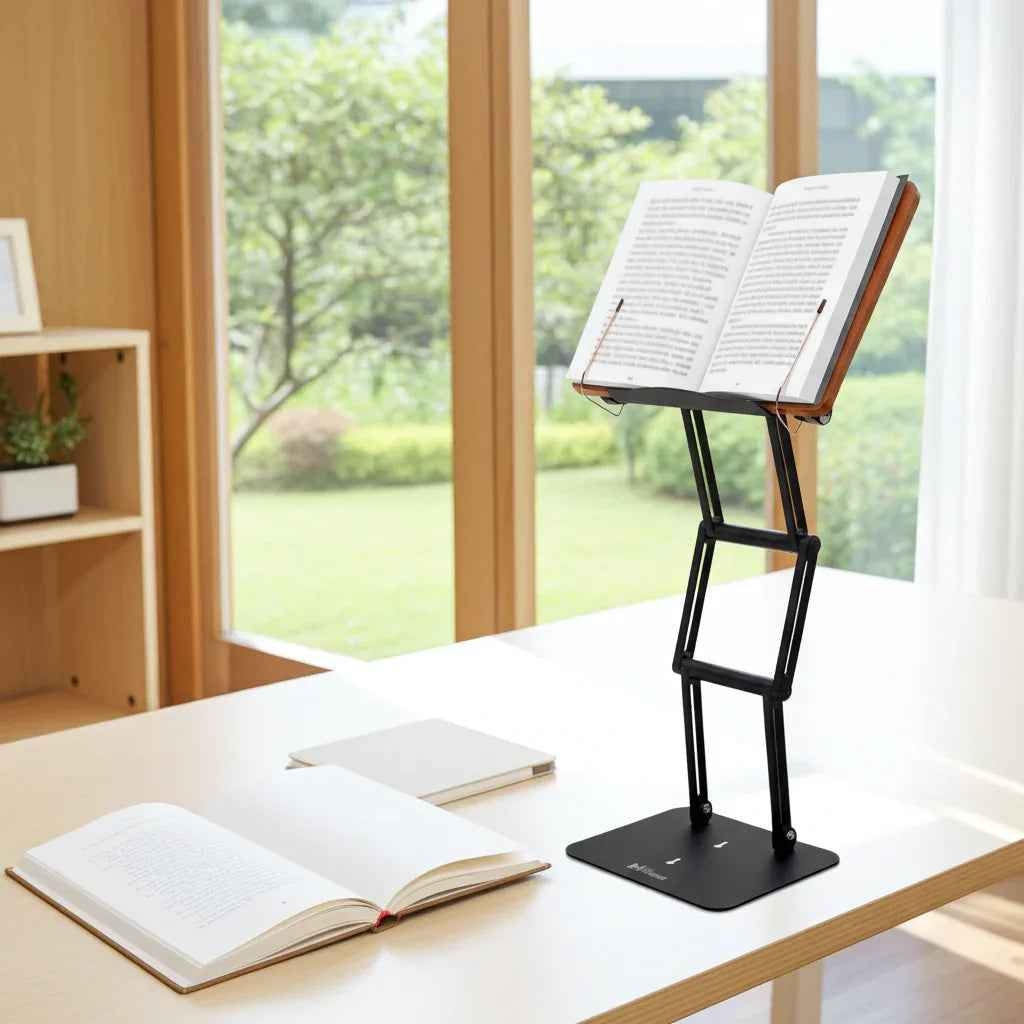
This is also why a stable adjustable stand earns its place in a serious workspace. It lets you elevate material toward eye level while controlling the tilt, rather than stacking books beneath a book and hoping the tower does not develop opinions. The Stander 1.1 raises its support lip up to 17.8 inches above the tabletop, helping readers position textbooks, tablets, laptops, and substantial volumes at a useful height for both seated and moderate standing work.
Height matters because it reduces the temptation to drop your chin toward the page. Tilt matters because it redirects reflections. Together, they create a more readable surface and a more defensible posture.
Manage Glossy Surfaces and Screen Reflections
If glare persists after changing your light and angle, examine the surface itself. Glossy screens provide rich contrast and color, but they are more reflective than matte displays. A matte screen protector can help in a bright office or sunlit home, though there is a trade-off: some protectors slightly soften image sharpness or alter the feel of touch input.
For paper materials, glossy textbook pages, magazines, and laminated sheets may need more deliberate positioning. Move the lamp, tilt the page, or shift your seating position before adding more light. More light on a reflective surface often creates more reflection, not more clarity.
Keep screens clean as well. Smudges scatter light and make glare feel worse, especially on tablets used for annotations. Use a microfiber cloth designed for screens and avoid harsh household cleaners that can damage coatings.
Build a Reading Position Your Body Can Keep
The best glare solution is one you can maintain for an hour, not one that works for five minutes. Your eyes should meet the page or screen with your head balanced over your shoulders. For extended reading, keep your feet supported, shoulders relaxed, and elbows close enough to your body that you are not reaching forward.
If you work with a large textbook, legal binder, siddur, or reference volume, stability is not a luxury. Flimsy stands wobble under weight, slide as you turn pages, and encourage constant adjustment. A sturdy platform lets you keep the material elevated and angled without guarding it with one hand.
For standing reading, bring the material high enough that you are not folding at the waist. Alternate between sitting and standing when your workflow allows. Neither position is magic if held without movement all day, but changing positions can relieve the static load that builds during focused work.
A Quick Glare Check Before You Settle In
Before a long reading block, take thirty seconds to assess the setup. Look at the page or screen from your normal posture. If you see the lamp, window, or ceiling fixture reflected in it, move the light or change the angle. If the room feels dim except for a blazing display, add ambient light and lower the screen brightness. If you are already leading with your chin, raise the material.
These are small adjustments, but they compound. Clearer text demands less squinting. Less squinting reduces the urge to lean in. A better reading angle gives your neck a break while your attention stays where it belongs: on the argument, the assignment, the research, or the page in front of you.
A well-lit reading space should feel almost unremarkable. You should notice the ideas in the book, not the lamp reflected across them.