A 1,000-page casebook has a way of exposing weak equipment. Set it on a light book stand and the stand may flex, slide backward, or settle into an angle you did not choose. Book holders for reading hands free are supposed to remove that distraction. For serious reading, though, the question is not whether a stand can hold a paperback for five minutes. It is whether it keeps a heavy book where you put it for a full evening of study.
That difference matters to law students working through assigned cases, medical students reviewing dense chapters, researchers consulting reference works, and anyone spending a long seder over a full Gemara. A good holder brings the material up to a comfortable working position, frees both hands for notes or page turning, and stays quiet and steady. It should not become one more thing to manage.
What Book Holders for Reading Hands Free Need to Do
Most book holders fall into two broad categories. The first is a simple desktop rest: often wire, plastic, or bamboo, with a fixed footprint and a panel that tilts. These are useful for recipes, a thin paperback, or occasional reading at a table. Their limitation is straightforward: they usually sit only a few inches above the desk.
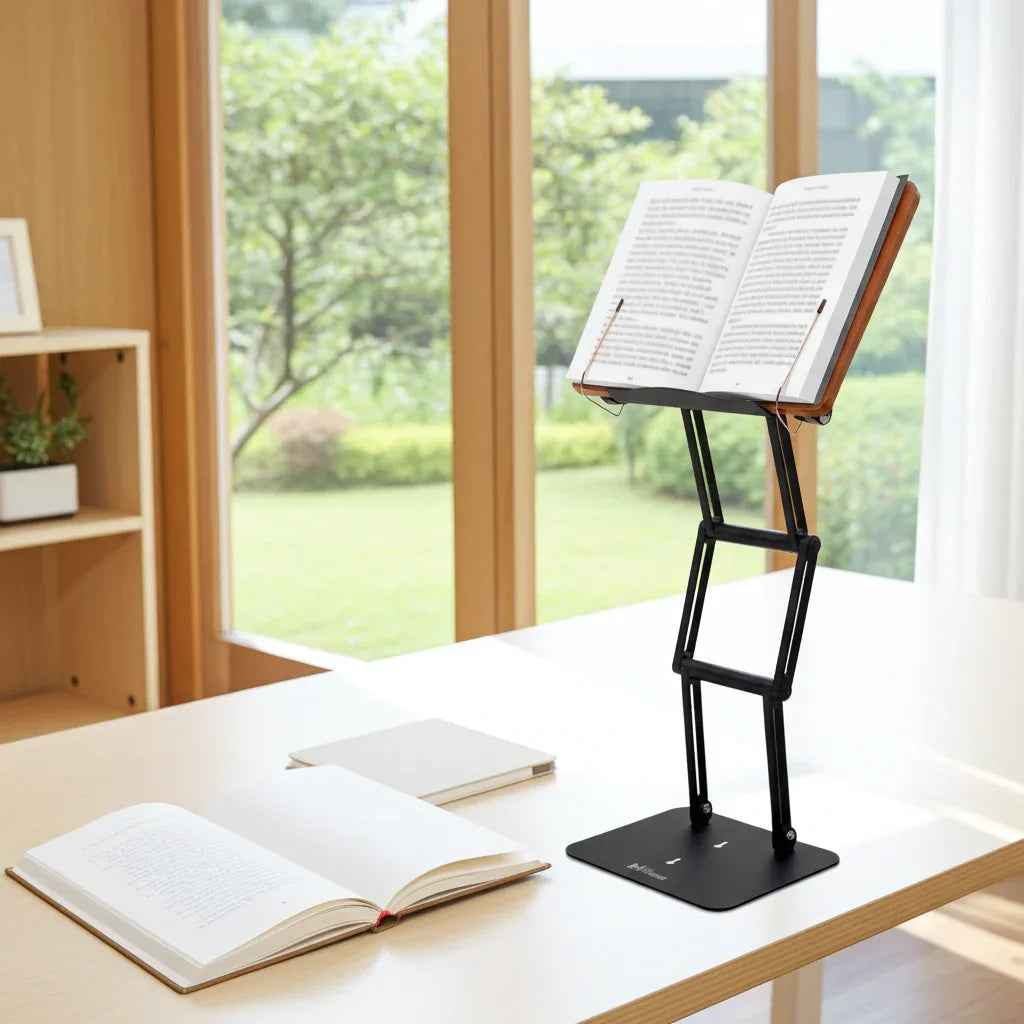
The second category is an adjustable stand designed to raise the book itself. This is the better approach when the work is long, the material is heavy, or the reader needs room for a notebook beneath it. Height is not a decorative feature. A stand that only tilts a book still leaves the reader looking down at the tabletop for hours.
For demanding use, look for four things: meaningful height adjustment, a stable frame, a platform sized for real books, and a way to keep pages open without fighting the stand. Miss one of these, and the stand can feel clever in a product photo but irritating halfway through a chapter.
Height changes the reading position
A tilted book is an improvement over a flat book, but it is not the same as a raised book. If the support point remains near the desk, the reading material remains near the desk. People then compensate by leaning forward, lowering their head, or propping the stand on a stack of books. That last solution is common, unstable, and not much of a system.
For a law student, the practical test is simple: can the stand raise a casebook high enough to read while a legal pad stays usable below it? For a bochur learning a long seder, can a Gemara sit at a natural level without turning the shtender into a balancing act? If the answer is no, a lower-priced tilt stand may be adequate for recipes, but it is not built for the job.
Weight capacity is not a minor specification
Heavy books create leverage. A thick textbook places its weight farther from the stand's center, especially when opened wide. That is why a holder that feels steady with a novel can wobble or tip when asked to carry a full-volume reference work.
Pay attention to both the stated load and the construction behind it. A large platform, a substantial base, secure hardware, and joints that hold their position all matter. So does the material of the frame. Thin wire can work for light use, but it is not a serious answer to a heavy book that will be opened, marked, and repositioned repeatedly.
The same standard applies to page holders. They should keep pages from closing without covering half the text or requiring constant adjustment. A reader should be able to annotate, turn a page, and continue. That is the entire point of hands-free reading.
The Trade-Offs Between Common Book Stand Types
A simple bamboo or plastic stand is light, inexpensive, and easy to store. It can be a sensible choice for a light cookbook or a short reading session. The trade-off is limited height and a tendency to feel less planted under substantial weight.
A wire stand often folds small and works well for occasional travel. It also tends to have a narrow support area and limited resistance to shifting. Put a heavy medical text on one, then start taking notes, and its limits become obvious rather quickly.
A traditional shtender offers presence, space, and a familiar learning posture. For a fixed beis midrash spot or home study corner, that can be exactly right. It is less convenient when your work moves between a desk, dining table, office, or library, and it may not provide the fine height and angle adjustment needed for different users and materials.
An articulated aluminum stand costs more than a basic book rest and weighs more in a bag. Those are real trade-offs. In return, it can serve as a dependable work surface for a heavy sefer, textbook, or laptop, rather than a temporary prop. For people who read intensely several times a week, that distinction tends to matter more than the lowest possible price.
A Practical Setup for Long Reading Sessions
Start by placing the stand on a firm, level surface. Open the book to the section you will actually read, because the balance of a book changes as pages move from one side to the other. Set the angle so the text is easy to scan without the book feeling as if it will slide forward.
Then raise the platform until you can read without repeatedly folding toward the page. Keep a notebook or legal pad in the clear space below the book, not off to the side where you have to twist back and forth. If you are using a particularly thick text, test the setup before starting: turn several pages, write a few lines, and make sure the page holders are secure but unobtrusive.
Do not overcomplicate this. The goal is a stable arrangement that disappears from your attention. If you find yourself catching the book, resetting the tilt, or rebuilding a stack of books every half hour, the setup is failing its basic assignment.
Why The Stander Is Built Differently
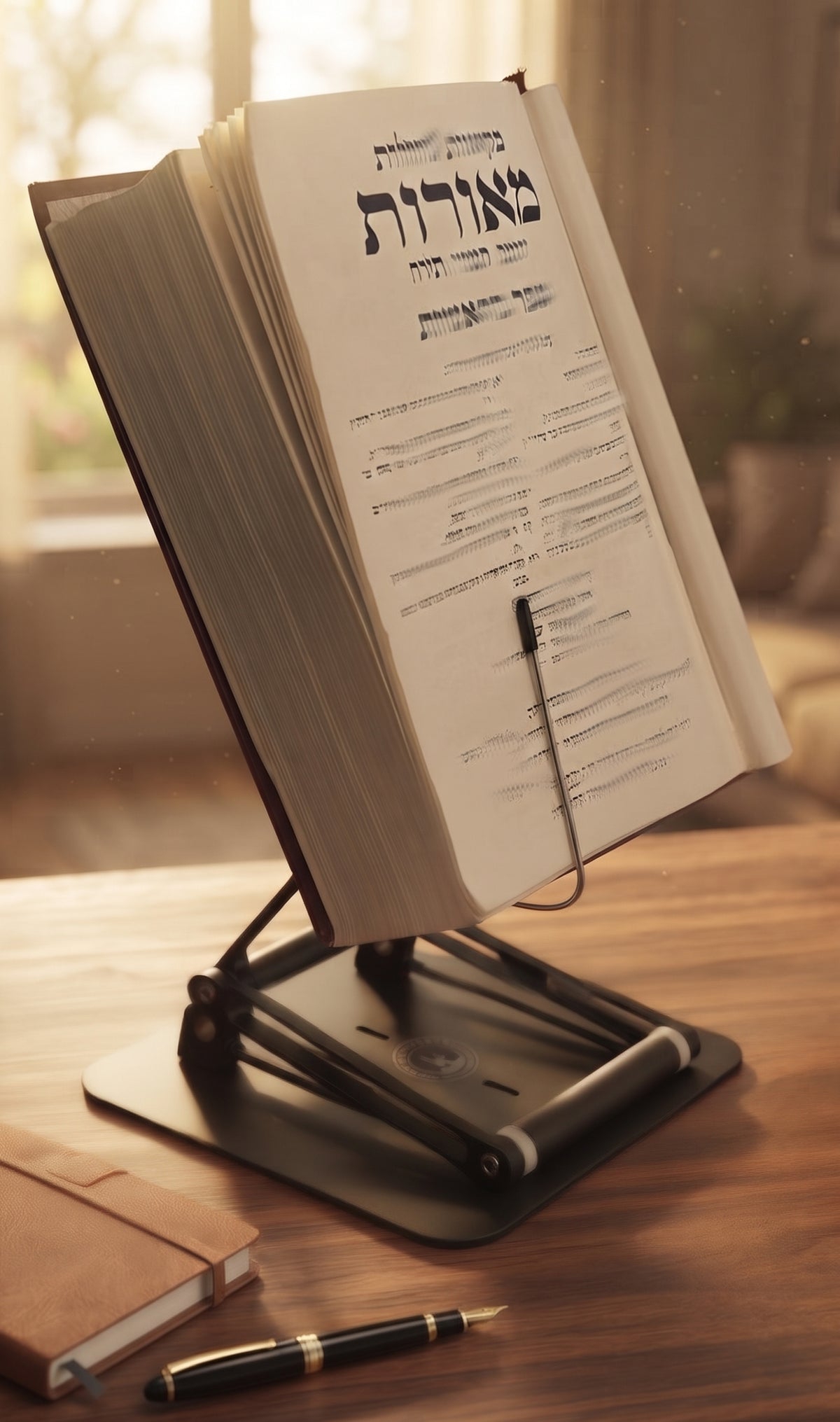
The Stander was built for the gap between a light recipe stand and a permanent piece of furniture. Its 5052 aluminum alloy frame uses stainless steel screws and nuts, with friction joints that hold the chosen height and angle without drifting. It weighs 1.5 kg / 3.3 lb and has been tested with books up to 5 kg / 11 lb - enough for a full Gemara, a law casebook, or a substantial medical textbook.
Its support lip reaches 17.8 in from the tabletop, with the book sitting higher still. That is the key measurement, because it creates a genuinely raised reading position instead of a slightly tilted desktop one. The 32 x 22 cm (12.6 x 8.7 in) wooden platform gives large books a proper base, while adjustable page holders keep them open for reading and note-taking.
It also folds flat to 6.5 cm / 2.6 in, or 10 cm / 4 in including the book lip. That makes it practical to store on a shelf or carry in a bag, though it is plainly not meant to be as weightless as a wire easel. The design favors stability and useful adjustment over clever fragility.
At $95 + shipping in the US, with free 30-day returns, it is not the choice for someone who only needs to prop up a paperback once a month. It is for the person who has learned that long study sessions demand equipment that stays put. It can also serve as a cookbook holder, sheet music stand, or portable lectern, but its real value shows up when the material is heavy and the work is serious.
A book holder should leave you thinking about the case, the sugya, or the next chapter - not about whether the stand is about to give up. If that is the standard you need, see The Stander.