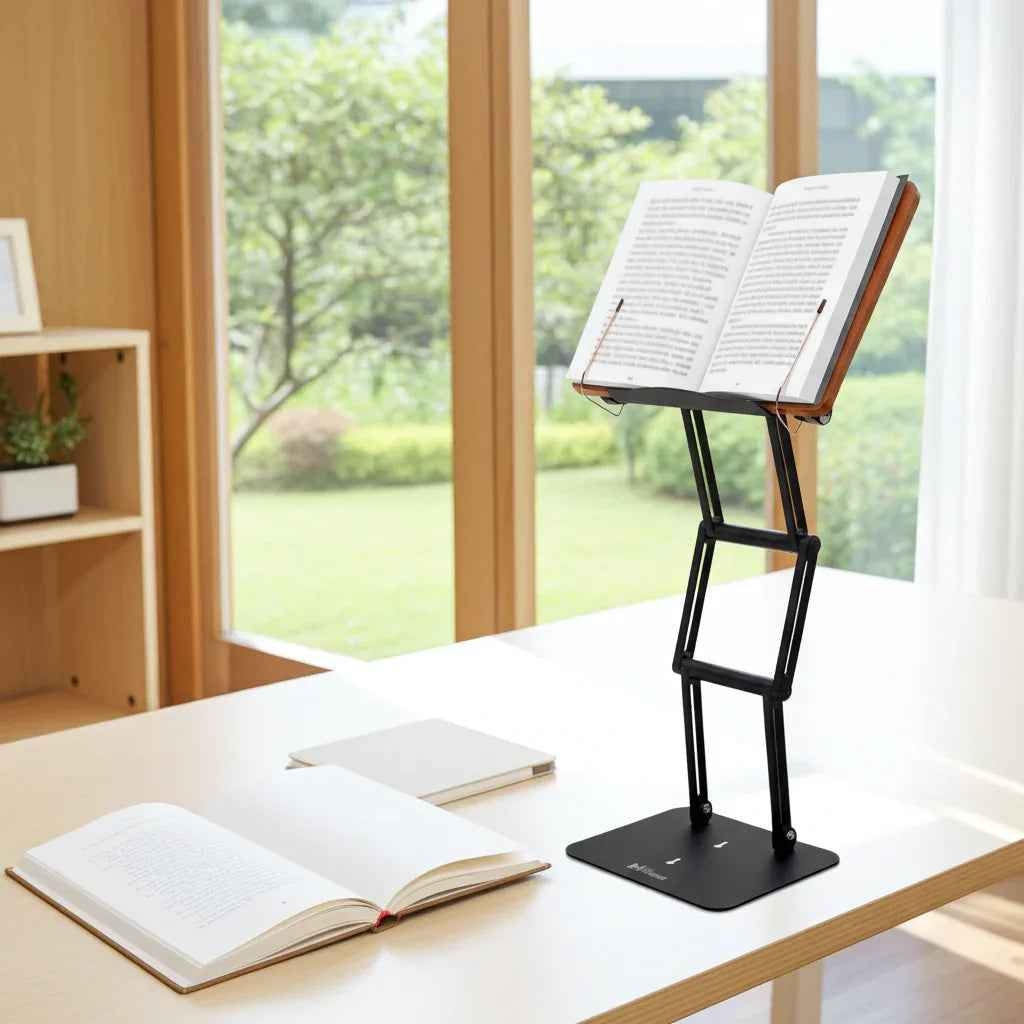
A law student can spot bad desk ergonomics fast - usually around page 843 of a casebook, when the neck starts pulling forward, the shoulders round in, and concentration drops before the reading is done. A good book stand for law school books is not a desk accessory. It is a study tool that helps you hold posture, keep the text in view, and stay engaged through long hours of dense reading.
Law school puts unusual demands on a reading setup. Casebooks are large, heavy, and often physically awkward. Statutory supplements, rule books, and annotated materials add more bulk. If your stand slides, collapses, or sits too low, it stops being useful the moment the workload gets serious. That is why choosing the right stand has less to do with convenience and more to do with performance.
Why law students need more than a basic stand
A lightweight cookbook stand or tablet holder may look fine in product photos, but law school exposes weak equipment quickly. The average casebook is not just heavy. It is wide, thick, and meant to stay open while you brief, highlight, and cross-reference notes. Many low-cost stands are built for occasional reading, not sustained academic use.
The core ergonomic problem is simple. When a book lies flat on the desk, your head drops forward to meet it. That position increases strain on the cervical spine and upper back. Over time, the result is familiar: neck tension, shoulder tightness, headaches, and mental fatigue that arrives earlier than it should. Raising the material closer to eye level helps reduce that forward-head posture and keeps your visual field aligned with your work.
For law students, this matters because the workload is repetitive. You are not reading for ten minutes. You are reading for hours, often while typing notes, marking passages, and preparing for class discussion. Small ergonomic failures become big productivity losses when repeated every day.
What to look for in a book stand for law-school books
The first requirement is stability. If the stand wobbles when you turn a page or shifts under the weight of a casebook, it is not built for legal study. Stability comes from material quality, joint strength, and a base that stays planted on the desk. Heavy books create leverage. Weak hinges and thin supports fail under that pressure.
Height range matters just as much. Many stands angle a book upward but keep it too low, which still forces you to look down. For actual posture improvement, the text needs to rise enough to reduce cervical flexion. The ideal position depends on your desk, chair, height, and whether you are seated or doing some of your reading while standing, but in general, more vertical adjustment gives you a better chance of finding a neutral viewing angle.
The ledge or support lip also deserves attention. Law books are thick, and the lower edge needs a secure resting point that will not let pages slump forward. A stand that works for a paperback may fail with a Torts casebook. Wide support arms, page holders that do not damage paper, and enough depth to hold substantial weight all make a difference.
Then there is workspace efficiency. Law students rarely use just one item at a time. You may have a casebook elevated, a laptop open, a notebook at hand, and a statutory supplement nearby. A stand should make that workflow cleaner, not more cramped. If it can also function as a laptop riser or support tablet-based reading, that versatility matters in a small apartment, dorm, or shared study area.
The trade-off between portability and real support
This is where many students make the wrong call. Portable stands are attractive because they fold flat and cost less. If your use case is occasional reading at a coffee shop, that may be enough. But if you are buying one stand to carry a semester of Civil Procedure, Contracts, and Constitutional Law, portability should not come at the expense of structural strength.
A serious stand is usually a bit larger, heavier, and more mechanically capable. That is not a flaw. It is what allows the stand to hold a heavy book high enough and steadily enough to make a physical difference during study. If you need something for library travel, there is room for compromise. If you need something that lives on your desk and supports daily reading, prioritize load-bearing performance first.
How the right setup improves study endurance
A strong book stand for law school books does more than reduce discomfort. It supports better study mechanics. When the book is elevated and stable, you spend less time repositioning the text and more time reading actively. Your eyes track more naturally. Your hands are freer for notetaking. Your breathing is less compressed because your torso is not folded forward over the desk.
That physical improvement affects mental endurance. Students often describe fatigue as if it is purely cognitive, but posture plays a major role. If your body is under constant strain, attention becomes harder to sustain. Reading speed drops. Retention suffers. You take more breaks, not because the material is impossible, but because the position is wearing you down.
A better setup will not make Property law enjoyable. It can, however, make a three-hour reading block more sustainable.
When a law book stand should also work as a laptop riser
Most law students split time between printed materials and digital work. You may brief cases on your laptop, review outlines on a tablet, and read assignments in hard copy. A stand that only handles books can still be useful, but a multi-use platform often provides better value and a cleaner desk arrangement.
That is especially true if the stand has enough structural integrity to support both dense textbooks and a laptop at eye level. Many products claim to do both, but the details matter. A flimsy frame that shakes under typing or sags under a heavy text is trying to cover too many categories without excelling in any of them.
Well-built adjustable stands solve a real workflow problem. They let you switch from reading to writing without rebuilding your desk every time. For serious students, that continuity helps maintain focus.
Why premium construction matters in legal study
There is a category difference between a casual reading stand and a professional-grade study stand. Law school makes that difference obvious. Heavy books stress the joints. Frequent adjustments test the hinges. Daily use exposes low-end materials fast.
Premium construction is not about appearance alone. It affects how confidently the stand holds position, how long it lasts, and whether it keeps performing after months of real use. Durable metal joints, rigid supports, and a stable base are the features that protect both your posture and your study rhythm.
This is one reason some students eventually move away from commodity stands and choose a higher-capacity option such as The Stander 1.1. The appeal is not novelty. It is the combination of elevation, stability, and enough structural strength to handle demanding books and modern desk work in the same footprint.
A few buying mistakes to avoid
Students often underestimate book weight, overestimate the usefulness of a low-angle stand, and ignore adjustability until after the purchase. If a stand cannot raise the text meaningfully, it may reduce glare or desk clutter, but it will not do much for neck strain.
Another mistake is focusing only on the stand in isolation. Your chair height, desk height, and reading habits all shape the outcome. Even the best stand works best when the screen or page is high enough, the shoulders stay relaxed, and the elbows are not forced into an awkward reach.
Finally, do not confuse simple with durable. Some minimalist stands are engineered well. Others are just undersized. For law school, the question is not whether the stand looks clean. It is whether it holds a loaded book steadily at the height you need, every day.
Improve Your Setup
If you're looking to elevate your law books, tablets, or laptops to a more comfortable reading position, an adjustable stand can make a significant difference.
Choosing the right stand for your study style
If you mostly read at one desk for long sessions, choose a stand built for maximum stability and elevation. If you move between home, class, and library constantly, you may accept a little less height in exchange for portability. If you read both printed casebooks and digital materials, a stand that handles books, tablets, and laptops will usually serve you better over time.
The right choice depends on how serious your reading load is and how much strain your current setup creates. For many law students, the tipping point comes when discomfort starts interfering with concentration. At that point, a stronger stand is no longer a nice upgrade. It becomes part of a better working system.
Law school already asks enough from your attention. Your setup should support that effort, not quietly drain it every evening you sit down to read.
Other Related Blogs:
Best Adjustable Textbook Holder for Studying
How to Study Longer Without Neck Pain
Want to Work Smarter? The Talmud's 3-Step Secret to Health and Focus