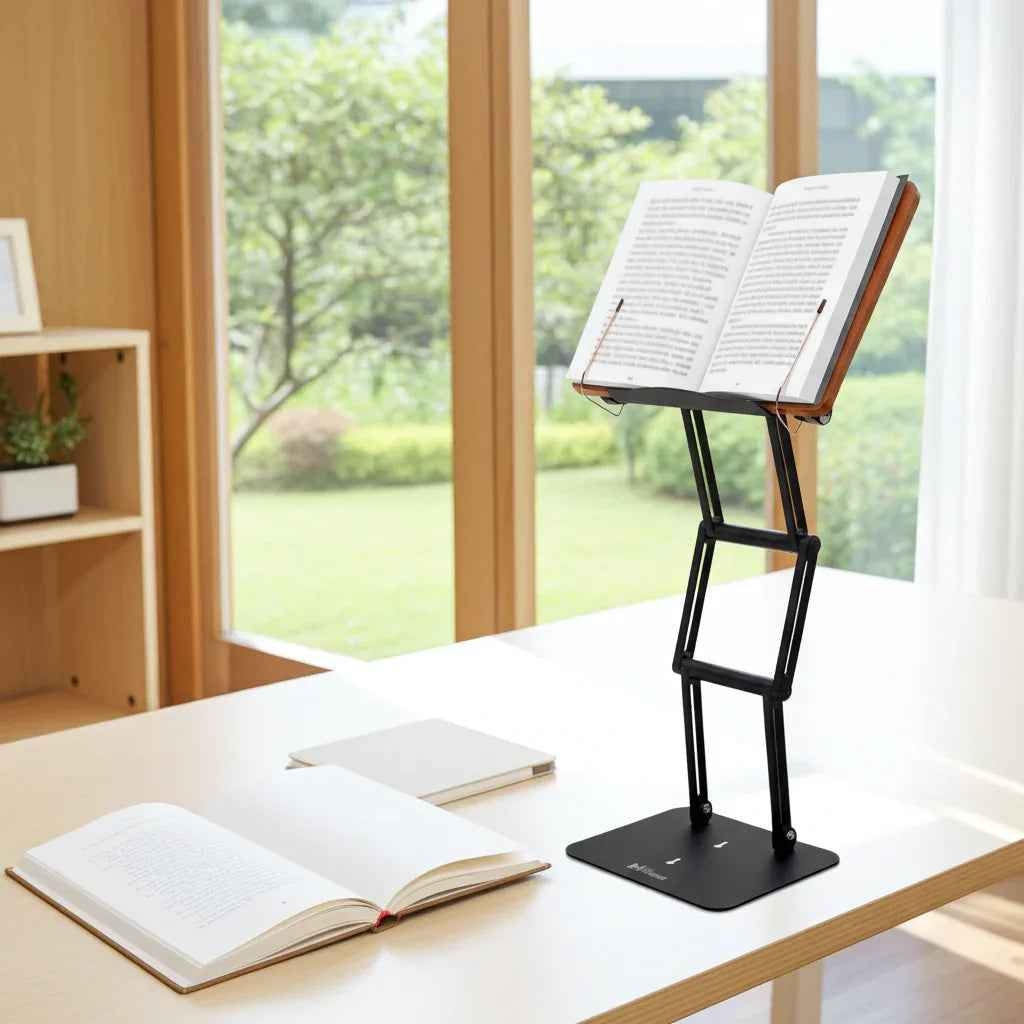
A long study session usually starts with good intentions and ends with your neck drifting forward, your shoulders rounding, and a heavy textbook lying flat where your body has to chase it. An adjustable textbook holder for studying changes that geometry. Instead of forcing your eyes and cervical spine downward for hours, it raises the page closer to eye level and creates a setup that supports focus instead of fatigue.
That sounds simple, but the difference is not minor. For students, researchers, and serious readers, textbook position affects posture, reading endurance, note-taking flow, and even how long a desk session remains productive before discomfort takes over. The right stand is not desk decoration. It is a performance tool.
Why an adjustable textbook holder for studying matters
When a book sits flat on a desk, your neck flexes forward to meet it. Over time, that repeated posture can load the cervical spine, tighten the upper trapezius, and contribute to the familiar combination of neck stiffness, shoulder tension, and mental drag. Most people notice the pain first, but the productivity cost shows up earlier. You reread lines. You fidget. You lose your place. You shorten sessions because your body is asking for relief.
An elevated holder improves the visual angle between your eyes and the page. That helps you sit taller, keep your chest more open, and reduce the constant downward collapse that long reading sessions encourage. If you annotate, compare sources, or work between a textbook and a laptop, it also reduces the awkward twisting and hunching that happens when one device is high and the other is low.
There is a reason scholars have used raised reading platforms for generations. The traditional shtender was not merely ceremonial. It was practical. It recognized that serious study requires a stable reading surface at a better angle than a flat table can provide.
What separates a serious textbook holder from a flimsy stand
Not every book stand is built for textbooks. That distinction matters more than product photos suggest. Many low-cost stands are designed for tablets, thin paperbacks, or occasional cookbook use. They can look acceptable until you place a dense chemistry book, legal text, or oversized academic volume on them. Then the weaknesses show up quickly.
The first issue is stability. A stand that wobbles under load creates small but constant distractions. The second is height range. Many products tilt, but do not elevate enough to make a real ergonomic difference. The third is joint strength. If the hinge slips under weight, the angle you set is not the angle you keep.
A serious adjustable textbook holder for studying should support heavy materials without sagging, maintain its position through long sessions, and rise high enough to bring the text meaningfully closer to eye level. Those are functional requirements, not premium extras.
The features that actually improve study performance
Height adjustment matters most when your goal is posture correction rather than simple convenience. A low stand with a few tilt settings may slightly improve readability, but it will not fully address forward head posture. The more useful approach is a stand with enough vertical lift to raise the page into your natural line of sight while you remain seated upright.
Angle adjustment matters because not all study tasks are the same. Reading dense material, copying notes, reviewing diagrams, and working from a source while typing each call for a different page angle. Fine control is better than fixed presets because your body, desk height, and chair height all affect the ideal position.
Load capacity is often overlooked until it becomes a problem. Heavy textbooks, religious volumes, binders, and large reference books demand a stand with real structural integrity. Lightweight stands tend to flex or drift under that pressure. A stronger frame with durable joints gives you confidence that the platform will hold where you place it.
Page support is another practical detail. A good holder keeps thick books open without fighting you. If the page clips are too aggressive, turning pages becomes irritating. If they are too weak, the book closes or shifts while you read. The best design disappears into the workflow. You stop thinking about the stand and stay with the material.
How to choose the right adjustable textbook holder for studying
Start with what you read most often. If your books are large, heavy, or used daily for extended sessions, choose a stand built around structural strength first. Thin portable stands may seem convenient, but they often fail the moment serious academic use begins.
Next, look at your desk habits. If you switch between reading and typing, you need enough elevation to align the book with your screen or at least reduce the gap between them. If you handwrite notes beside the text, make sure the stand does not consume your entire work surface. The right choice depends on whether your desk setup is static or constantly shifting.
Then consider session length. For occasional review, a basic angled platform may be enough. For medical students, graduate researchers, legal professionals, and anyone spending multiple hours a day with dense materials, a more substantial stand is usually the better investment. Long sessions expose every design weakness.
Finally, be honest about whether you want portability or permanence. There is always a trade-off. Ultra-light stands travel more easily, but they rarely offer the same stability, height, or load-bearing performance as a heavier-duty model. If your main goal is neck strain reduction at a primary desk, performance should win.
A textbook holder should work with your full desk setup
The best results do not come from a stand alone. They come from alignment across the desk. Your chair should allow your feet to rest flat. Your elbows should stay near a comfortable 90-degree bend when writing or typing. And your reading material should sit high enough that your eyes move more than your neck.
If you use a laptop, an elevated stand can also help unify your workspace. One of the most frustrating desk problems is switching between a low textbook and a slightly higher screen, which creates repeated nodding and twisting. A more capable stand can function across multiple tasks, supporting books, tablets, and even laptops depending on the design. That versatility matters for modern study because most people no longer work from a single format.
This is where premium engineering earns its value. A stand that supports both heavy books and screen-based work eliminates the need for multiple unstable accessories crowding the desk. Fewer compromises usually lead to better posture and better concentration.
Who benefits most from a premium stand
College and graduate students are obvious candidates, especially in disciplines built around large texts and long reading blocks. Researchers and academics benefit because source comparison becomes easier when materials are elevated and stable. Professionals working with manuals, contracts, or reference books also gain a more sustainable desk posture.
There is also a clear fit for religious study. Raised platforms have long been part of serious textual engagement, and the modern shtender remains relevant because the physical demands of studying sacred texts are no different from any other prolonged reading task. Stability, angle, and endurance still matter.
For all of these users, the common thread is simple. Casual reading can tolerate casual tools. Serious study cannot.
When a cheaper stand is enough - and when it is not
There are cases where a lower-cost option is perfectly reasonable. If you read light materials, use the stand occasionally, or need something temporary for travel, a simpler product may cover the basics. Not every desk requires a heavy-duty platform.
But if you are dealing with recurring neck discomfort, heavy books, long hours, or a daily study routine, a bargain stand often becomes a false economy. It slips, shakes, sits too low, or fails under weight. You replace it, work around it, or stop using it. None of those outcomes saves money.
A better stand costs more because it solves harder problems. It must hold real weight, maintain height, resist joint fatigue, and support repeat use over time. That is the difference between a study accessory and a piece of ergonomic equipment.
What to look for before you buy
A few questions make the decision clearer. Can the stand raise the book high enough to reduce downward gaze in a meaningful way? Will it stay fixed under the weight of a heavy textbook? Does it offer enough angle control for reading, note-taking, and cross-referencing? And does it fit your desk without creating a new clutter problem?
If the answer to those questions is yes, you are looking at a stand that can genuinely improve how you work. If not, it may still hold a book, but it will not do much for your posture or your endurance.
For readers who want one platform that supports textbooks, digital devices, and long hours of focused work, Dr. Shtaygen’s approach stands out because it treats the stand as a serious ergonomic tool rather than a lightweight accessory. That distinction is exactly what many desks are missing.
A good study setup should let your mind stay with the material instead of negotiating with your neck, shoulders, and back every twenty minutes. When a textbook is finally where it belongs, the work feels lighter even when the book is not.
Improve Your Study Setup
If you're looking to elevate books, tablets, or laptops to a more comfortable reading position, an adjustable stand can make a significant difference.
Other Related Blogs:
Best Book Stand for Law School Books
How to Study Longer Without Neck Pain
Want to Work Smarter? The Talmud's 3-Step Secret to Health and Focus