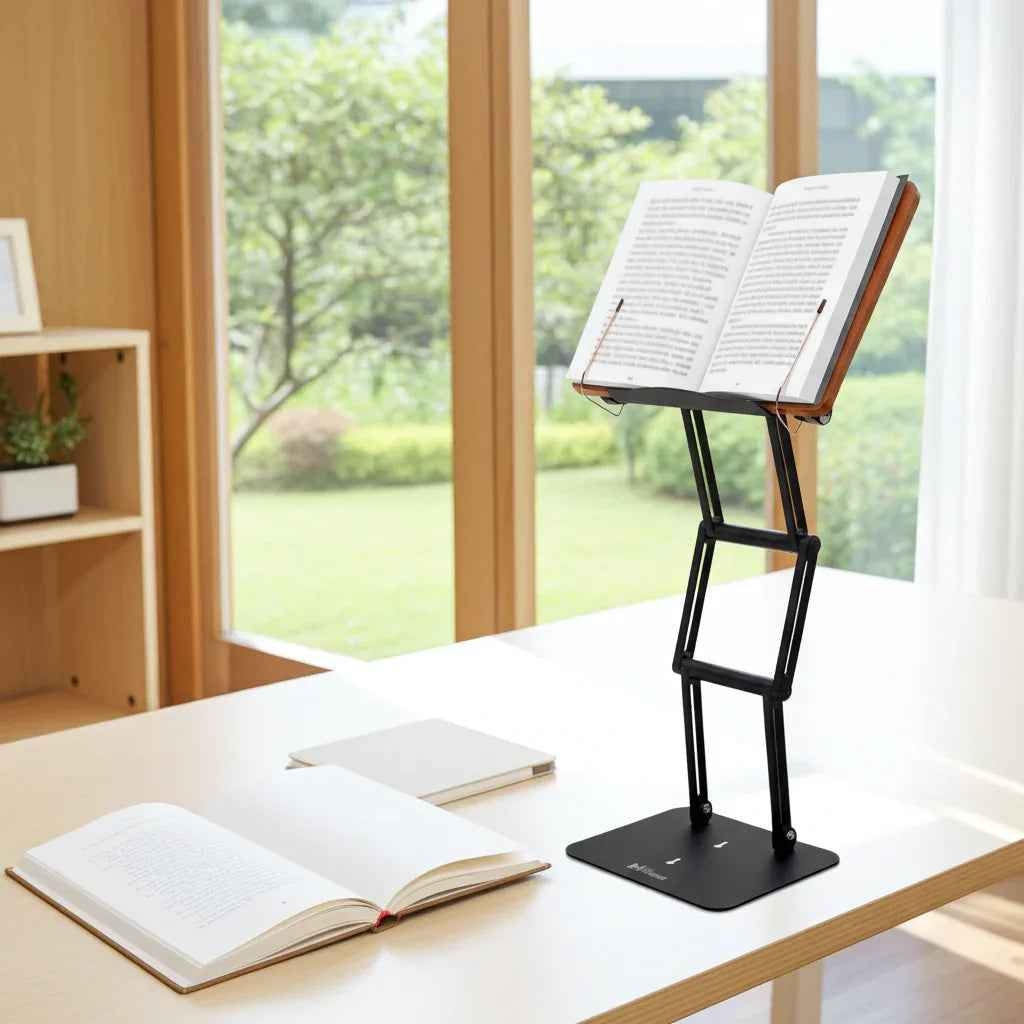
A 900-page legal treatise, medical reference, technical service manual, or sacred text does not behave like a paperback novel. It pulls forward, resists staying open, consumes desk space, and invites the familiar posture of leaning down until your neck begins protesting. A book stand for reference manuals solves a practical problem first: it puts the material where you can actually read it. Done properly, it also changes how your body holds up through the work.
For serious readers, the stand is not a decorative desk accessory. It is working equipment. The right model needs enough strength for real books, enough elevation for an upright viewing angle, and enough stability that turning a page does not become a small engineering project.
Why Reference Manuals Need a Different Kind of Stand
Reference manuals are demanding by design. They are often oversized, heavy, densely printed, and consulted repeatedly rather than read straight through. You may be checking a table, comparing diagrams, making notes, or moving between a volume and a computer screen every few minutes. A light tablet prop might hold the book for a moment, but it is rarely designed for this rhythm of use.
The first issue is weight. Thick textbooks and bound manuals place real load on the support lip, back plate, hinges, and base. A stand that flexes or shifts under that load is distracting at best. At worst, it creates an expensive and irritating crash onto the desk.
The second issue is page control. Reference books commonly have stiff bindings and pages that spring upward near the beginning or end of the volume. A useful stand needs a broad, secure lower ledge and a reading surface that supports the book evenly. Depending on the book, page holders can help, but they should not press so aggressively that they obscure diagrams or damage pages.
Then there is height. A manual placed at a shallow angle may reduce some forward bending, yet it still leaves your eyes aimed downward. The greatest posture benefit comes when the text moves closer to eye level. That makes the neck’s job easier and helps keep your chest open rather than collapsed toward the desk.
What to Look for in a Book Stand for Reference Manuals
The best choice depends on the size of your books, the height of your desk, and whether you work sitting, standing, or both. Still, several features separate a serious stand from a temporary workaround.
High elevation, not just a tilted surface
Many book stands offer a few angle settings but remain close to the tabletop. That can be helpful for handwriting, but it does little for someone who spends hours reading source material. For extended reading, vertical adjustment matters as much as tilt.
A stand that raises the support point substantially above the desk lets you position a manual higher without stacking books, boxes, or whatever office supplies happen to be nearby. That is especially valuable when alternating between seated work and moderate standing. Your screen or book should meet your eyes more than it demands that your neck meet it.
A base that stays planted
Heavy manuals create leverage. The farther a book sits from the stand’s center of gravity, the more a weak base can wobble or tip. Look for a broad footprint, quality joints, and a frame that does not feel flimsy when adjusted.
Aluminum construction and stainless steel joints are meaningful here because they address long-term use, not just first-day appearance. A stand should hold its position under a loaded book without slowly drooping. If you are using a reference volume while taking notes, even minor movement becomes surprisingly disruptive.
A support lip built for thick books
The lower lip is easy to overlook until it is too shallow. A thick manual needs enough ledge depth to sit securely, particularly when opened near the middle where its weight is distributed unevenly. A properly designed lip also keeps the book from creeping forward as you turn pages.
Check the usable surface dimensions as well. A stand may technically support a large book while leaving the edges poorly supported. For an occasional paperback, that may be fine. For a costly professional text you use every day, full and stable support is the better standard.
Adjustments you can make without losing your place
A stand should adapt to your work, not interrupt it. Smooth height and angle adjustments make it easier to switch from reading a manual to reviewing a laptop, tablet, recipe, or sheet music. The adjustment mechanism should feel deliberate and secure, not loose, fussy, or dependent on tiny plastic parts.
This versatility matters because most serious desks serve more than one purpose. The same platform may hold a chemistry textbook in the morning, a laptop for a meeting in the afternoon, and a siddur or sefer during evening study. The old-fashioned shtender understood the value of bringing a text upward. A modern version should add the precision and durability demanded by contemporary work.
Set Up Your Stand for Better Reading Posture
Even an excellent stand cannot compensate for a poor setup. Start by placing the manual directly in front of you instead of off to one side. When your primary reference sits at an angle, your neck tends to rotate toward it for hours. That is a quiet way to accumulate discomfort.
Raise the book until the upper portion of the page is near your natural line of sight. You do not need to force your eyes to the exact top edge of every page, especially with a large volume. The goal is to reduce the amount of neck flexion required to read comfortably. If you find yourself repeatedly lowering your chin toward the text, the book is still too low.
Use the tilt setting based on the task. A more upright angle is usually better for sustained reading. A slightly lower angle may be preferable when copying notes, following diagrams, or working with a manual that requires frequent page marking. It depends on whether your priority is viewing, writing, or switching between both.
Keep the rest of the desk honest. If the stand gives your manual a clear position but your keyboard is too far away, you may trade neck strain for reaching through your shoulders. Place frequently used tools within easy reach, and consider using a separate keyboard and mouse when your laptop is elevated. Better posture is a system, not a single purchase.
When a Compact Stand Is Enough, and When It Is Not
A simple folding stand can be perfectly sensible for light reading, travel, recipes, or a slim workbook. It takes up little space and may offer enough angle adjustment for short sessions. There is no need to bring industrial-grade equipment to every airport lounge.
But compact stands have limits. They generally sit low, carry less weight, and provide less stability as books get larger. If your work involves coding manuals, legal binders, graduate-level textbooks, religious study volumes, medical references, or large-format instructional books, those limits show up fast.
That is where a heavy-duty adjustable stand earns its place. The Stander 1.1 raises the support lip 17.8 inches above the tabletop, with the book itself sitting even higher depending on its size. Its aluminum structure and stainless steel joints are designed for users who need a steady platform for substantial texts, not another fragile accessory that gives up when the reading gets serious.
A Better Desk Is One You Can Use Longer
The point of raising a reference manual is not to create a showroom desk. It is to preserve attention. When your book stays open, visible, and stable, you spend less time repositioning it and less time unconsciously folding yourself over it.
A good book stand for reference manuals respects the fact that serious reading is physical work. Give the book a stable place, give your neck a better angle, and let the hours belong to the material rather than the discomfort.