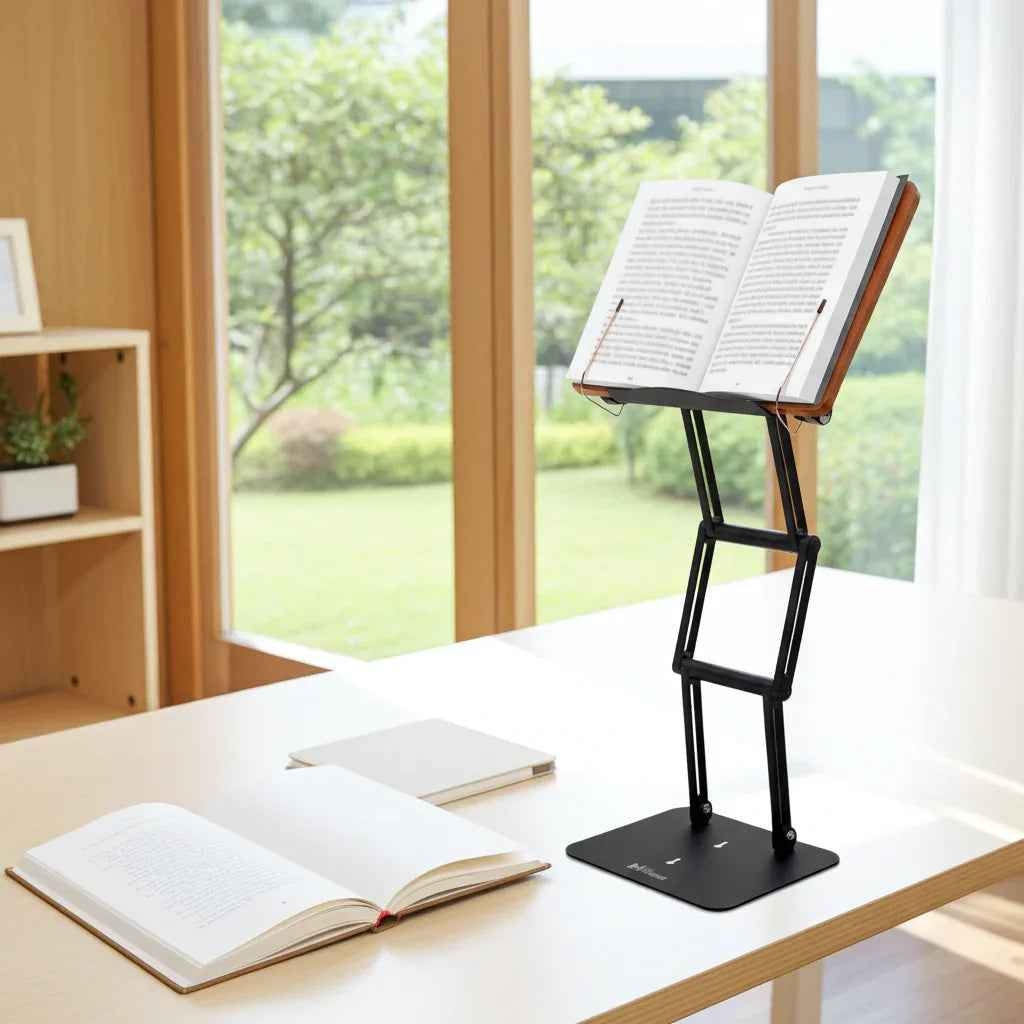
A thick textbook on a weak stand tells you everything you need to know in about ten seconds. The tray dips, the hinge shifts, the page clips feel flimsy, and your head starts dropping forward to compensate. A premium aluminum book stand solves that problem at the source by doing what cheap stands rarely do well - holding weight steadily at eye level for hours, not minutes.
For anyone who reads, studies, annotates, or works at a desk for long stretches, that difference is not cosmetic. It changes posture, concentration, and how much strain accumulates in the neck and upper back. If your daily workflow includes textbooks, legal materials, religious texts, binders, sheet music, tablets, or even a laptop, the stand under that material becomes part of your ergonomic setup, not a minor accessory.
What makes a premium aluminum book stand premium
The word premium gets used loosely. In this category, it should mean better engineering, better materials, and better performance under real load. A true premium aluminum book stand is built to stay stable at useful heights, resist wobble while turning pages or typing nearby, and support heavier reading materials without gradual sagging.
Aluminum matters because it offers a strong balance of rigidity, durability, and weight control. A well-made aluminum structure can feel substantial without becoming awkward to reposition. More importantly, quality aluminum joints and support points tend to hold adjustment better than the thin plastic hinges found in commodity stands. That shows up in daily use. You set the angle you need, and it stays there.
Premium also means the stand is designed for serious reading posture, not just occasional device viewing. Many low-cost stands are really tablet props with a broader marketing label. They may look acceptable in product photos, but once you place a dense textbook or large hardcover on them, their limitations become obvious.
The ergonomic case for a premium aluminum book stand
Most reading strain begins with a simple habit: looking down for too long. The farther the head drops forward, the more load the cervical spine and surrounding musculature must manage. That load does not stay local. It often spreads into the shoulders, upper back, and even the forearms as posture collapses around the task.
A premium aluminum book stand helps by lifting the page or screen closer to eye level. That allows a more upright spine, a more neutral neck position, and less repetitive flexion throughout the day. For students in long study sessions, professionals reviewing documents, and scholars working through dense texts, this is not a small comfort upgrade. It is a practical way to reduce avoidable strain.
That said, ergonomics is not one-size-fits-all. The ideal height depends on your chair, desk, body proportions, and whether you are primarily reading, writing, or alternating between the two. A stand should adjust enough to support your posture without forcing your shoulders upward or placing the material so high that your gaze becomes awkward. Good ergonomic design creates options. It does not lock you into one narrow setup.
Premium aluminum book stand for serious work
The best reason to choose a premium aluminum book stand is performance under demanding use. Serious users need stability more than novelty. A stand for occasional recipes or a short video call has very different demands than a stand used for four hours of reading, note-taking, cross-referencing, and page turning.
Students working with heavy textbooks need a tray and lip that can handle real weight. Academics and researchers often move between books, printouts, and tablets throughout the day, which means the stand must adapt without feeling delicate. Religious scholars using a raised study platform need dependable elevation and a respectful sense of permanence - something closer to a modern shtender than a disposable accessory.
This is where premium construction earns its place. Better hinges, stronger support arms, and a more stable base reduce micro-movements that interrupt focus. You may not notice those small shifts in the first minute, but over a long session they matter. A stand that holds position lets you keep attention on the text rather than on the hardware.
Why cheap stands often fail
The most common failure in low-end stands is not dramatic breakage. It is gradual underperformance. The angle slips. The platform bounces when you touch the page. The height range sounds impressive but becomes unstable near the top. The base footprint is too small, so the whole setup feels nervous under load.
These trade-offs are predictable because the product is built to hit a price point, not to support sustained intellectual work. Thin materials can reduce manufacturing cost, but they also reduce confidence. Once a stand starts feeling unreliable, users tend to lower it, hunch more, or stop using it altogether.
A premium stand costs more upfront, but the comparison should be made against hours of use, not just shelf price. If it becomes a daily tool for reading, working, studying, and holding multiple types of material, the value shifts quickly. The better question is not whether a premium stand is cheaper than a basic one. It is whether a basic stand can do the job you actually need done.
The features that matter most
Not every advertised feature has equal value. For a serious desk setup, the most important traits are structural stability, elevation range, angle adjustability, and support for heavy materials. If a stand can reach eye level but shakes while you use it, the headline feature loses practical value.
Material support is equally important. A useful stand should handle more than one format well. Books with thick spines, large hardcovers, legal pads, tablets, and laptops all place different demands on the tray and support structure. Page holders should secure content without becoming annoying during frequent page turns. The platform should feel wide and planted, not like a narrow ledge pretending to be versatile.
Finish and build quality matter too, especially in a product that stays visible on your desk. A premium aluminum book stand should look clean and intentional, with smooth adjustment and durable contact points. Premium is partly about aesthetics, but in this category aesthetics should reflect engineering discipline, not distract from it.
One stand, multiple workflows
A strong stand becomes more useful as your day changes. You might begin with a textbook in the morning, use it as a laptop riser in the afternoon, and switch to a tablet or printed reference material later on. That versatility is valuable when the transitions feel natural rather than compromised.
Still, there is a difference between being multifunctional and being mediocre at everything. Some stands claim to do it all but perform well at none of it. The better approach is a stand designed around core ergonomic principles first: elevation, stability, and adjustability. Once those are done well, multiple use cases become a real advantage.
That is why products like The Stander 1.1 appeal to readers and professionals who expect more from their equipment. The appeal is not novelty. It is that one well-built platform can support posture correction and serious daily use across books, laptops, tablets, and study materials without feeling temporary.
Who benefits most from a premium aluminum book stand
This kind of stand is especially valuable for people who spend long hours in text-heavy work. Students in graduate programs, attorneys, clinicians, engineers, clergy, researchers, and committed readers often work with heavy or large-format materials that punish weak hardware. For them, the stand is part of maintaining output and comfort over time.
It is also a smart choice for anyone already noticing neck tension, shoulder tightness, or fatigue from looking down. A stand will not fix every ergonomic problem by itself. Chair height, monitor placement, keyboard position, and movement habits still matter. But raising the material you read most often can remove one of the most persistent stressors in a desk setup.
If your use is occasional and light, a simpler stand may be enough. But if your reading is central to your work, or if you routinely support substantial materials, premium construction is usually the better fit.
How to judge the right stand for your desk
Start with your heaviest and most frequent use case. If you mainly read dense textbooks or large religious volumes, choose for weight support and stability first. If you alternate between books and a laptop, focus on elevation range and adjustment quality. If your desk is compact, pay attention to footprint and how easily the stand integrates with writing space.
Then consider duration. A stand that feels acceptable for twenty minutes may feel inadequate after two hours. Stability, viewing angle, and ease of repositioning become far more important as session length increases. Serious work exposes weak design quickly.
The right stand should feel like part of a disciplined workspace - supportive, reliable, and built for repetition. When your reading tool holds steady, your posture improves, your desk feels more intentional, and your attention has one less reason to drift. That is a worthwhile upgrade for anyone whose best work begins with a page in front of them.