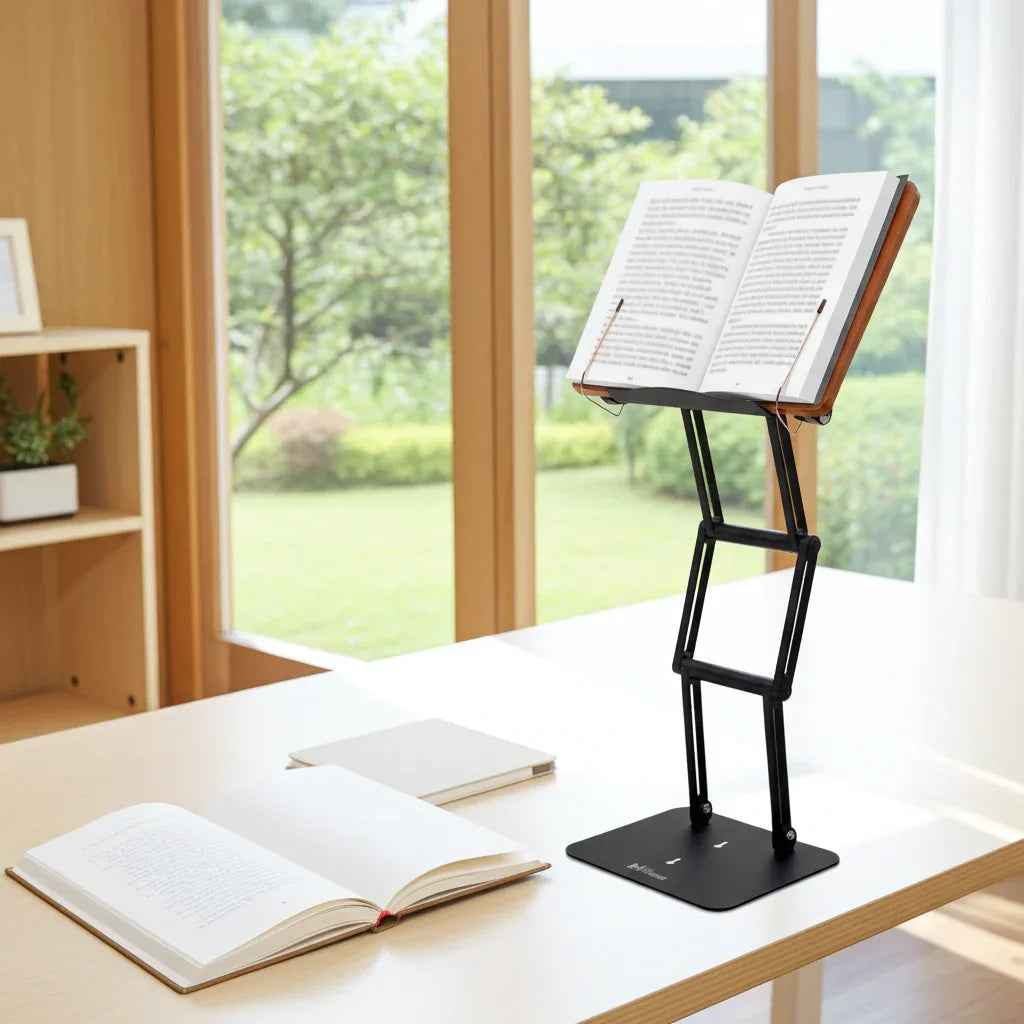
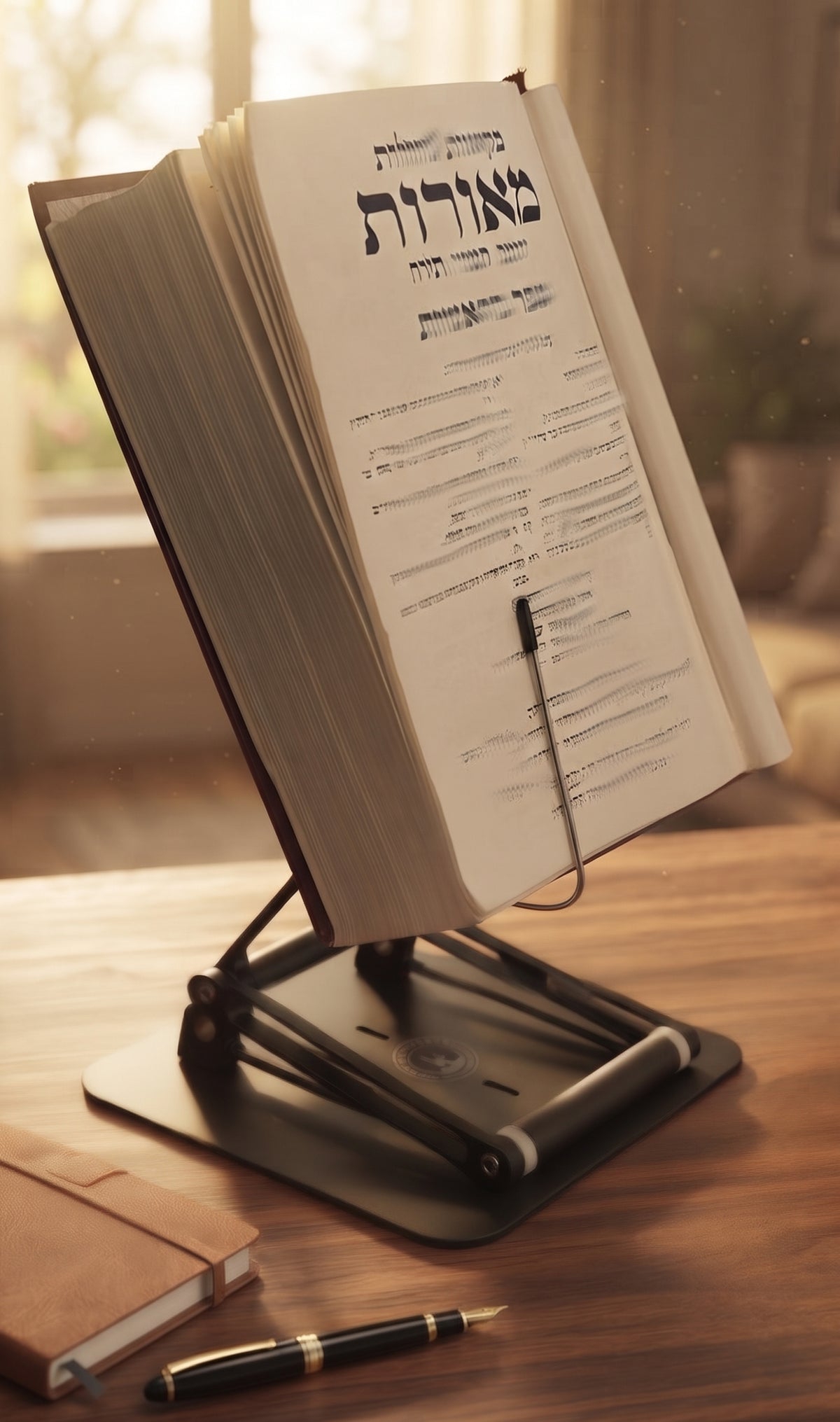
A heavy textbook has a predictable effect on a desk: it pulls your head down. A textbook holder stand changes that geometry by bringing the page closer to eye level, where your neck does not have to spend the next three hours bent over biochemistry, case law, or a densely annotated volume of Talmud.
This is not a minor desk accessory for people who enjoy buying accessories. For serious students, researchers, professionals, and scholars, the right stand can make sustained reading more comfortable, more organized, and easier to maintain. The wrong one, however, becomes one more flimsy object beneath the book you are trying to read.

The Stander by Dr. Shtaygen
An adjustable stand for heavy textbooks and long reading
Height- and angle-adjustable. 5052 aluminum alloy frame, 1.5 kg (3.3 lb), tested with heavy volumes up to 5 kg (11 lb). $95 + shipping, free 30-day returns.
See The StanderWhy a textbook holder stand changes the workday
Reading from a flat desk asks the cervical spine to do repetitive, low-grade work. The book sits below your natural line of sight, so your chin drops, shoulders round forward, and the upper back follows. You may not notice the position during the first chapter. By the end of a long study session, your neck usually has a different opinion.
Elevating a textbook does not eliminate every cause of discomfort. Chair height, screen placement, lighting, eyesight, breaks, and stress all matter. But it addresses one of the most obvious mechanical problems: a reading surface that is too low. When the text is raised and angled toward you, it is easier to keep your head in a more neutral position rather than repeatedly folding toward the page.
There is a productivity benefit as well. A raised book occupies less usable desk space than an open volume spread flat across it. Notes, a keyboard, reference materials, and a writing pad can stay in front of you instead of being pushed to the side. For work that requires reading and writing at the same time, that order matters.
What separates a real textbook stand from a light-duty bookrest
Many stands are designed primarily for tablets, recipes, or paperback novels. Those uses are perfectly legitimate, but a substantial textbook creates a different engineering problem. Large academic volumes are wide, heavy, and often used open for hours. A stand needs sufficient weight capacity, a stable base, a deep support lip, and joints that do not gradually sink under load.
A useful textbook holder stand should be judged by how it behaves while you work, not by how attractive it looks empty on a product page. If you turn a page, rest a hand on the margin, or make a notation, does the platform shift? If the book is thick, do the page holders interfere with the text? If you raise the platform, does the center of gravity remain secure?
Material is not merely a cosmetic choice. Thin plastic can be convenient for occasional use and easy to transport, but it has limits when supporting a large textbook or reference work. Metal construction, particularly aluminum with friction joints, is better suited to repeated adjustment and demanding loads. The trade-off is straightforward: a serious stand is usually heavier and less disposable. For a reader who uses it daily, that weight is often a sign that it belongs on the desk rather than in a junk drawer.
Height is the feature most stands leave out
Angle adjustment helps, but height adjustment is what turns a bookrest into an ergonomic workstation tool. A low platform may tilt the book nicely while still leaving you looking down. That is better than flat on the desk, but it is not the same as positioning the text near your line of sight.
This becomes especially useful for people who alternate between sitting and moderate standing work. A stand with meaningful vertical range can support a morning of seated reading and an afternoon review session at a higher desk position. It also accommodates different users, different chairs, and different book sizes without forcing everyone into one fixed setup.
The Stander by Dr. Shtaygen, for example, raises its supporting aluminum lip 17.8 inches above the tabletop. Because the book or screen sits above that lip, the actual reading surface can be higher still. That range is unusual in a category crowded with low-profile stands, and it is precisely what makes the distinction for long-form study.
How to set up a textbook holder stand correctly
Start by placing the stand directly in front of you, not off to one side. If you need to rotate your head for every paragraph, the stand is creating a new problem while solving an old one. Center it with your chair and primary work surface.
Then raise the book until the top portion of the page approaches your comfortable viewing level. You do not need to force the page directly in front of your eyes. The goal is to reduce the amount of downward head tilt, not to create a rigid posture that feels theatrical. A slight downward gaze is natural. A sharply folded neck for two hours is not.
Set the angle so the text is readable without glare. Glossy pages and overhead lighting can make a steeply angled book reflective, while a very flat angle brings your head downward again. Small adjustments are worth making here. Your best position is the one you can maintain without leaning closer every few minutes.
Finally, arrange the rest of the desk around the task. If you are typing notes from a textbook, place the keyboard beneath the stand only when there is sufficient clearance and your wrists can stay neutral. If the book is your sole focus, use the cleared space for a notebook or a separate writing surface. The goal is a working area that supports concentration, not an elaborate control room.
Choose the stand for the books you actually use
A medical textbook, a legal reporter, a large siddur, and a cookbook do not make identical demands. Think about your heaviest and most frequently used item first. If the stand can securely support that book, it will have little trouble with a tablet, e-reader, or paperback.
Pay attention to the platform dimensions and lower ledge. A narrow lip can feel inadequate under a thick book, especially when pages are turned frequently. Adjustable page retainers are useful, but they should hold pages without covering diagrams, footnotes, or Hebrew and Aramaic text close to the margins. Scholars working with sacred texts know that a poorly placed clip can be surprisingly distracting.
Portability is another legitimate consideration. A compact folding stand may suit a student moving between lecture halls, libraries, and apartments. But the lightest option is not automatically the best choice for a fixed study space. If your work regularly involves heavy volumes, stability should outrank convenience. You should be able to consult a book with both hands, not treat it like a precarious museum exhibit.
Beyond textbooks: one stable platform, many uses
A well-built stand earns its place by doing more than one job. It can support a laptop at a better viewing height when paired with an external keyboard, hold a tablet for reference material, display sheet music, or keep a recipe book upright on the counter. Some users employ the same platform as a portable lectern or a projector holder, provided the device is secure and the stand is used within its intended capacity.
For religious and scholarly study, the connection to the traditional shtender is immediate. A shtender has always served a practical purpose: it raises the text, establishes a dedicated place for learning, and helps the learner remain engaged for longer stretches. A modern adjustable version simply brings that principle to the desk, the home office, the beit midrash, and the classroom.
That versatility should not become an excuse for compromise. A stand that claims to do everything but wobbles under a textbook is not versatile. It is a table of contents for features it cannot deliver. Prioritize stability, elevation, and adjustability first. The secondary uses will follow naturally.
Small habits that make elevated reading work better
Even an excellent stand cannot compensate for marathon sessions without movement. Change position periodically, let your eyes focus at a distance, and stand up before stiffness forces the issue. If you are reading a dense source, use short pauses to annotate or summarize what you have covered. This helps your body and usually improves retention.
Also consider the relationship between the book and your screen. If you constantly look from a low laptop to a raised textbook, one of those surfaces is still asking your neck to travel too far. Align the heights as reasonably as your task allows. For dual-source work, an external keyboard and mouse often make a higher laptop position much more practical.
A textbook holder stand is a simple intervention, but serious work benefits from simple tools that do their job exceptionally well. Put the book where your eyes can find it, give it a platform worthy of its weight, and let your attention stay on the material rather than the ache building at the base of your neck.
The Stander by Dr. Shtaygen
An adjustable stand for heavy textbooks and long reading
Height- and angle-adjustable. 5052 aluminum alloy frame, 1.5 kg (3.3 lb), tested with heavy volumes up to 5 kg (11 lb). $95 + shipping, free 30-day returns.
See The Stander