A 900-page biology text, a legal casebook, or a dense volume of Talmud can defeat a study session before the first note is written. The best tools for textbook studying do more than add color to a page. They help you retrieve information, protect your neck, and keep the physical work of studying from becoming a distraction.
For serious students and scholars, the goal is not to collect apps and accessories. It is to build a small system that makes reading more active, review more efficient, and long sessions more physically sustainable. A tool earns space on your desk only when it helps you think better or work longer with less strain.
Start With the Tool Most People Forget: Book Position
Textbooks create an ergonomic problem that laptops do not. They are heavy, wide, and constantly invite you to bend forward. After an hour of looking down at a book on a flat desk, the issue is not a lack of discipline. Your neck, shoulders, and upper back are doing unnecessary work.
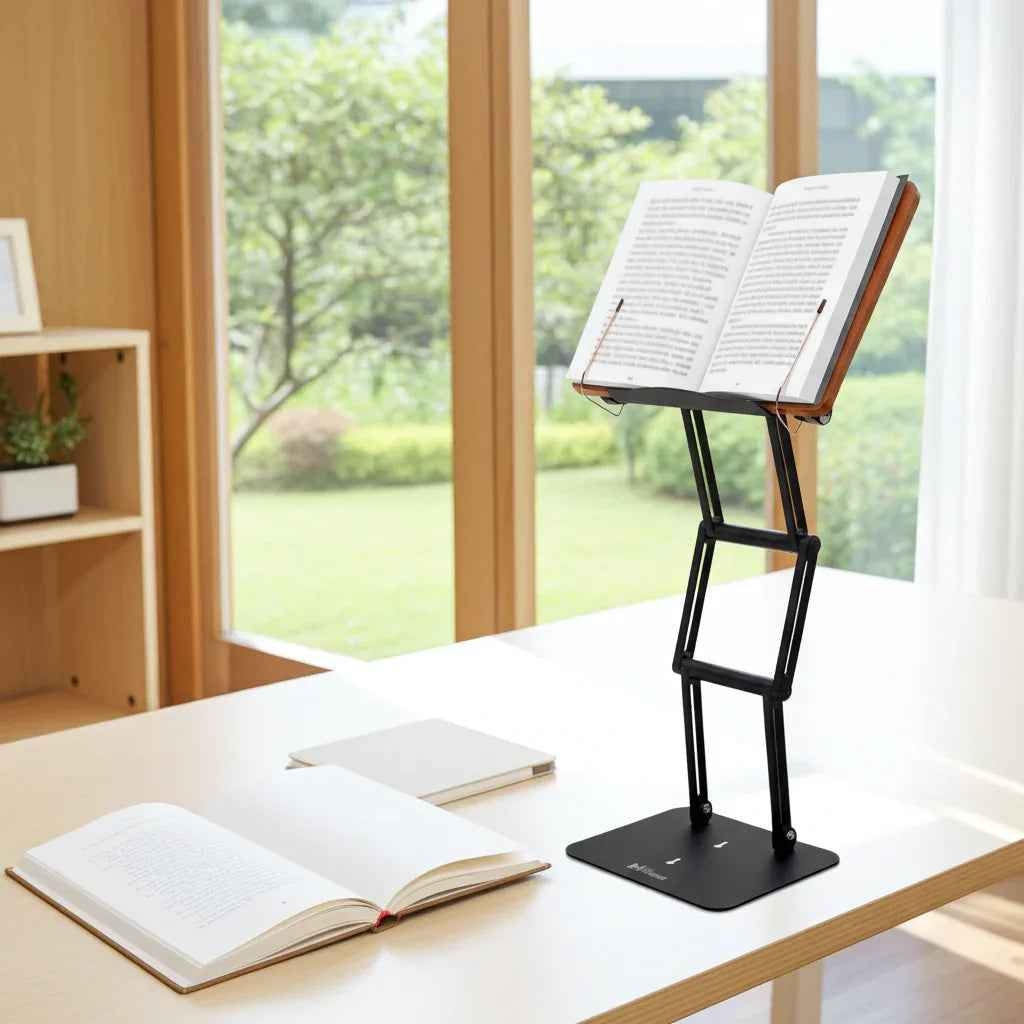
A substantial adjustable book stand belongs near the top of any list of the best tools for textbook studying because it changes the position of the material itself. Raise the text closer to eye level, and you reduce the repeated forward-head posture that makes focused reading feel like a physical endurance event. It also leaves room beneath the book for notes, a keyboard, or a second reference source.
The stand matters most when the book is genuinely heavy. Lightweight wire easels and fold-flat tablet stands may be acceptable for a paperback, but they often wobble under a large textbook, medical manual, siddur, or legal volume. A serious study stand should have a broad base, dependable joints, a secure lower lip, and enough height adjustment to work while seated or during a moderate standing session.
The Stander 1.1 is built for this category of work. Its aluminum construction and stainless steel joints support demanding texts and devices, while its adjustable platform can rise 17.8 inches above the tabletop to the supporting lip. That range matters because an eye-level setup is not one-size-fits-all. A tall reader, a thick textbook, and a standing desk arrangement all require more than a token tilt adjustment.
Tools That Turn Reading Into Learning
A textbook is not a lecture. It will not pause to ask whether you understood the mechanism, argument, formula, or historical claim in the last section. Good study tools create those pauses for you.
Active-recall flashcards
Flashcards work when they force recall rather than recognition. The front should ask a specific question, and the back should require a concise answer in your own words. For anatomy, that might be a structure and its function. For economics, it may be the condition under which a model applies. For a religious text, it may be a phrase, source, or interpretation that needs to be recalled accurately.
Digital spaced-repetition systems are useful for large sets because they schedule review based on what you miss. Paper cards still have a place for diagrams, equations, and material you want to manipulate by hand. The better choice depends on your course and temperament. The system you review consistently beats the system with the most features.
A question-first notebook
Many students highlight a chapter, write a few attractive headings, and later discover they cannot answer the exam questions. A question-first notebook fixes that problem. Before reading a section, write two or three questions the section should answer. After reading, close the book and answer them without looking.
This method is especially effective for chapters with processes, competing theories, or layered arguments. It exposes uncertainty early. If your explanation is vague, the next step is clear: return to the source, find the missing piece, and test yourself again.
A small timer
A timer is not glamorous, but it is remarkably effective when studying feels too large to begin. Set a focused block of 25 to 50 minutes, then take a brief break away from the text. The exact interval is less important than protecting it from messages, browser tabs, and the familiar urge to reorganize your desk instead of reading.
Longer blocks can work well for advanced reading, provided your posture and attention remain steady. If your neck starts pulling forward or you are rereading the same paragraph, that is useful feedback. Adjust the material, stand up, or stop for a short reset. Grinding through physical discomfort rarely produces better retention.
The Writing Tools That Actually Help
A good pen, pencil, and highlighter are still study equipment, but they should support thought rather than decorate a page. Use a pencil or pen to write a short margin question, identify the claim of a paragraph, or mark the step that breaks your understanding. Those marks give you a useful path when you return for review.
Highlighters deserve restraint. If half the page is fluorescent, nothing has been selected. Assign each color a limited job, such as definitions, key evidence, or exam-worthy formulas. Better yet, highlight sparingly and use the margin to explain why the sentence matters. That explanation is where learning begins.
For quantitative courses, graph paper or a tablet with a precise stylus can be more valuable than another note-taking app. Working through equations vertically makes errors easier to spot. For reading-heavy subjects, sticky flags can help identify sections to revisit, but do not let them become a substitute for a written question or brief summary.
Use Digital Tools for Retrieval, Not Escape
Digital tools can sharpen a textbook workflow, but they can also turn a study session into a scavenger hunt for the perfect template. Keep their role narrow and purposeful.
A calendar or task manager is useful for assigning chapters to specific days. A flashcard platform helps with facts, vocabulary, and formulas that require repeated exposure. A document scanner can capture a diagram or a page of problems for review when you are away from your desk. A distraction-blocking app can protect the time you already committed to studying.
Be cautious with automatic summaries. They may help you orient yourself to a chapter, but they cannot replace the effort of identifying a concept, connecting it to prior knowledge, and recalling it later. If a tool makes the material feel easier without requiring you to produce an answer, it may be improving convenience more than learning.
Build a Desk That Supports the Work
The most effective textbook studying setup is usually simple: your book is raised, your notes are accessible, your writing arm has room to move, and your phone is out of reach. The arrangement should allow you to look from text to notes without repeatedly folding your neck toward the desk.
If you study from both a book and a laptop, place the primary item directly in front of you. The secondary source can sit slightly to the side. Avoid trying to read a heavy book balanced on a keyboard or stacked on improvised boxes. It may save money for an afternoon, but it is unstable, awkward to adjust, and a poor long-term answer for daily study.
Lighting also deserves attention. Position it so the page is evenly illuminated without glare. A stand that supports multiple angles helps here: a flat page may reflect overhead light, while a modest angle can improve visibility. For readers who use glasses, this adjustment can make the difference between a productive evening and a headache.
Improve Your Setup
If you're looking to elevate your law books, tablets, or laptops to a more comfortable reading position, an adjustable stand can make a significant difference.
Choose Tools Based on the Type of Studying
There is no universal best tool because textbook work takes different forms. A nursing student memorizing terminology benefits from spaced repetition and diagrams. A law student needs a stable reading position, annotations, and a way to retrieve rules and holdings. An engineering student needs a clear surface for problem sets. A scholar working through sacred or classical texts may need a raised platform that can securely hold substantial volumes through extended sessions.
The common thread is active engagement. Your tools should make it easier to ask, recall, explain, calculate, compare, and review. They should not make your desk look productive while your attention drifts elsewhere.
Start with one improvement that removes the biggest source of friction. If your neck hurts, raise the book. If you forget what you read, add active recall. If you never begin, use a timer and a defined chapter target. Serious study is demanding enough. Your tools should carry their share of the load.
A well-positioned text, a clear question, and a repeatable review habit can make even the heaviest book feel more manageable - which is exactly what a study setup should do.