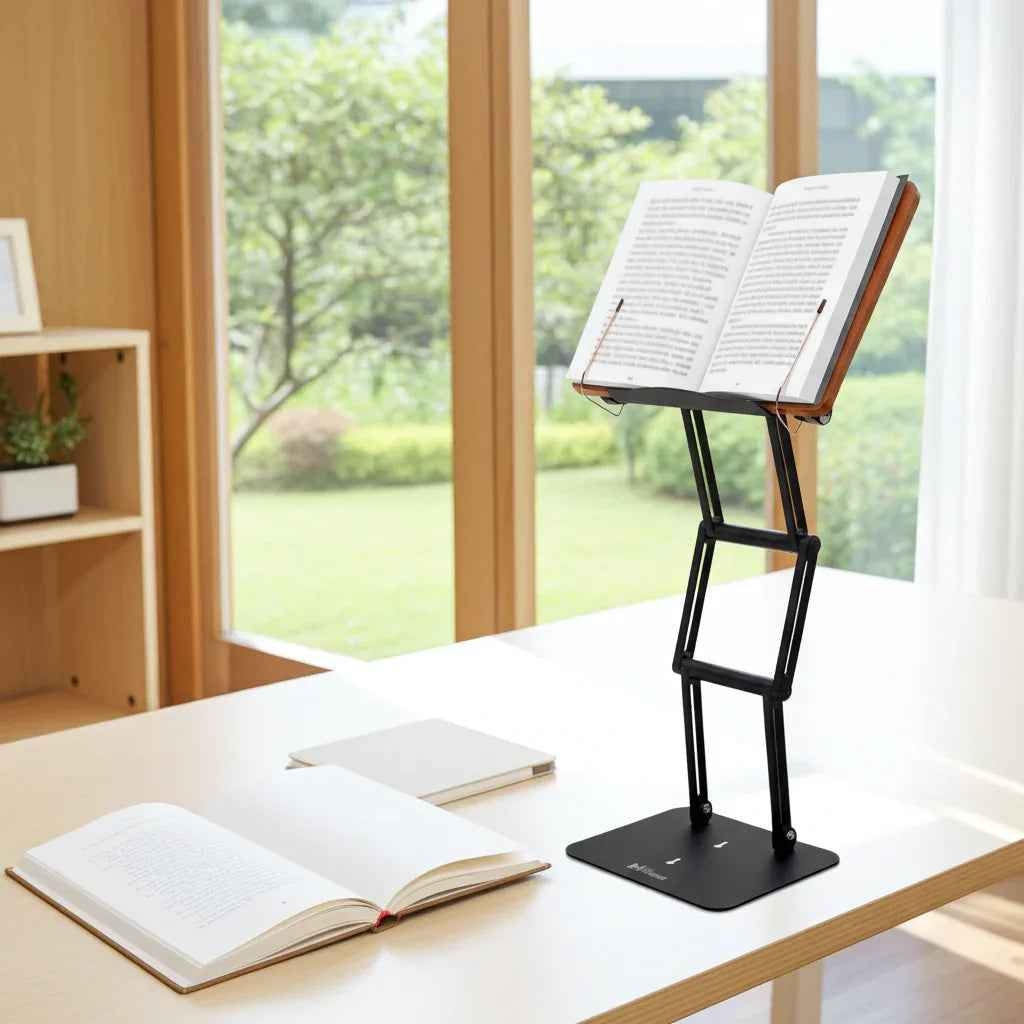
A dense textbook has a way of pulling the entire upper body toward it. After an hour of reading, the familiar result is a lowered head, rounded shoulders, a cramped desk, and a neck that has quietly become the center of the study session. Ergonomic book holders for study address that problem at its source: they bring the material up instead of asking your body to keep bending down.
For serious students, researchers, professionals, and scholars, this is not a minor desk accessory decision. A book holder must support the way you actually work - with heavy books, long reading blocks, notes beside the text, and sometimes a laptop or tablet in the same workflow. A flimsy stand that works for a paperback recipe card is not necessarily built for a medical textbook, a legal volume, or a well-used sefer.
Why Book Position Changes the Study Experience
Reading from a flat desktop places the book below your natural line of sight. To see it clearly, most people flex their neck forward and gradually allow the shoulders to follow. The body can tolerate that position briefly. The problem is repetition: 30 minutes becomes two hours, then a semester of the same posture.
An elevated book holder helps place the page closer to eye level, reducing the need to look sharply downward. The goal is not military-straight posture or an elaborate workstation ritual. It is a more neutral, sustainable position in which the head does not have to hover far in front of the shoulders while you read.
That adjustment can also improve concentration. When the text is easier to see and the desk is less crowded, it is simpler to stay with the material. You are spending less time shifting, re-propping a book, or rubbing the back of your neck between paragraphs. Serious study is demanding enough without making your furniture an adversary.
What Ergonomic Book Holders for Study Must Do
The best stand depends on the material, the desk, and whether you work seated, standing, or both. Still, a genuinely useful ergonomic holder should solve more than one problem. It should raise material high enough to make a meaningful positional difference, hold it securely at a readable angle, and remain stable when pages are turned or notes are taken nearby.
Height matters more than a slight tilt
Many low-profile book stands angle a book, but leave it only a few inches above the desk. Tilting is helpful, especially for reducing glare and making pages easier to view. But a modest incline alone may not do much for someone who is tall, uses a deep desk, or needs to alternate between sitting and standing.
Look at the stand's actual maximum elevation, measured from the tabletop to the surface supporting the book. Then remember that the book itself adds height. A platform that rises 17.8 inches above the tabletop, for example, can position the top of a large textbook substantially higher. This creates a more practical range for both seated reading and moderate standing work.
Stability is an ergonomic feature
A wobbling stand does not encourage better posture. It encourages caution, interruptions, and eventually abandonment in a closet. Stability matters particularly with thick textbooks, reference works, religious texts, binders, and laptops. The unit should stay planted while you turn pages, adjust the angle, or rest a hand on the lower edge of a book.
Materials and joints deserve attention here. Aluminum construction and stainless steel joints generally signal a stand designed for repeated adjustment and substantial loads, not occasional tablet viewing. Weight alone is not a guarantee of quality, but a serious holder needs a balanced base, strong hinges, and a support lip that does not feel like an afterthought.
The support lip has a real job
The lower lip or ledge carries the load. It should be wide and secure enough to hold a thick book without forcing the spine into an awkward position. It should also keep pages accessible. If the lip blocks the bottom lines of text or makes page-turning irritating, the stand will become another obstacle between you and the work.
For open books, page holders can be useful, but they should not clamp so aggressively that they damage pages or make it tedious to move between sections. The right amount of restraint is enough to keep the book open while allowing normal study behavior: highlighting, checking footnotes, and flipping back three chapters because the author finally defined the term.
Match the Stand to Your Actual Material
A good purchase starts with an honest inventory of what lands on your desk most often. A tablet-only user can prioritize portability. A graduate student working from oversized texts should prioritize load capacity, height, and base stability. A musician may need a platform that keeps sheet music visible at a comfortable angle. A home cook may value a stand that holds a cookbook clear of countertop clutter.
For scholarly and religious study, the modern shtender offers a useful model. Traditionally, a shtender elevates sacred texts for extended learning, standing prayer, and serious attention. Its lasting value is practical as much as symbolic: a raised text commands less strain from the reader and gives the work a dedicated place. A well-engineered modern version can bring that same principle to textbooks, research materials, laptops, and tablets.
If your day moves between reading and writing, consider how the stand works with your keyboard and notes. The book should be high enough to read comfortably without pushing other essential tools off the desk. Some people prefer their book centered above a keyboard, while others position it slightly to one side for frequent handwriting. Neither setup is universally right. The better choice is the one that keeps your neck from repeatedly twisting or dropping.
Set Up Your Study Station Without Overcomplicating It
Begin with the chair, not the stand. Sit back with your feet supported and your lower back comfortably against the chair. Place the book holder on a stable surface, then raise and angle the material until the upper half of the page is close to your natural gaze. You should be able to read without constantly dropping your chin toward your chest.
Fine-tune from there. A small angle adjustment can reduce page glare. Moving the stand a few inches closer can prevent you from leaning forward. If you use bifocals or progressive lenses, the ideal height may be lower than it is for someone using single-vision lenses. Ergonomics is evidence-informed, but it is also personal.
Use these practical checks before settling on a setup:
- Can you read the upper and lower portions of the page without sustained neck bending?
- Does the stand remain steady when you turn pages in a heavy book?
- Can you write notes without hunching over the desk?
- Does the arrangement leave room for a keyboard, notebook, or reference materials?
Why a Premium Stand Can Be the Practical Choice
Commodity book holders often look similar in a product photo. The differences show up at page 600, during a late-night exam review, or when a thick volume makes a lightweight frame sag. A premium adjustable stand costs more because it is intended to perform under recurring load, support a wider range of materials, and remain useful as your work changes.
The Stander 1.1 was designed around that serious-use standard. Its adjustable aluminum platform and stainless steel joints provide high elevation and dependable support for books, laptops, tablets, and other demanding desk tasks. It is equally at home holding a textbook during study, a cookbook during dinner prep, or sheet music during practice. One stable tool can replace several lesser stands that each do one job tolerably.
That does not mean every reader needs the largest or heaviest option. If you travel daily and only read from a small tablet, portability may outweigh maximum elevation. If your study consists of large texts and long sessions at a fixed desk, stability and height are usually worth prioritizing. Buy for the work you do repeatedly, not the work you imagine doing once.
Make the Book Holder Part of a Better Routine
An ergonomic holder will not replace breaks, sleep, movement, or sensible workload management. It can, however, remove one persistent source of unnecessary strain from the study environment. Pair it with brief position changes, a clear reading surface, and lighting that lets you see the page without craning forward.
The useful test is simple: after a demanding study block, did your workstation help you stay focused on the argument, the problem set, or the text itself? A well-chosen book holder keeps the material in view, holds its ground under real weight, and lets your posture spend less of the day negotiating with gravity. That is a modest change with a very serious payoff.