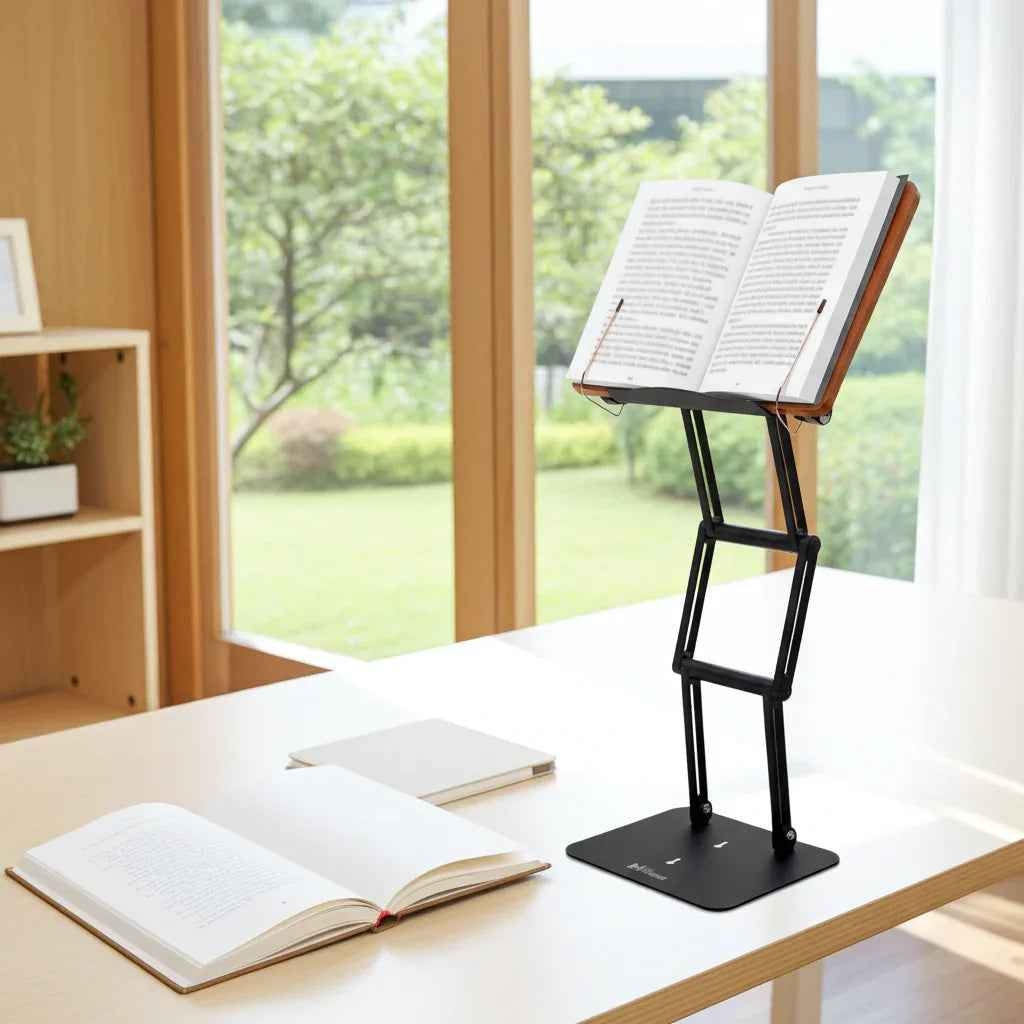
Set a heavy sefer, law casebook, or anatomy text on a cheap book stand and you learn the difference fast. The whole shtender vs standard book stand question stops being semantic the moment the tray wobbles, the angle slips, or your neck starts doing overtime by page thirty.
For casual reading, almost any stand can look acceptable on a product page. For sustained study, desk work, and text-heavy focus, the gap gets much wider. A real shtender comes from a tradition of raised, purposeful study. A standard book stand usually comes from the office-supply mindset: hold the book up, keep the price down, hope for the best.
That does not mean one is always better in every setting. It means they are built for different levels of use, different bodies, and different expectations.
Shtender vs standard book stand: what is the real difference?
At the simplest level, a standard book stand is designed to prop up a book at an angle on a desk. It is usually compact, light, and serviceable for occasional reading, recipes, or a paperback. Many are made for convenience first.
A shtender is traditionally a dedicated study stand. It is meant to support sustained learning, repeated use, and a more upright relationship between the reader and the text. In modern ergonomic terms, that matters because reading posture is not just about comfort. It directly affects cervical flexion, shoulder tension, and how long you can work without fatigue.
The modern version of a shtender can go beyond tradition. It can function as a serious ergonomic platform for books, tablets, laptops, and large texts while preserving the core purpose: bring the work higher, closer, and more naturally into your line of sight.
So when people compare a shtender vs standard book stand, they are often really comparing two philosophies. One asks, "Will this hold my book?" The other asks, "Will this support hours of focused work without punishing my neck, shoulders, and attention span?"
Why height changes everything
Most standard book stands lift the reading material a little. That helps, but only to a point. If the book still sits far below eye level, your neck still bends downward. Maybe less than before, but still enough to create strain over time.
This is where premium shtender-style design pulls ahead. Greater elevation allows the text or screen to sit much closer to eye level, which reduces the tendency to collapse forward through the neck and upper back. For students, researchers, and professionals who read for long stretches, that is not a minor feature. It is the feature.
A stand that reaches meaningful height also changes your workflow. It lets you alternate between seated and moderate standing use, which can improve endurance through long study sessions. That flexibility is rare in commodity book stands, which tend to stay low and fixed in a narrow comfort zone.
In practical terms, if you spend ten minutes reading a novel, a modest lift may feel fine. If you spend three hours reviewing source material, comparing notes, or learning Talmud, medicine, or law, that extra height becomes the difference between support and compromise.
Stability is not glamorous, but it is everything
Most people shop for stands by looking at angles, price, and maybe aesthetics. Then they place a heavy text on one and discover the missing variable: structural integrity.
A standard book stand may work well enough with a thin paperback or tablet. Load it with a dense textbook, a large religious volume, or a laptop, and the weak points show up quickly. Hinges loosen. Bases shift. The support lip feels undersized. The whole thing starts acting like it has other plans.
A true shtender-style stand for serious users should handle weight without drama. That means solid materials, strong joints, and a base that stays planted. Aluminum construction and stainless steel connection points matter here because they resist the gradual decline that plagues lighter-duty products.
This is one of those areas where trade-offs are real. A flimsy stand is easy to carry and cheap to replace. A heavy-duty stand takes up more visual presence and costs more upfront. But if your work involves real books, real hours, and real posture concerns, stability is not a luxury feature. It is the baseline.
The use case decides the winner
The wrong way to compare a shtender and a standard book stand is to ask which one is universally better. The right question is better for what.
If you want a lightweight stand for occasional recipes, a slim novel, or travel, a standard book stand may be enough. It is simpler, smaller, and often perfectly adequate for light-duty use.
If you are reading intensively at a desk, switching between books and screens, or working with heavier materials, a shtender-style stand makes more sense. It supports a more upright posture, tends to offer better elevation, and is usually built with sustained use in mind.
This is especially true for people who do serious intellectual work. Graduate students, attorneys, clinicians, clergy, teachers, and engineers do not just need a stand that technically holds something up. They need one that stays stable under load, supports concentration, and helps reduce the physical cost of desk-based work.
That is also why the traditional shtender still resonates. It was never just furniture. It was a tool for committed study.
Ergonomics: where the modern shtender pulls ahead
A lot of stands are sold as ergonomic because they tilt. Tilt helps, but ergonomics is not a one-feature category.
A more complete ergonomic setup considers viewing height, viewing angle, distance, shoulder position, and how the stand interacts with the rest of the workspace. A low stand with a decent angle can still leave you craning downward. A stand with good height but poor stability can make you tense up to compensate. A stand that works for a tablet may fail completely with a textbook.
The stronger case for a modern shtender is that it can serve as an ergonomic utility stand, not just a page holder. If it raises books, tablets, and laptops high enough to improve line-of-sight positioning, it starts supporting a healthier full-day workflow rather than a single isolated task.
That is why products like The Stander 1.1 are in a different category from commodity book stands. With substantial elevation, heavy-duty construction, and support for books, tablets, and laptops, the stand becomes part of a posture strategy. Not a desk accessory. A strategy.
And yes, that sounds serious. Neck pain has a way of making everything serious.
Heritage and function are not opposites
Some buyers hear the word shtender and think it applies only to religious use. Others hear book stand and assume it covers everything. Both views miss the middle.
The shtender has cultural and scholarly roots, especially in Torah study, but the concept translates extremely well to modern work. Raised text, focused posture, stable support, and long-session usability are just as relevant in a library, home office, seminary, classroom, or law firm.
In that sense, the modern shtender is not old-fashioned at all. It is a refined answer to a very current problem: too much downward looking, too many weak accessories, and too many workspaces that quietly train people into pain.
A standard book stand can still be useful. It simply tends to live lower on the performance ladder. For lighter needs, that is fine. For serious users, the limitations show up quickly.
So which should you buy?
If your reading is occasional, your books are light, and portability matters more than posture optimization, a standard book stand may do the job. There is no need to overengineer a simple need.
If you spend long hours studying, working from texts, or moving between books and devices, a shtender-style stand is usually the smarter choice. Better elevation supports a more neutral neck position. Better construction supports heavier materials. Better stability supports concentration. All three matter.
The real test is simple: what happens after an hour? Not when you first set the stand on the desk. Not when it is empty. Not when the marketing photos are flattering. After an hour, does your posture improve or drift? Does the stand feel planted or fussy? Do you stay focused, or do you keep adjusting the tool that was supposed to help you work?
That is where the shtender vs standard book stand comparison stops being theoretical. It becomes physical, immediate, and very hard to ignore.
Choose the stand that respects the weight of your work and the mechanics of your body. Your books may be old, your deadlines may be new, but your neck is not interested in making that distinction.