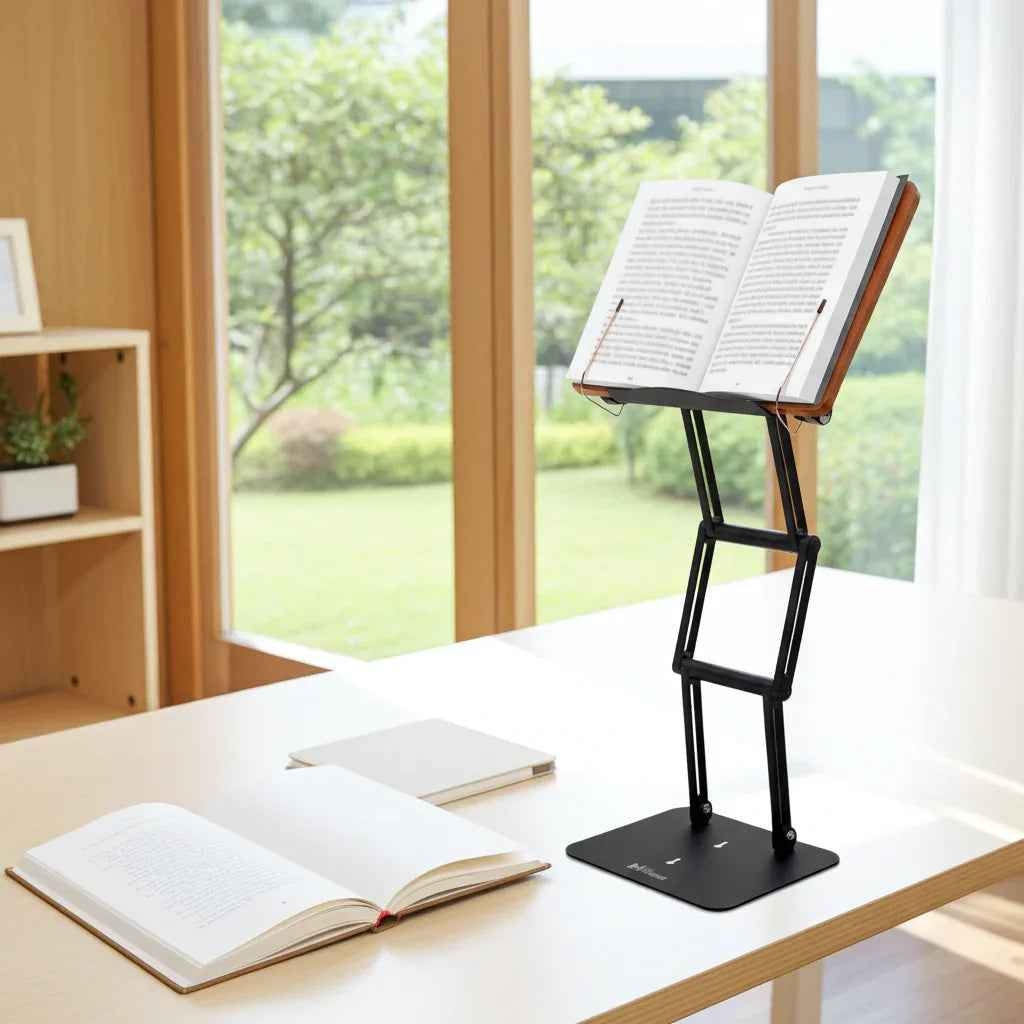
A book that will not stay open creates a surprisingly expensive posture problem. One hand holds down a page, the other tries to take notes, and the head gradually moves closer to the text. After an hour, the reader is hunched over a desk, the neck is working overtime, and concentration has been replaced by constant repositioning. Ergonomic book holders with page holders solve both parts of that problem: they support the material at a useful viewing angle and keep the pages where they belong.
For students working through dense textbooks, professionals reviewing printed documents, musicians reading scores, and serious scholars studying weighty volumes, that difference is not cosmetic. It changes how long the work can be done comfortably and how much of the desk remains available for the work itself.
What Ergonomic Book Holders With Page Holders Should Do
A basic book stand is often little more than an angled surface. It may be fine for a paperback novel on a coffee table, but serious desk work asks more of the equipment. A truly ergonomic holder needs to position the book high enough and securely enough that the reader can look forward rather than continually flexing the neck downward.
Page holders add a second, equally practical function. They are the arms, clips, or retaining tabs that keep pages flat without requiring a hand on each side of the book. This matters with thick textbooks, law books, cookbooks, prayer books, manuals, and older volumes with stiff bindings. Without page retention, a stand can become an attractive place for a book to close itself.
The goal is not to eliminate every movement or create a rigid workstation. Healthy study still includes changing positions, taking breaks, and moving the eyes away from close work. The point is to remove the unnecessary strain caused by a book sitting too low and fighting the reader at every page turn.
Height matters more than a slight tilt
Many inexpensive reading stands offer several angles but remain close to the tabletop. An angle helps, but it does not fully address the central issue: the material is still low. When the book stays near desk height, the reader must look down, especially when using a large text.
A height-adjustable stand gives the reader more control. It can bring the page closer to eye level while seated and can also support moderate standing work. That flexibility is especially useful for people who alternate between reading, typing, taking notes, and presenting from a desk or countertop.
The correct setup depends on the person, chair height, book size, and task. A screen or book does not need to sit at exactly the same height for every activity. What matters is finding a position that lets the neck remain more neutral and the shoulders stay relaxed rather than pulled forward.
Page Holders Are Not a Minor Feature
Readers often focus on the stand itself and treat page holders as an afterthought. In practice, they determine whether the stand works with real books.
A useful page holder must secure the outer edges of the pages without covering too much text or damaging delicate paper. It should allow a reader to turn pages quickly, then return the retainers without a wrestling match. The best designs apply controlled pressure at the edges, not across the center of the page where reading happens.
This is particularly valuable when working from an open reference book while writing. With the book held open independently, both hands are free: one can type, annotate, solve problems, or handle documents. For religious and scholarly study, the raised-platform tradition of the shtender has always recognized this principle. A text deserves a stable place, and the reader deserves a posture that can sustain attention.
There is a trade-off. Extremely aggressive clips may grip thin pages well but can be annoying for frequent page turns. Very light retainers may be convenient but fail when a thick book has a strong tendency to close. Consider the kinds of books you actually use most often, not just the smallest paperback in the house.
How to Choose a Holder for Serious Reading
The right stand is not necessarily the one with the most adjustment points or the lowest price. It is the one that remains stable under the material you need to use and gives you a realistic path to better posture.
Start with load capacity. A slim novel and a 1,500-page medical text place very different demands on a stand. If you study from heavy academic, legal, or religious volumes, look for a sturdy platform and joints built to resist sagging over time. A stand that shakes when you turn a page is not helping focus.
Next, examine the range of height adjustment. If a holder rises only a few inches, it may improve the viewing angle but still leave the book well below eye level. A taller range provides more usable positions, including seated reading at a higher desk and occasional standing sessions.
Then consider the support lip and page-retention mechanism together. The lower lip carries the weight of the book. It should be substantial enough that a large volume does not feel precarious. The page holders should keep the book open while allowing normal page turns. Both components matter because a good page clip cannot compensate for a shallow, unstable base.
Finally, think about the rest of your workflow. A platform that supports books but cannot hold a tablet, laptop, sheet music, or printed packet may be perfectly appropriate for a dedicated reading station. But many people benefit more from one serious stand that can adapt as the day changes. A utility stand that works as a textbook holder in the morning, laptop riser in the afternoon, and cookbook holder in the evening earns its desk space.
Set Up the Book Before You Start Working
Even a well-engineered stand needs sensible placement. Put it directly in front of you rather than off to one side, unless the task requires a secondary reference. Twisting the neck repeatedly toward a book can create a different discomfort problem than looking down.
Raise the book until you can read without dropping the chin toward the chest. If you wear progressive lenses, you may need a slightly different height or angle than another reader. Make small adjustments, read for several minutes, and notice whether you are leaning forward. The body usually gives an honest review faster than a product description will.
Keep the text close enough to read comfortably, but leave room for your keyboard, notebook, or writing surface. For long study blocks, alternate tasks when possible. Read from the raised text, take notes, stand briefly, and return. An ergonomic tool supports better work habits; it does not make movement unnecessary.
A stand should feel settled, not delicate
Stability is one of the clearest signs that a stand belongs in a serious workspace. The platform should stay where you set it, the joints should hold their position, and the base should not consume so much space that it creates a new clutter problem. Lightweight stands have a place for travel and occasional tablet viewing, but they can be a poor match for heavy books and sustained use.
The Stander 1.1 was built for this more demanding category of work. Its aluminum construction and stainless steel joints are designed for substantial books, laptops, and tablets, while its adjustable design raises the supporting lip up to 17.8 inches above the tabletop. That range gives readers meaningful control over seated and moderate standing setups rather than merely adding a decorative tilt to a low desk.
Who Benefits Most From a Page-Holding Stand?
Students and researchers benefit because they can keep a source open while typing or writing. Attorneys, accountants, and professionals who work from printed materials gain a clearer desk and fewer repeated bends toward documents. Musicians can position sheet music at a useful angle. Home cooks can keep a recipe visible and away from countertop spills.
The strongest case is often for people who read for long, focused stretches. Graduate students, clergy, Torah learners, academics, writers, and anyone whose work depends on returning to the same page repeatedly will notice the practical difference. A stable modern shtender is not a novelty when the text is heavy, the session is long, and the body has already made its opinion about a low desk clear.
A book holder with page holders is a small piece of equipment, but it changes the relationship between the reader, the text, and the workspace. Choose one that can carry the real weight of your work, place it at a height that lets you look ahead, and let your hands return to the task they were meant to do.