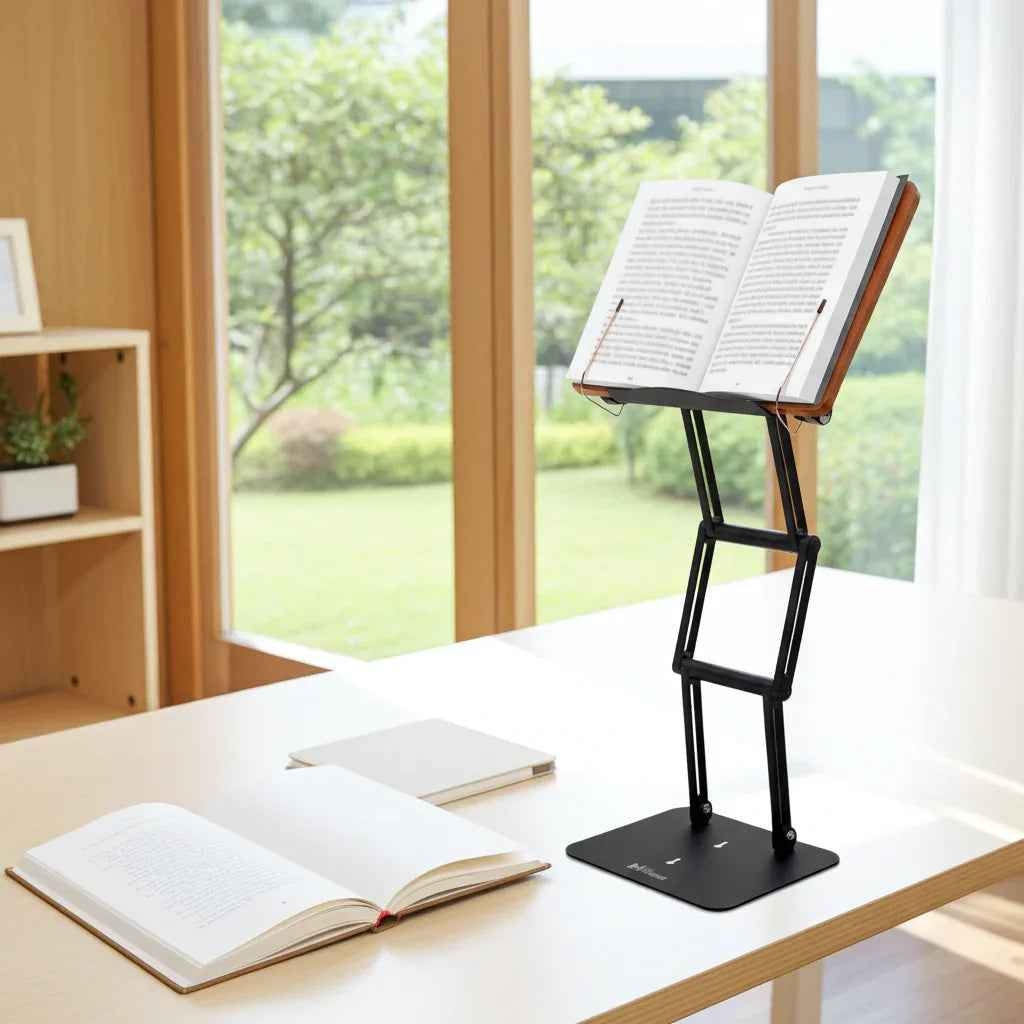
A 900-page textbook has a way of pulling your head toward the desk. So does a laptop, a tablet, a legal brief, a siddur, and the cookbook you are trying to read while chopping onions. The issue is not a lack of discipline. It is geometry. An ergonomic reading stand changes that geometry by bringing the material up to you instead of asking your neck to spend hours bent toward it.
For people who read, study, research, write, or work from screens for long stretches, this is not a decorative desk accessory. It is a practical way to create a healthier visual line, a more upright working position, and a workspace built for sustained concentration.
What an Ergonomic Reading Stand Should Do
A proper reading stand supports the material at a height and angle that lets you look forward more often than down. The goal is not to sit unnaturally rigid. It is to reduce the constant forward-head position that creeps in when a book lies flat on a desk or a laptop sits below eye level.
When the page or screen is raised, your head has less distance to travel downward. Your upper back and shoulders are less likely to round forward just to see the material clearly. That can make long reading sessions feel less punishing, particularly for students in exam season, professionals reviewing documents, and scholars spending serious time with dense texts.
Height is the decisive feature. A low, fixed book holder may improve the page angle, but it can still leave you looking down. An ergonomic setup needs enough elevation to suit your body, your chair, your desk, and the size of the book or device. It should also adjust without wobbling or requiring a small engineering project every time you change tasks.
Why Flat Reading Creates a Posture Problem
Most desks were designed as work surfaces, not as ideal viewing surfaces. A book placed directly on one forces the eyes downward. To keep reading, the neck bends, the chin drifts toward the chest, and the shoulders tend to follow. Hold that position for 20 minutes, and you may barely notice it. Hold it for three hours, and your body usually sends a more direct message.
The problem is compounded by concentration. When a passage is difficult, people lean closer. When they are tired, they slump. When they are annotating, they may twist sideways to make room for a notebook. The work itself is demanding enough. Your setup should not quietly add a neck and shoulder endurance test.
A raised stand will not solve every discomfort. Chair height, monitor placement, keyboard position, screen glare, vision correction, and movement habits all matter. But it addresses one of the simplest and most persistent problems in desk work: the reading material is often far too low.
The Difference Between a Book Holder and a Serious Stand
Many inexpensive book holders are adequate for a light paperback or a tablet during a short recipe video. That is a valid use case. It is also a very different job from holding a heavy medical text, a laptop, a large reference volume, or a bound religious work through an extended study session.
For serious use, look beyond the word “adjustable.” Ask how high the platform actually rises, whether it remains stable at higher settings, and whether its joints are built to carry real weight. A stand that shakes as you turn a page is distracting. One that gradually sinks under a book defeats the purpose. And one that requires you to remove the book before every adjustment will encourage you to settle for a poor position.
Materials matter here. Aluminum construction and stainless-steel joints are not merely premium talking points when the stand is supporting valuable equipment and heavy texts. They contribute to a structure that can stay planted and usable over years of daily work. A stable platform also makes writing, highlighting, following sheet music, or typing beside the stand far easier.
There is a practical trade-off. Heavy-duty stands are generally less featherweight and less disposable than thin folding models. That is usually an advantage at a desk, library table, kitchen counter, or study area, where stability is more valuable than shaving a few ounces from the setup. If you need something for occasional travel, a compact holder may be the better choice. If you need a daily workstation tool, choose accordingly.
Choosing the Right Height and Angle
Start with your normal seated position. Sit back in your chair, place your feet securely on the floor or a footrest, and bring the stand up until the top portion of the page or screen is near your natural line of sight. You should be able to read without repeatedly dropping your chin. A slight downward gaze is normal and often comfortable. The issue is sustained, steep neck flexion.
Angle is equally personal. A more upright book angle often improves visibility and keeps the neck in a better position. But if you are actively writing in the book, working through equations, or making extensive notes, you may prefer a somewhat lower angle. The best arrangement is the one that supports the task without forcing you into a cramped posture.
For laptops, elevation is only half the equation. Raising the screen can improve viewing height, but it also raises the keyboard. For longer typing sessions, pair the elevated laptop with an external keyboard and mouse when possible. That allows your screen to stay higher while your hands remain at a more comfortable working level. For brief emails, video calls, or reference work, using the laptop directly on the stand can still be useful.
The Stander 1.1 is designed for this range of real-world setups. Its platform raises to 17.8 inches above the tabletop, measured to the aluminum support lip, with the book or device sitting higher depending on its size. [Take note! Most stands claiming a bigger height raise are misleading! They measure the stand from the table to the very top of the reading/laptop stand!] That extra elevation is what makes the stand useful not only for seated reading but also for moderate standing work. It is a modern shtender built with the demands of contemporary study and professional work in mind.
Make It Part of the Way You Work
An ergonomic reading stand is most valuable when it stops being something you pull out only after your neck starts complaining. Set it up as a default part of your desk. Keep the text you are actively using on the stand, and reserve the desk surface for notes, a keyboard, writing tools, or a second device.
Researchers can use it to hold source material beside a computer. Students can keep a textbook elevated while taking notes. Attorneys and accountants can position a printed document where it is readable without hunching. Musicians can use the same stable platform for sheet music. In the kitchen, it can hold a cookbook or tablet far enough from spills and flour. A good stand earns its space because it serves the work already happening there.
For traditional Jewish study, the connection is especially natural. The shtender has long recognized a simple truth: sacred learning deserves a dedicated, upright place. A modern adjustable stand carries that principle into homes, offices, classrooms, and study halls, while adding the height range and structural strength needed for varied posture and materials.
Improve Your Setup
If you're looking to elevate your law books, tablets, or laptops to a more comfortable reading position, an adjustable stand can make a significant difference.
Small Habits That Protect Your Neck During Long Reading
Even excellent equipment cannot make a four-hour session entirely static and comfortable. Use the stand as the foundation, then add movement. Every so often, look away from the page, let your shoulders relax, and change position. Stand for a few minutes if your workspace permits. The goal is not perfect posture held like a statue. The goal is to avoid one strained position for too long.
Keep frequently used materials within easy reach so you are not repeatedly twisting or leaning across the desk. If glare causes you to crane your neck to find a readable angle, adjust the room lighting or reposition the stand. If you use bifocals or progressive lenses, your preferred screen height may differ from someone using single-vision lenses. Ergonomics is specific to the person and the task.
Most of all, do not wait for pain to justify a better setup. A reading stand is a preventive tool as much as a comfort tool. It supports the kind of upright, focused work that lets your attention stay on the argument, the lesson, the prayer, or the next page - not on the growing tension between your shoulders.
A serious book deserves more than a flat desk, and serious work deserves more than a flimsy prop. Raise what you read, give your neck a fairer position, and let your workspace support the hours you are asking from yourself.