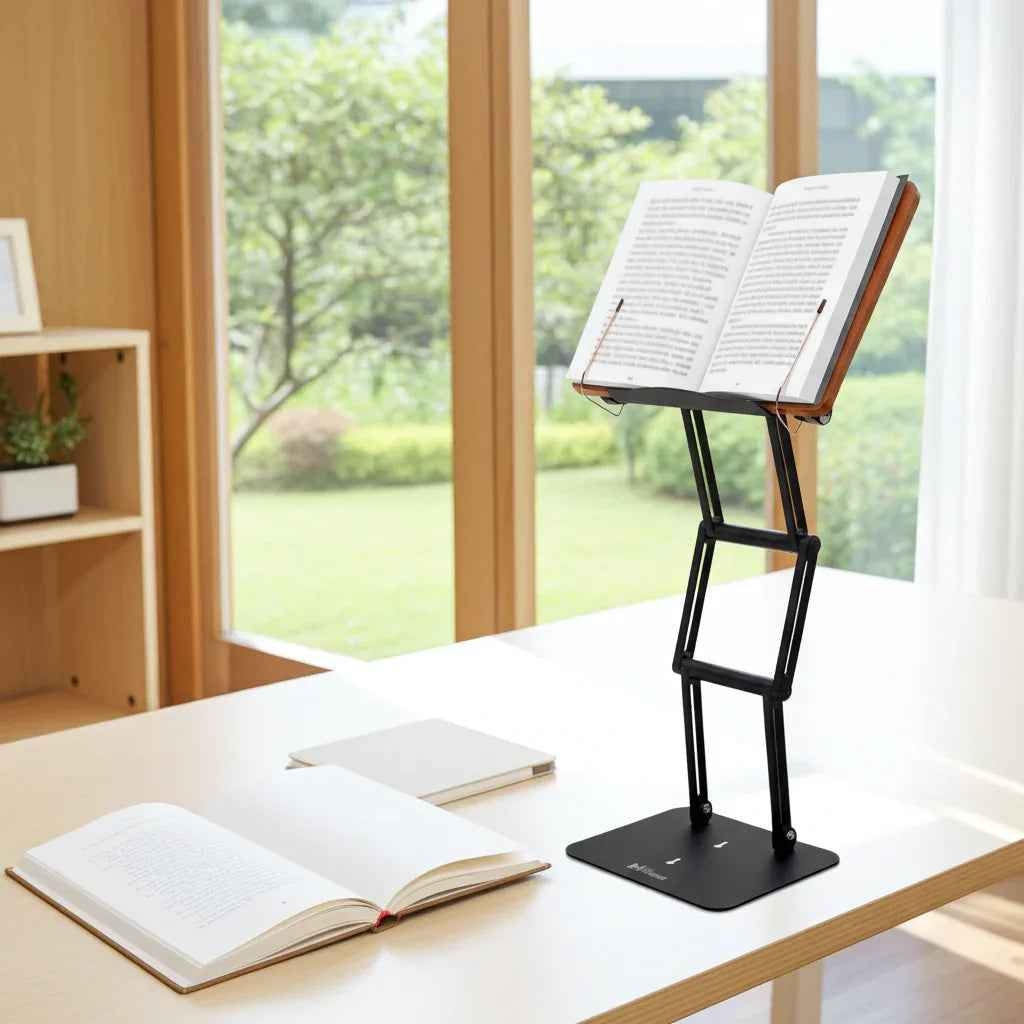
A thick textbook propped against a coffee mug is not an ergonomic setup. Neither is spending three hours with your chin pulled toward your chest because the book never had a chance of reaching eye level. Foldable adjustable book holders are designed to solve that simple but costly problem: keeping reading material raised, stable, and usable without permanently claiming your desk.
For serious readers, the right holder is more than a convenience. It is a work surface. It affects how long you can read comfortably, how often you lose your place, whether your notes fit beside the text, and whether your neck starts negotiating an early end to the study session. The difference between a light tablet easel and a serious adjustable stand becomes obvious the moment you place a heavy legal volume, medical textbook, siddur, or reference book on it.
What Foldable Adjustable Book Holders Should Actually Do
Most people begin with a modest request: hold the book open. That is reasonable, but it is not enough for long study sessions. A capable holder needs to keep pages visible, support the weight of the material without sagging, and position the text at a height and angle that reduces the need to bend forward.
Foldability matters because desks are rarely dedicated to one task. A student may move from a textbook to a laptop. A home cook may need a recipe holder for an hour, then want the counter back. A scholar may study at a dining table and need the setup stored before the next family meal. A folding design earns its place when it can be set up quickly and put away without becoming another object to wrestle with.
Adjustability is the other half of the equation. A book stand that only tilts changes the page angle, but it does not necessarily bring the text high enough. Tilt can reduce glare and improve visibility. Height adjustment helps bring the reading surface closer to your natural line of sight. For seated work, this can reduce the forward head position that develops when the book remains flat on the desk. For moderate standing work, real elevation is what makes the stand useful rather than decorative.
Height Matters More Than Most Buyers Expect
A low book holder can be useful for recipe cards, casual reading, or preventing pages from closing. But it often leaves the reader looking down for hours. That is precisely the posture many people are trying to avoid.
The practical goal is not to place every book at an identical, perfectly fixed eye level. Book sizes, chair heights, screen positions, and individual proportions vary too much for that. The goal is to raise the material enough that you can read with less neck flexion, then fine-tune the angle and seating position. A larger book naturally sits higher once it is supported by the stand, which is useful when working with textbooks and reference volumes.
This is where compact foldable holders often reveal their limitation. They may offer several angle settings but very little vertical lift. That can be perfectly acceptable for occasional use. It is less suitable for the person who spends several hours each day reading dense material, reviewing documents, or alternating between a book and a computer.
A premium height-adjustable option such as The Stander 1.1 raises its support lip 17.8 inches above the tabletop. That is a materially different category from a desktop easel. It gives seated users more flexibility and provides enough elevation to support moderate standing workflows, depending on the user’s height and the size of the book or screen.
Stability Is a Health Feature, Not a Luxury
A stand that wobbles changes behavior. You begin holding the book with one hand, leaning closer to keep it steady, or avoiding page turns because every movement threatens to shift the whole setup. The posture benefit disappears quickly.
For light paperbacks and tablets, a lightweight folding stand may be sufficient. For hardcovers, binders, thick textbooks, large prayer books, or professional reference materials, look closely at construction and load support. Aluminum components, substantial joints, a broad base, and a secure front lip are not merely premium details. They determine whether the stand stays put under real working conditions.
The joints deserve special attention. Weak plastic hinges are often the first failure point on inexpensive holders, especially when they are repeatedly folded and adjusted. Stainless steel joints and well-engineered locking mechanisms help a stand maintain its chosen position instead of slowly collapsing under the weight of a book. Nobody needs a surprise book avalanche during a late-night study session.
The front lip should also be deep and secure enough to support the material without covering excessive text. Page holders are useful, but they should restrain pages gently. Aggressive clips can damage thin pages or make it irritating to turn them. The best design holds a book open while leaving the reader in control of the text.
Choosing the Right Stand for Your Work
The best foldable adjustable book holder depends on what you are asking it to carry and where you intend to use it. A compact, low-profile model can be a smart choice for travel, a small cookbook, or occasional tablet viewing. It is inexpensive, quick to store, and often all that is needed for brief tasks.
Heavy academic work calls for a different tool. If your reading routinely involves dense textbooks, commentaries, law books, research binders, or large religious texts, prioritize height range and structural stability over the smallest folded footprint. A stand that is slightly larger but reliably supports the material can make a long session far more workable.
For desk-based professionals, versatility matters. A holder that supports books but cannot accommodate a laptop or tablet may create clutter by forcing you to own several separate risers. A sturdy adjustable stand can serve as a textbook holder during study, a laptop riser during writing, a tablet stand during meetings, and a document holder when reviewing printed material. The transition between tasks should not require rebuilding your entire workspace.
For traditional study, the modern stand has an obvious ancestor: the shtender. The traditional raised study platform was never just furniture. It created a designated place for focused reading and gave the text a proper physical position. A modern foldable stand can carry that same logic into apartments, offices, classrooms, and shared spaces - with adjustable height, portable storage, and support for the tools of contemporary work.
Set Up the Holder So It Helps Your Posture
Even an excellent stand cannot compensate for a poor setup. Start by placing the stand directly in front of you, rather than off to one side. Twisting your neck to read is simply replacing one strain with another.
Raise the book as high as the stand and your workspace allow, then set the page angle so you can read without excessive glare. If you wear progressive lenses, you may prefer a slightly lower position or a more upright page angle. That is not a flaw in the stand. It is a reminder that ergonomics is personal, and the right configuration is the one that lets your head remain comfortably balanced over your shoulders.
Keep frequently used notes and writing tools within easy reach. If you need to take extensive notes from a book, position the stand so it leaves a clear writing area beside it, or alternate between reading and writing rather than hunching over both at once. For laptop use, an external keyboard and mouse are usually the practical companions to a raised screen. Raising a laptop without changing where you type can create a new wrist and shoulder problem.
Finally, vary your position. A height-adjustable stand makes it easier to alternate between seated and standing work, but it does not require you to stand all day. Movement and position changes are often more realistic and sustainable than searching for one flawless posture to hold indefinitely.
When Foldability Becomes a Compromise
Foldable adjustable book holders offer genuine convenience, but portability has limits. Extremely thin, ultralight designs are easier to carry, yet they are usually less capable with heavy materials. A tall stand with a wide base may take more room in a bag, but it can provide the stability and elevation needed for serious daily use.
Consider where the stand will live most of the time. If it will move between classrooms, libraries, and coffee shops, a compact design may deserve priority. If it will live on a primary desk, kitchen counter, study table, or lectern-style workstation, choose the stronger design first. The ideal stand is not the one that folds into the smallest rectangle. It is the one you can depend on when the reading gets demanding.
A book holder should make the work in front of you feel more intentional: the text raised, the desk clearer, and your attention less divided by discomfort. Choose one built for the weight of your ideas, not just the weight of a paperback.