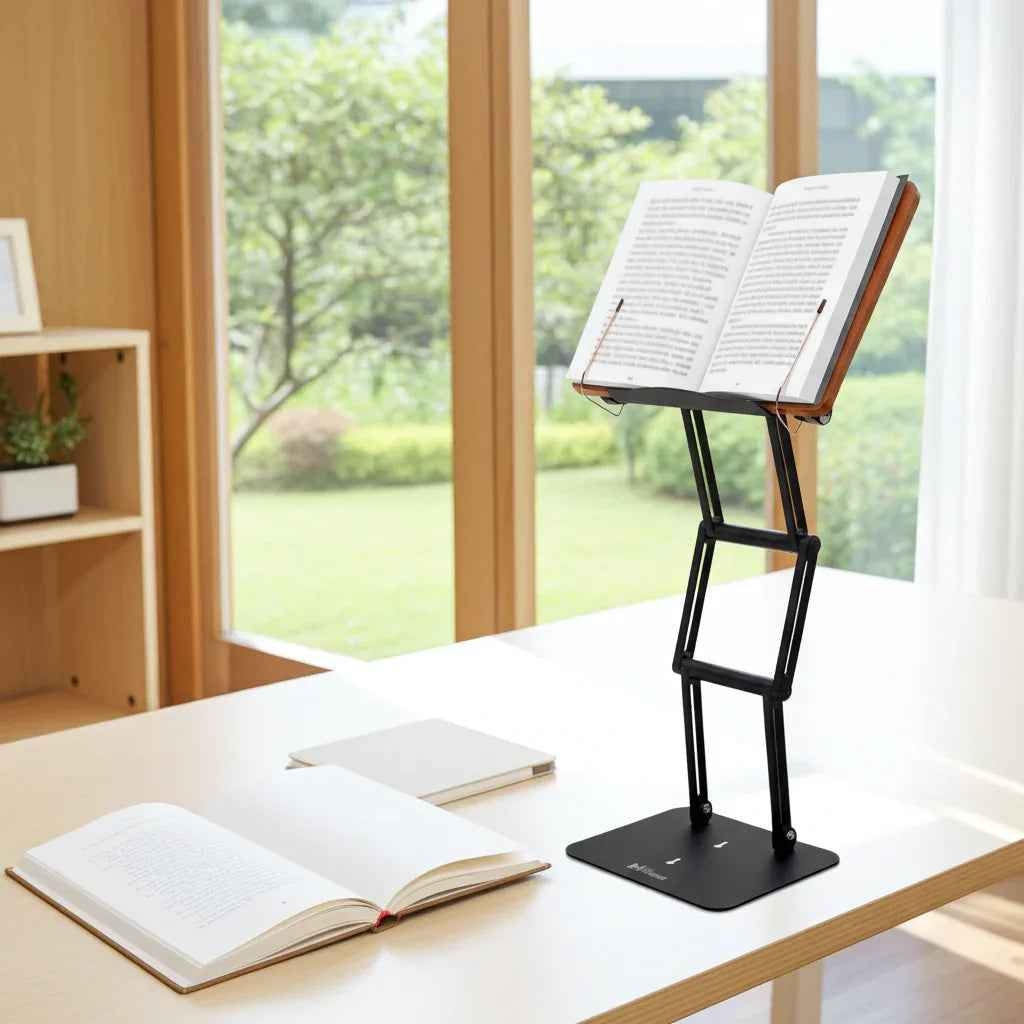
A textbook that weighs five pounds has a way of exposing bad equipment fast. The same stand that looks fine under a paperback starts wobbling, sagging, or tipping the moment you put real work on it. That is why a heavy duty book stand is not a niche accessory. For students, scholars, professionals, and anyone who spends long hours reading, it is part of a healthier and more productive setup.
Most people start shopping for a stand because of discomfort. Neck strain creeps in after hours of looking down. Shoulders round forward. The upper back stiffens. Then there is the practical frustration - pages won’t stay open, the angle is wrong, the stand slides across the desk, and your so-called solution becomes one more problem sitting in front of you.
What a heavy duty book stand should actually do
A serious stand has two jobs. First, it must support weight without flexing, collapsing, or shifting under load. Second, it must place reading material in a position that supports better posture rather than forcing your body to adapt to the desk.
That second point gets missed all the time. Many stands are called ergonomic because they tilt. Tilt helps, but it is only part of the story. If the book still sits low on the desk, you are still spending hours in cervical flexion, which is a cleaner way of saying your neck remains bent downward. A stand that raises material closer to eye level can reduce that demand and help keep the head, neck, and shoulders in a more neutral position.
In other words, heavy duty should refer to more than just weight capacity. It should also mean serious enough for serious use.
Stability matters more than people think
When a stand shakes every time you turn a page, you stop trusting it. That sounds minor until you use it for three hours straight. Micro-adjustments, wobble, and slippage create friction. Friction breaks concentration.
A well-designed heavy duty book stand should feel planted. That comes from material quality, joint design, and a structure that does not depend on wishful thinking. Aluminum construction, stainless steel joints, and a base designed to resist tipping make a measurable difference, especially when you are supporting dense textbooks, large art books, legal volumes, cookbooks, or sacred texts.
This is also where cheap stands tend to reveal their real category. Many are fine for a tablet, maybe a slim novel, and little else. Once you ask them to hold a serious volume at a meaningful height, they start acting like they were hired for a job above their pay grade.
Height is the feature most buyers underestimate
If you compare stands closely, one difference will matter far more than it seems on a product page: maximum elevation. A platform that raises a book only a few inches may improve the viewing angle, but it often does not meaningfully change posture. Your eyes still track downward. Your neck still follows.
A heavy duty book stand with substantial height adjustment gives you far more control. It allows seated reading at a better visual level and can also support moderate standing workflows. That matters for people who move between reading, note-taking, and device use throughout the day.
For example, a stand that can raise reading material 17.8 inches above the tabletop is operating in a different category from the average desk accessory. That kind of elevation creates options. It can serve as a true study platform, not just a prop.
Why weight capacity is only half the story
People often ask how much weight a stand can hold, and that is a fair question. But capacity alone does not tell you how the stand behaves under real use.
A stand may technically hold a heavy object while still feeling unstable, awkward to adjust, or vulnerable at the joints. What you really want is confident support through the whole range of motion. Can it hold a thick textbook at a steep angle? Can it remain steady while you annotate, flip pages, or rest your hands lightly on the lower edge? Can it support a laptop without the structure feeling stressed?
That is where build quality separates premium equipment from commodity gear. The difference is not just whether it survives day one. It is whether it keeps performing month after month without loosening, drifting, or becoming annoying to use.
The best heavy duty book stand is usually multi-use
If you are building a desk around long hours of focused work, single-purpose tools are not always the smartest investment. A strong stand should earn its place by handling more than one format.
Books are the obvious use case, but many people also need support for laptops, tablets, sheet music, printed reference materials, and cookbooks. Religious study adds another dimension, because the stand may function like a modern shtender - a raised platform built not just for convenience but for sustained concentration and respect for the text.
This versatility matters because work and study are rarely confined to one medium anymore. You may read a printed casebook in the morning, elevate a laptop for writing in the afternoon, and use the same stand for a tablet or recipe in the evening. A product that adapts across those contexts reduces desk clutter and increases the chance that you actually use it every day.
What to look for before you buy
The easiest mistake is to shop by appearance. Plenty of stands look sleek in photos. Fewer are engineered for real load, frequent adjustment, and long sessions.
Start with materials. Metal construction generally outperforms lightweight plastic when durability and stability matter. Then look at the joints and adjustment points. These are the mechanical stress areas. If they are flimsy, the stand will eventually tell on itself.
Next, assess height range, not just angle range. If posture improvement is a priority, the stand should raise the material enough to change where you are looking, not merely change the slope.
Finally, think about your heaviest and most common use cases. A medical student using dense textbooks, a rabbi studying large sefarim, a lawyer working through bound materials, and a home cook referencing oversized books all need something different from a casual e-reader stand. The right purchase depends on whether your stand is a convenience item or a daily tool.
Who benefits most from a heavy duty book stand
Anyone who reads for long stretches can benefit, but some users will notice the value immediately. Students working through heavy textbooks are one group. Researchers and academics are another, especially those managing large reference works and dense note-taking sessions. Professionals who split time between printed documents and digital devices also tend to appreciate a stand that transitions smoothly between formats.
Then there are users for whom raised study has cultural and practical significance. A modern shtender can support religious learning in a way that feels both traditional and contemporary. It respects the seriousness of the work while solving a very modern ergonomic problem.
And yes, leisure users can benefit too. A premium stand may sound like overkill for reading a novel or following a recipe, until your shoulders stop aching and your counter setup stops looking like a balancing act.
When a premium stand is worth it
Not everyone needs the highest-grade option. If you read occasionally, use only lightweight materials, and do not care about maximum elevation, a simpler stand may be enough.
But if you spend hours at a desk, deal with neck or upper back discomfort, or regularly use heavy books and multiple devices, the economics change. In that context, a premium heavy duty book stand is not about luxury. It is about consistency, comfort, and performance.
That is the logic behind products like the Stander 1.1. The value is not merely that it holds a book. It is that it supports better posture, meaningful elevation, serious stability, and multiple workflows in one piece of equipment. For the right user, that is not an upgrade for its own sake. It is a correction.
A good stand should disappear into your routine. It should hold the load, stay where you put it, and help your body do less compensating. If your current setup asks your neck to do all the work, that is not discipline. That is just bad engineering wearing a study hat.