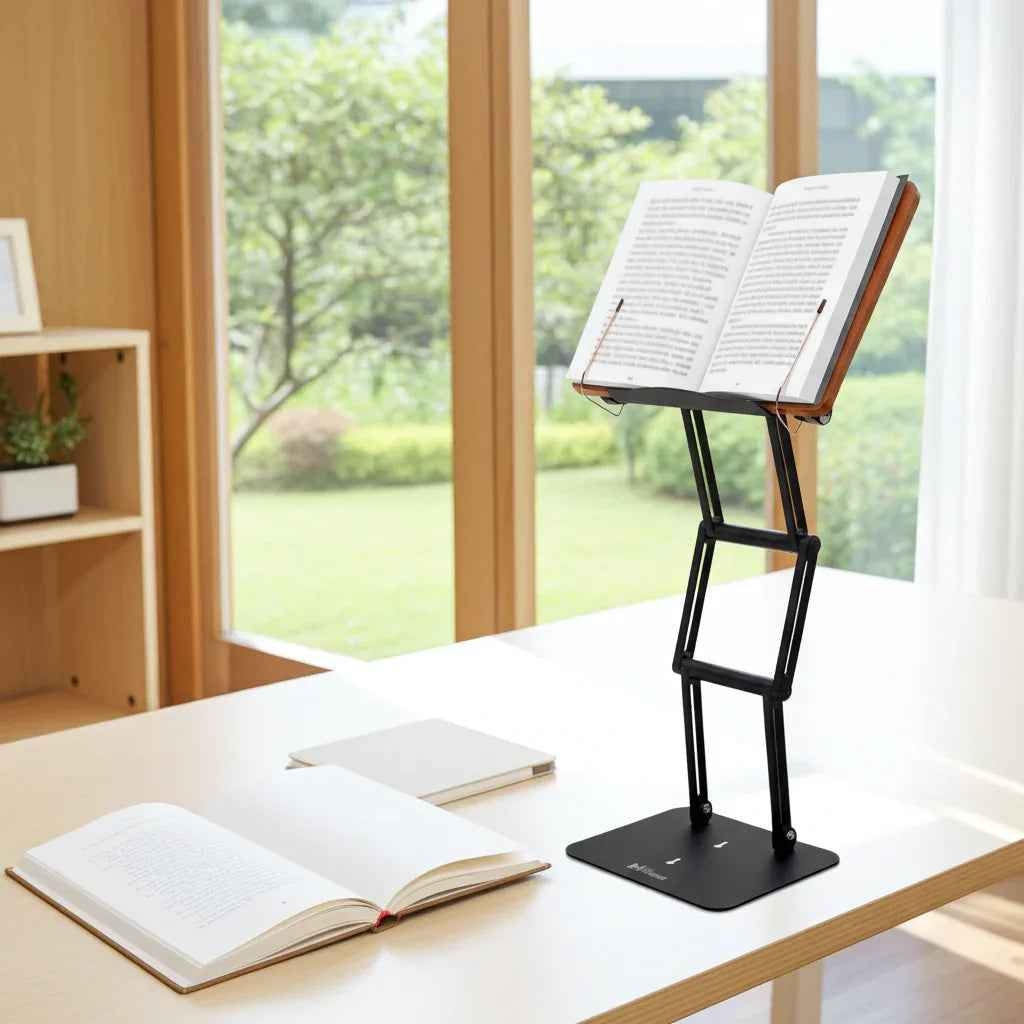
A desk can be perfectly organized and still create a bad reading posture. Put a heavy textbook flat on the surface, lower your head for an hour, and your neck will explain the problem soon enough. Foldable book stands for desks address that problem by bringing the page upward, where your eyes can meet it without turning every study session into a slow cervical-spine workout.
But “foldable” is only one part of the decision. A stand that folds flat may travel well yet wobble under a medical textbook. Another may hold a tablet nicely but stop far below a comfortable viewing height. For serious readers, students, professionals, and scholars, the useful question is not simply whether a stand folds. It is whether it can support focused work without asking your body to compensate for weak design.
Why a flat book creates a posture problem
When reading material sits directly on a desk, the reader usually responds by bending the neck and rounding the upper back. The longer the material stays low, the more likely that forward-head position becomes the default. This is especially common during exam preparation, legal review, research, religious study, recipe reading, and any task that asks for sustained attention to a page.
A book stand does not make posture perfect by itself. Your chair height, screen position, keyboard placement, and habits still matter. It does, however, remove one very predictable source of strain: the need to repeatedly angle your head downward to see the material clearly.
Elevating the page also changes the quality of attention. When a book is propped at a readable angle, users often spend less time repositioning pages, leaning on one elbow, or hunching closer to small text. The workspace begins to support the task rather than quietly fighting it.
What foldable book stands for desks should do
The best stand depends on what you read, where you work, and whether the stand needs to travel. Still, a serious desk stand should deliver four things at once: a useful height range, dependable stability, a secure page-support system, and a footprint that does not consume the whole desk.
Raise material toward eye level
Angle matters, but height matters more than many buyers realize. A small incline can make pages easier to see, yet it may leave the reader looking downward for hours. For a seated workstation, the ideal position varies with body proportions, chair setup, and book size. For a standing workflow, it varies even more.
Look for a stand with enough vertical adjustment to place the upper portion of the reading material closer to eye level. This is where many compact folding stands reach their limit. They are often built as page holders, not as true ergonomic tools.
A taller stand also creates flexibility. You can use it low for a cookbook or reference manual, higher for seated reading, and higher still when alternating between sitting and moderate standing. One stand can serve more than one room and more than one kind of work.
Stay steady under real weight
A stand should not require a delicate touch when you turn a page. That sounds obvious, but lightweight plastic frames and narrow hinges can become unstable when they hold dense textbooks, large print books, binders, or sacred volumes.
Stability comes from material strength, joint construction, base design, and the relationship between the load and the stand’s center of gravity. Aluminum construction and stainless steel joints are not decorative upgrades when a stand is expected to support serious materials repeatedly. They are part of what keeps the platform steady when the work gets heavy.
If your usual reading involves paperback novels, a compact stand may be enough. If it involves anatomy texts, legal volumes, reference books, laptops, or a Gemara opened wide, choose accordingly. A stand that saves a few inches of storage space but cannot reliably carry the load is not really saving space. It is creating a new problem.
Hold pages open without damaging them
A good lower lip supports the book securely, while page holders keep pages from falling closed. These details matter most with thick books, stiff new bindings, and materials that must remain open to a particular passage.
The goal is support, not force. Aggressive clips can obscure text or put unnecessary pressure on fragile pages. Weak clips, on the other hand, are little more than decorative optimism. The right design holds the material open while allowing easy page turns and clear sightlines.
Fold for storage without becoming flimsy
Folding is valuable. It lets a stand move from office to kitchen, from dorm room to library, or from a study desk to a standing counter. It also makes it easier to store when the desk needs to serve another purpose.
Still, folding mechanisms involve trade-offs. The more adjustment points a stand has, the more carefully those joints must be engineered. A simple, low-profile folding stand can be excellent for occasional reading. A height-adjustable, heavy-duty design needs stronger hardware and a more deliberate structure. Serious portability is not the same as thinness.
Choose the right stand for your workflow
Start with the material you use most often. A tablet or e-reader needs a different type of support than a 1,200-page textbook. A laptop adds heat, keyboard, and screen-position considerations. Sheet music needs a broad viewing surface. A cookbook benefits from easy cleanup and a stable base on a counter.
Then consider how long you use it. Ten minutes of recipe reading does not demand the same ergonomics as four hours of dissertation research. If your sessions are long, prioritize elevation and rigidity over a stand designed mainly to disappear into a backpack.
Finally, measure the available space and your usual working height. A stand may look compact in product photos but still need enough clearance for its base, support arms, and the book itself. The good news is that vertical storage can reduce desk clutter. When the book rises off the desktop, you gain room for notes, a keyboard, a notebook, or simply your forearms.
The difference between a book holder and a modern shtender
The traditional shtender was built around a sensible principle: serious study deserves a raised, dedicated surface. That principle remains useful whether the material is a siddur, a scholarly text, a litigation binder, or a laptop displaying source material.
A modern version should retain that seriousness while adapting to current work. It should hold material at a meaningful height, tolerate substantial weight, and adjust to the person rather than forcing the person to adapt to the furniture. This is not an indulgence for people who care about their desks. It is practical equipment for people who spend real time at them.
The Stander 1.1 was designed in that spirit. Its adjustable structure raises the supporting lip up to 17.8 inches above the tabletop, with the book or screen sitting even higher depending on its size. That range makes it useful for seated work and moderate standing, while its aluminum body and stainless steel joints are intended for the demands of heavy texts and daily use.
Set up your stand for less strain
Begin by placing the stand directly in front of you, not off to one side. If you must twist your neck to read, even a tall platform loses much of its ergonomic value. Set the height so your gaze lands on the upper half of the page with only a modest downward angle.
Keep frequently used writing tools close enough that you do not reach around the stand all day. If you take notes by hand, position the book slightly higher and leave a clear writing zone below it. If you use a laptop alongside a book, remember that the laptop keyboard may need to be separate from the raised screen for a fully comfortable setup.
Take breaks as well. A well-designed stand reduces the need to hunch, but no piece of equipment can make motion unnecessary. Change position, look into the distance, and reset your shoulders periodically. Your body appreciates variety, even when the research question does not.
A better desk begins with where the page sits
The right foldable stand turns reading material from a low, static object into an adjustable part of your workstation. Choose one based on height, stability, load capacity, and the kind of work you actually do. Your textbook may be heavy, your reading list may be unreasonable, and your desk may be small. The stand should be the easy part.