A heavy textbook has a talent for turning a study session into a full-body endurance test. Ten minutes in, your wrists start negotiating, your shoulders creep upward, and your neck bends forward like it owes the page something. If you are wondering how to hold textbooks comfortably, the real answer is not just about your hands. It is about position, support, angle, and how long your body is being asked to do a job it was never built to do.
Most people try to solve textbook discomfort with grip strength. That is usually the wrong fix. The problem is rarely that you are too weak to hold the book. The problem is that a large, dense object is pulling your arms down while your eyes want the page higher. Your body compensates by rounding the upper back, jutting the head forward, and loading the neck and shoulders. You can get away with that for a few pages. Over an hour, it becomes expensive.
Why holding textbooks gets uncomfortable so fast
Textbooks are awkward by design. They are wide, heavy, and resistant to staying open. Unlike a paperback novel, they often demand visual attention to diagrams, footnotes, and dense blocks of text, which means you naturally lean in. That forward lean matters. Even a modest bend at the neck increases the strain on the cervical spine and the muscles supporting the head.
There is also the issue of static effort. A textbook does not have to feel extremely heavy to wear you out. Holding anything in one position without movement creates fatigue. Your forearms tense to stabilize the pages, your shoulders contract to keep the book elevated, and your lower back often joins the protest because the rest of your posture shifts around the task.
This is why comfort is less about heroic posture and more about reducing the need to hold the book at all.
How to hold textbooks comfortably without fighting your body
If you must hold the book in your hands, bring it closer to eye level instead of dropping your head to the page. That single adjustment reduces the urge to crane your neck. Keep your elbows supported whenever possible, either against your torso, on armrests, or on the desk. Unsupported arms turn a reading problem into a shoulder problem.
Your grip should stay light. Many readers squeeze the covers or spine harder than necessary, which creates extra tension in the hands and wrists. Let the palms support the weight while the fingers simply guide the book. If the book is very large, hold it from underneath rather than pinching it from the sides.
Switch positions before discomfort becomes obvious. That sounds simple, but many people wait until they are already stiff. Alternate between holding the bottom corners, resting the book partly on a desk, and changing the angle slightly every few minutes. The goal is not perfect stillness. The goal is less accumulated strain.
The best hand and arm positions for short reading sessions
For brief periods, the most comfortable setup is usually to rest the bottom edge of the textbook on your lap or desk while your hands steady it. This takes most of the load off the arms. If you are sitting back in a chair, use a pillow or folded blanket on your lap to raise the book closer to your face. It is not glamorous, but neither is a stiff neck.
If you are standing or walking between classes, cradle the book against your forearm and torso instead of gripping it with one hand at your side. Carrying a textbook one-handed like a brick may look efficient, but it pulls the shoulder down and encourages uneven loading through the neck and upper back.
When your lap is better than your hands, and when it is not
Reading on your lap is better than holding a heavy book fully in the air, but it is not a perfect solution. The lower the book sits, the more likely you are to bend your neck downward. For a short review session, that may be fine. For an hour of serious reading, it is usually not.
That is the trade-off with lap reading. It reduces arm fatigue but often increases neck flexion. If your textbooks are heavy and your sessions are long, the most useful improvement is to raise the book rather than simply changing how you grip it.
The ergonomic fix: support the textbook instead of supporting it yourself
There is a point where technique stops helping because the object itself is the problem. A large medical text, law casebook, engineering volume, or religious text can be too heavy and too unwieldy for comfortable hand-holding over time. In that case, the right answer is external support.
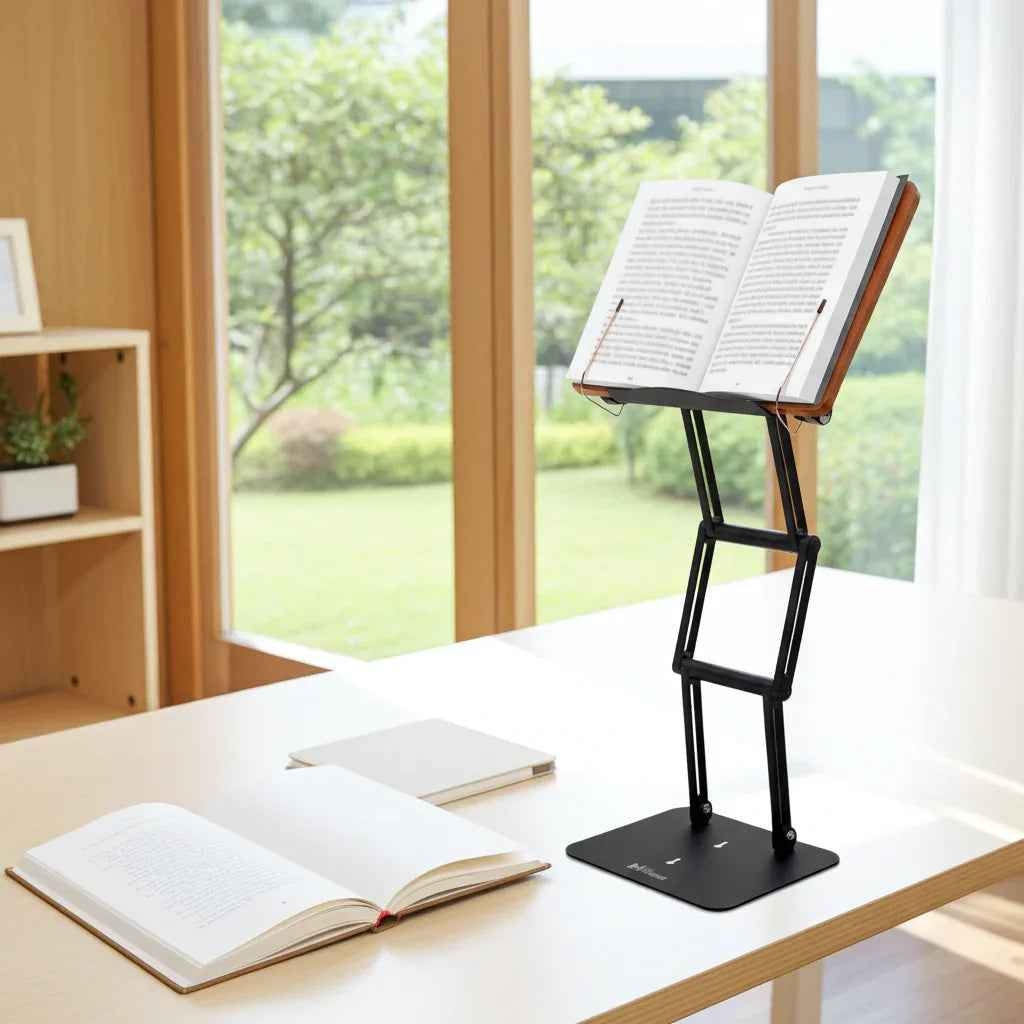
A properly designed stand changes the entire equation. It lifts the textbook toward eye level, holds the weight for you, and keeps the pages stable at a readable angle. That reduces neck flexion, decreases shoulder elevation, and frees your hands for note-taking, highlighting, or simply relaxing for once.
This is where many cheap stands fail. They may work for a tablet or a thin paperback, but heavy books expose every weakness fast. If the platform wobbles, slips, or sits too low, your posture still loses. For serious readers and students, stability matters as much as elevation.
How to hold textbooks comfortably at a desk
At a desk, the most effective setup is usually not to hold the textbook at all. Place it on a stable stand with the page angled toward your eyes. Ideally, the top half of the page should sit much closer to your natural line of sight than it would flat on the desk. That lets your head stay more upright and your spine more neutral.
If you are taking notes by hand, position the book slightly off-center and keep your writing surface close. If you are typing, make sure the book is high enough that you are not constantly looking down and then back up at the screen. Repetitive head movement is not always a problem, but repetitive downward strain often is.
A premium adjustable stand such as The Stander 1.1 is built for exactly this kind of work. It raises books significantly higher than typical book stands, supports heavy academic texts with real stability, and allows a seated or moderate standing workflow. That extra height is not a luxury feature. It is what makes eye-level reading more realistic, especially with larger books.
A note on standing study setups
Some people focus better while standing, especially during review sessions or long reading blocks. That can work well if the book is elevated enough. If the textbook is just sitting on a countertop and you are bending down to read it, standing solves very little. The page still needs to come to you.
This is one reason height adjustment matters. A stand that can move between seated and standing use gives you options, which is often the difference between a setup you admire and one you actually use.
Small adjustments that make a big difference
Lighting matters more than people think. Poor lighting makes you lean closer, even when the book is positioned reasonably well. A brighter, well-aimed lamp can reduce the unconscious forward drift that wrecks posture.
Page management matters too. If a textbook will not stay open, you end up using one hand as a human paperweight. A page holder or a stand with a solid retaining lip removes that problem. The less your hands are occupied with wrestling the book, the more relaxed your upper body can stay.
Chair height also plays a role. If your chair is too low relative to the desk, your shoulders rise and your wrists angle awkwardly. If it is too high, your forearms lose support. Comfort is rarely about one magic product or one magic cue. It is usually a chain of reasonable adjustments working together.
When discomfort is a sign to stop improvising
If you regularly finish reading with neck tightness, tingling in the hands, sore wrists, or a burning feeling between the shoulder blades, that is useful feedback. It usually means your setup is asking your body to compensate too much, too often. Stretching can help a little. Better positioning helps more. Proper support helps most.
There is a place for toughness in academic work. Holding a 1,200-page textbook in midair for two hours is not that place. Serious study deserves equipment that matches the seriousness of the task.
The most comfortable way to hold a textbook is, quite often, to stop holding it and let a stable, elevated support do the heavy lifting while you keep your attention on the page where it belongs.