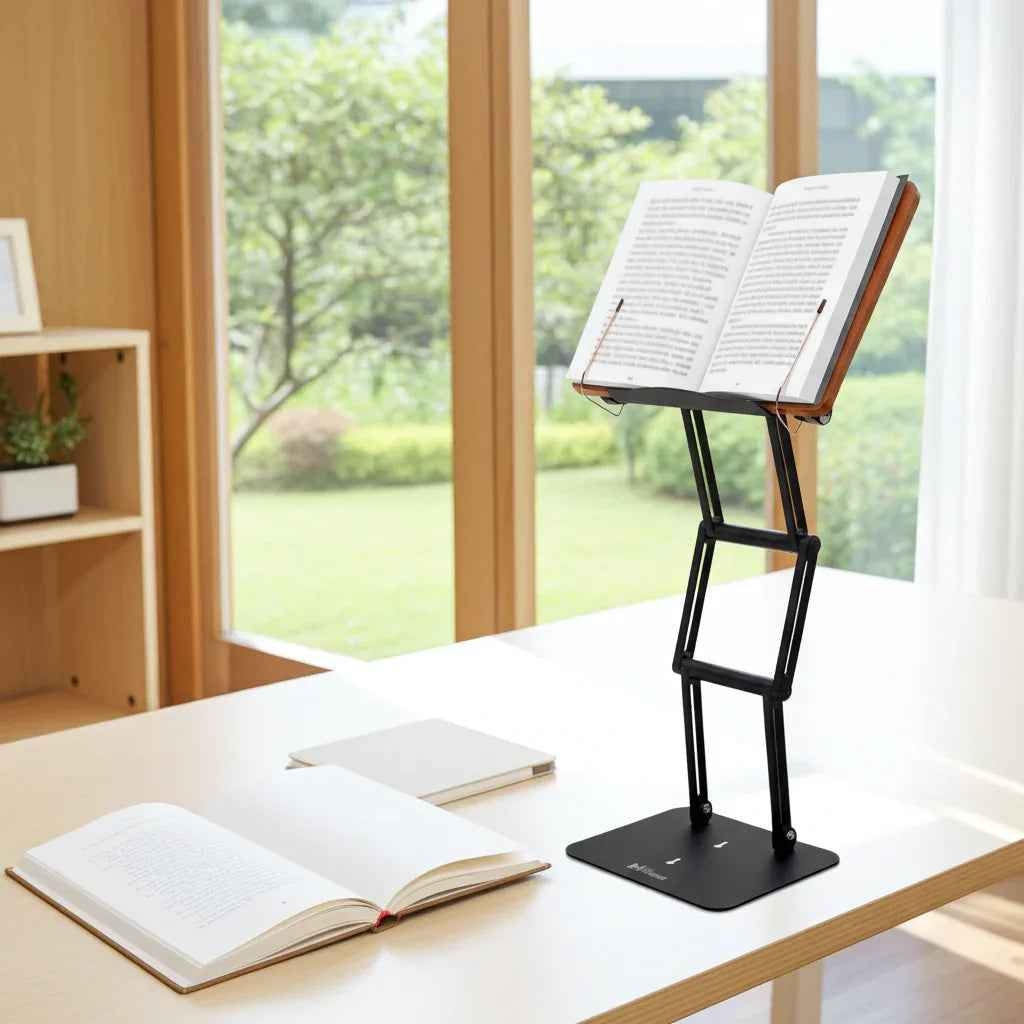
If your neck starts complaining halfway through a chapter, the question is not random at all: is a raised book holder worth it? For people who read, study, annotate, or work at a desk for hours, the answer is often yes - but not for every setup, and not every stand.
That distinction matters. A flimsy stand that props up a paperback a few inches off the table is one thing. A genuinely raised, stable holder that brings books or screens closer to eye level is another. One is a convenience accessory. The other can change posture, endurance, and how long you can work comfortably.
Is a raised book holder worth it for posture?
Usually, yes, especially if you spend long stretches looking down at textbooks, documents, or a tablet. The basic ergonomic problem is simple: when reading material stays flat on a desk, your head follows it downward. That repeated neck flexion loads the cervical spine, rounds the upper back, and tends to pull the shoulders forward.
People often think the issue is dramatic pain, but more often it starts as fatigue. You shift around. You prop your chin on your hand. You lean on one elbow. You hunch, straighten up, then hunch again. By the end of a study session, your focus is gone before your motivation is.
A raised book holder helps by changing the viewing angle. When reading material sits higher, you do not have to crane downward as much. That reduces sustained strain on the neck and upper back and makes a more upright posture easier to maintain. Easier is the key word. Good ergonomic tools do not force perfect posture by magic. They reduce the effort required to keep a decent one.
That said, height is everything. If the holder lifts the book only slightly, the benefit may be modest. If it raises the material meaningfully closer to eye level, the difference can be immediate.
The real value is not just comfort
People buy reading stands for comfort and then keep using them for performance. That is the part many shoppers miss.
When your material is better positioned, reading feels less physically taxing. That matters because physical strain quietly steals attention. You reread lines. You lose your place. You get distracted by discomfort. A well-raised holder can make serious reading feel more sustainable, which is exactly what students, attorneys, researchers, clergy, and desk-based professionals need.
There is also a workflow benefit. A raised holder can keep a textbook, notes, recipe, sheet music, or tablet visible without taking over the whole desk. If you are switching between reading and writing, or between a laptop and source material, elevation improves sight lines and reduces awkward twisting. It is not glamorous. It is just efficient.
When a raised book holder is absolutely worth it
A raised book holder makes the most sense when reading is not an occasional activity but a core part of your day. If you are working through dense material for an hour or more at a time, your setup matters.
It is especially useful for students dealing with heavy textbooks, graduate researchers reviewing articles, professionals referencing printed documents, and religious scholars studying substantial volumes. In those cases, stability is not a luxury. A stand that wobbles, slips, or collapses under weight becomes one more problem to manage.
It is also worth it if you alternate between sitting and standing. Most book stands are really desk props. They tilt, but they do not rise much. That is fine for light use. It is not fine if you want the material elevated enough to support multiple working positions.
And if you already know the pattern - neck tightness, forward head posture, shoulder fatigue, the urge to lie flat on the desk by 3 p.m. - then you are not really shopping for an accessory. You are trying to remove a recurring physical barrier from your work.
When it may not be worth it
There are cases where the answer is no.
If you read casually for short periods, use mostly audiobooks, or rarely sit with physical books at a desk, a raised holder may not earn its keep. The same goes if your main issue is chair height, monitor position, or keyboard placement rather than reading angle. A book holder can help one part of the setup, but it cannot fix an entire workstation on its own.
It may also be unnecessary if you only need to support very light material for occasional reference. Plenty of low-cost stands can handle a magazine, a thin paperback, or a tablet for short sessions. Not every user needs a professional-grade platform.
That is the trade-off. The more serious and prolonged the use case, the more a premium raised holder makes sense. The lighter and less frequent the use, the less value you may get from paying for higher elevation and stronger construction.
What separates a useful raised holder from a disappointing one
This is where many people waste money. They assume all book holders do the same job. They do not.
The first factor is height. If the stand does not raise your material enough, posture improvement will be limited. The second is stability. A stand that shakes while you turn pages or tap a tablet is irritating at best and unusable at worst. The third is load capacity. Serious readers do not always work with light paperbacks. They use casebooks, medical texts, large religious works, and laptops.
Material quality matters too. Plastic can be fine for light-duty use, but heavy-duty aluminum and strong joints create a very different experience over time. You feel the difference when adjusting the angle, placing a large book on the platform, or using it daily for months instead of occasionally on weekends.
Then there is versatility. A strong raised holder can function as a book stand, laptop riser, tablet stand, document holder, cookbook stand, or even a portable lectern. That does not mean it should try to be everything to everyone. It means the design should be robust enough to support real work across contexts.
A serious user needs more than a page perch
If your reading is rigorous, the stand needs to be equally serious. This is where premium designs earn their price.
For example, a height-adjustable stand that can raise material up to 17.8 inches above the tabletop changes the ergonomic equation far more than a basic tilted tray. That level of elevation makes it easier to bring books and screens toward eye level and to support both seated and moderate standing use. It is a meaningful difference, not a marketing flourish.
The same is true for construction. Aluminum platforms, stainless steel joints, and a stable base are not there to look impressive. They are what allow a stand to handle heavy books, legal volumes, laptops, and tablets without behaving like a folding music stand having a bad day.
For users who want a modern shtender with true ergonomic value, that combination of elevation, durability, and stability is exactly the point. One well-built stand can replace several compromised tools.
Cost versus value
The price question is fair. A raised book holder can range from cheap to surprisingly expensive, and not everyone wants another object on the desk.
But value is not just purchase price. If the holder helps you work longer with less neck strain, supports better posture, and keeps your reading material in a usable position every day, it is serving a health and productivity function. For many people, that is worth more than the cost difference between a premium stand and a disposable one.
On the other hand, if it ends up in a drawer after a week, it was not worth it no matter how affordable it looked.
A good rule is this: match the tool to the seriousness of the work. If your books are heavy, your sessions are long, and your body is already objecting to your setup, buying the cheapest option is usually false economy.
Improve Your Setup
If you're looking to elevate your law books, tablets, or laptops to a more comfortable reading position, an adjustable stand can make a significant difference.
So, is a raised book holder worth it?
If you are a serious reader, student, scholar, or desk worker, yes - provided it actually raises the material enough, stays stable, and supports the weight you put on it. The ergonomic benefit is real, but only when the design is up to the job.
If you read lightly and infrequently, probably not. A basic stand may be enough, and sometimes no stand at all is fine.
The better question is not whether any raised holder is worth it. It is whether your current setup is helping you read and work without dragging your neck, shoulders, and attention span down with it. If the answer is no, a well-designed raised holder is not an indulgence. It is a practical correction, and your spine is unlikely to send a thank-you card unless you make the change yourself.