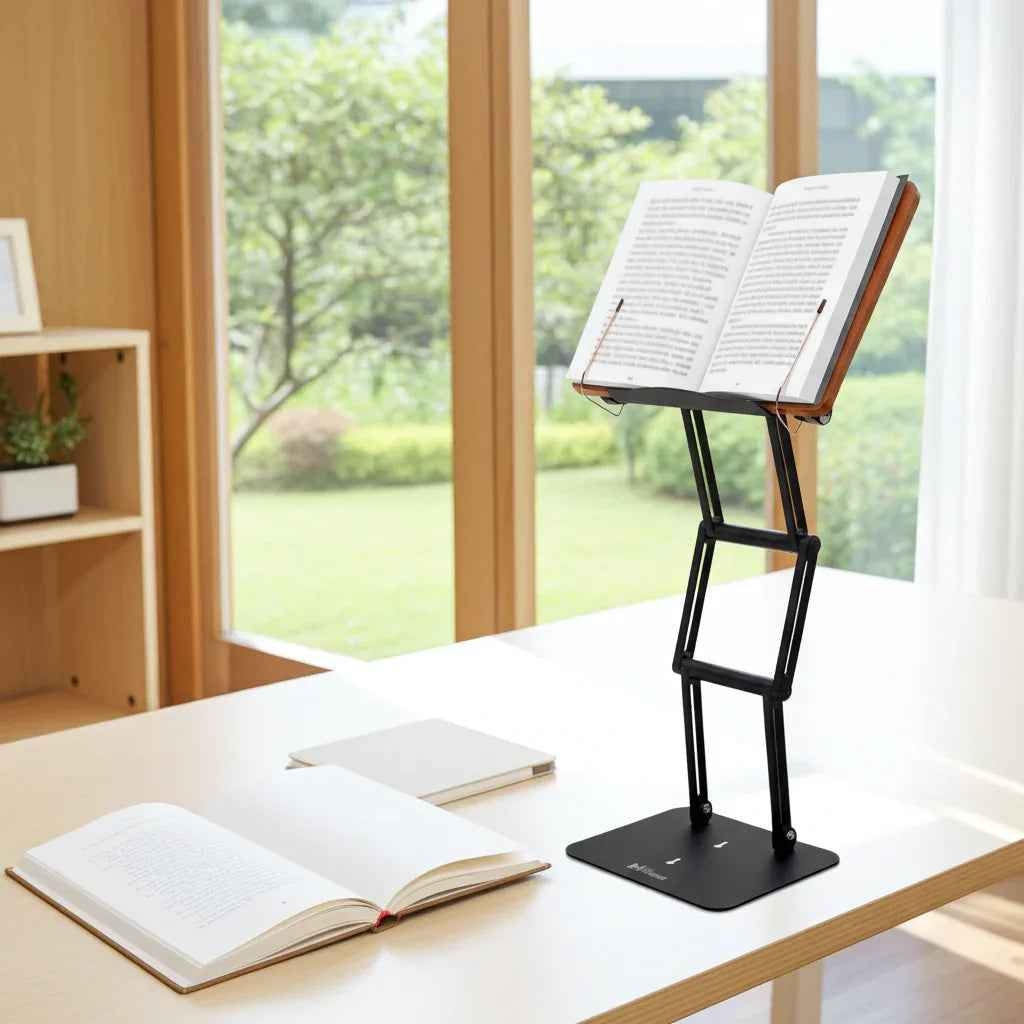
If you have ever balanced a heavy textbook on a cheap wire frame and called it good enough, you already know why the lectern vs book stand question matters. These two tools may seem similar at first glance, but they solve different problems. One is built around presentation and public reading. The other is usually built around personal study, reference work, and desk ergonomics.
That distinction matters more than most people think. If you spend hours reading casebooks, religious texts, sheet music, cookbooks, or academic material, the wrong setup does not just waste space. It pulls your head down, rounds your shoulders, and turns focused work into a neck and upper back complaint.
Lectern vs book stand: the core difference
A lectern is traditionally a freestanding angled platform designed for speaking, presenting, or reading aloud while standing. You see it in lecture halls, houses of worship, courtrooms, conference rooms, and ceremonies. It is made to hold papers, notes, or a book at a readable angle for someone addressing a room.
A book stand is usually designed for closer-range use at a desk, table, or countertop. It supports a book, tablet, laptop, or documents for one person working directly in front of it. In ergonomic terms, that changes everything. A book stand is less about projecting authority and more about reducing strain during sustained reading or study.
There is overlap, of course. Some book stands can function like a compact lectern, and some lecterns can hold books for study. But the intended use still shapes the design. A lectern prioritizes standing presentation. A book stand prioritizes personal access and object support.
Why the lectern vs book stand choice affects posture
Most people do not buy a reading support because they are thinking about cervical spine mechanics. They buy one because their neck hurts, their desk feels cramped, or they are tired of hunching over. Fair enough. The body, however, keeps score.
When reading material sits flat on a desk, your head tends to drop forward. That forward head posture increases the load on the neck and upper back. Over time, this can lead to stiffness, fatigue, shoulder tension, and shorter periods of comfortable focus. For students and professionals, that is not a small issue. It directly affects endurance.
This is where a well-designed book stand often has the advantage. It is meant to bring material upward into a more natural visual field. A standard lectern may also raise content, but many are designed around temporary use, not hours of close reading. If your goal is prolonged study, height adjustability and stable positioning matter more than the category name.
That is why the better question is not simply lectern or book stand. It is this: does the support hold your reading material high enough, steadily enough, and close enough to preserve better posture?
Where a lectern makes more sense
If you regularly speak to groups, lead services, teach from printed notes, or read aloud while standing, a lectern is often the right tool. It gives you a formal presentation surface, a wider reading area, and a familiar upright presence. In some settings, that matters culturally and practically.
A lectern can also work well when appearance is part of the function. Public events, classrooms, sanctuaries, and conference spaces often benefit from equipment that looks appropriate to the room. A desk-mounted reading stand may be ergonomically useful, but it will not always replace the visual role of a proper lectern.
That said, many lecterns are not built for portability, compact storage, or frequent repositioning around a work surface. They can also be overkill if you are studying alone at a desk. If your main task is reading a Talmud volume, reviewing contracts, editing manuscripts, or following a cookbook in the kitchen, a full lectern may feel like using a podium to butter toast.
Where a book stand makes more sense
A book stand is usually the better choice for individual workstations. It takes up less space, integrates more naturally with a desk, and can support the kind of repeated close-range reading that defines serious study.
This is especially true if you work with heavy or oversized materials. Law books, medical texts, religious volumes, art books, and large-format manuals need more than a decorative page holder. They need structural stability, a secure lip, and joints that do not sag halfway through the day.
A good book stand also tends to be more versatile. It can hold a textbook in the morning, a laptop in the afternoon, and a tablet at night. That matters for anyone moving between reading, writing, video calls, and reference work without wanting three separate contraptions cluttering the desk.
For many users, the best modern book stands are really ergonomic utility stands. They do not fit the old stereotype of a flimsy cookbook prop. They are closer to professional equipment for sustained intellectual work.
The features that actually matter
In the lectern vs book stand comparison, people often focus on appearance first. That is understandable, but function should win. The most important variables are height, stability, angle control, load capacity, and footprint.
Height is the big one. If the stand barely lifts a book off the desk, it may improve visibility a little but do far less for posture. Serious users benefit from a stand that can raise reading material much higher, especially if they alternate between sitting and moderate standing. The closer the top of the page or screen gets toward eye level, the less your neck has to do unpaid overtime.
Stability is next. A stand that shakes when you turn a page or dips under a heavy text is not ergonomic. It is distracting. This is where premium construction matters. Aluminum, strong hinges, and stainless steel joints are not marketing flourishes. They are the reason the platform stays where you put it.
Angle control matters because different tasks require different positions. Reading dense text, using a tablet, following sheet music, and referencing a recipe all feel better at different tilt settings. A rigid surface with one preset angle may be fine for occasional use. It is not ideal for long sessions.
Load capacity matters more than casual buyers expect. Plenty of stands are fine with a paperback and surrender immediately when introduced to a serious hardcover. If your materials are heavy, the support system has to be equally serious.
The traditional shtender and the modern ergonomic stand
For many religious scholars, this discussion has another layer. The traditional shtender is not just a piece of furniture. It is part of a study culture built around seriousness, focus, and respect for the text. That heritage still matters.
What has changed is the physical reality of modern study and work. People now move between seforim, laptops, tablets, printouts, and notebooks. They study longer, often at desks that were not designed especially well. The result is familiar: bent neck, tight traps, and the quiet belief that discomfort is simply the price of diligence.
It is not. A modern stand can preserve the spirit of the shtender while improving the ergonomics dramatically. That combination is why some users want something that functions as a book stand, laptop riser, textbook holder, and portable lectern without looking or performing like a disposable accessory. Dr. Shtaygen was built around that exact problem.
So which should you buy?
If your main job is public speaking or formal reading while standing in front of others, buy a lectern. It is designed for that environment, and trying to force a desktop stand into ceremonial duty is usually awkward.
If your main job is studying, reading, writing, or referencing material for long periods, a book stand is usually the better choice. If you also want posture support, look for one with substantial height adjustment, not just a token incline.
If you need both, the answer depends on how often each role matters. Some users genuinely need a dedicated lectern for public-facing work and a separate ergonomic stand for desk-based study. Others can use a premium adjustable stand as a hybrid solution, especially if portability and multi-device use matter more than formal presentation furniture.
The mistake is buying by label alone. A flimsy product called a lectern is still flimsy. A serious adjustable book stand may outperform it for nearly every private reading task.
The best setup is the one that lets you read longer, work more comfortably, and stop craning your neck toward the desk like the page has offended you personally.