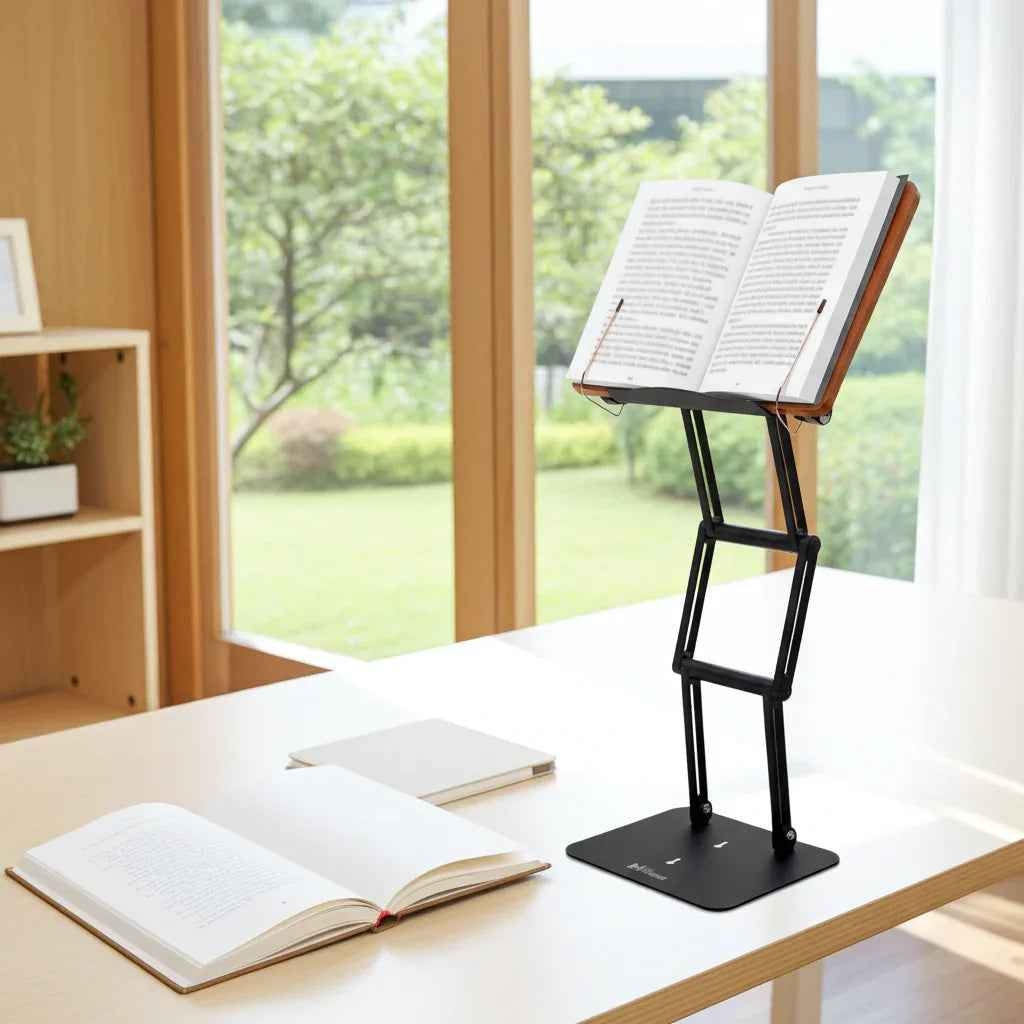
A premium desk book holder review should not begin with finish color or whether a stand folds into a small square. It should begin where serious readers feel the problem: several chapters into a textbook, legal brief, siddur, cookbook, or research paper, when the neck has been angled downward long enough to complain. A proper desk stand changes the height, angle, and stability of the material in front of you. That is the difference between a desk accessory and a tool for sustained work.
For readers who spend real hours at a desk, a premium holder earns its place by keeping books and screens closer to eye level, holding them without wobble, and adapting as the work changes. The standard is higher than “it can hold a tablet.” It needs to support the kind of reading that actually demands attention.
What a Premium Desk Book Holder Must Do
Most inexpensive book holders solve one limited problem: they prop up a light paperback or tablet at a modest angle. That can be useful for a recipe video or a few pages of leisure reading. It is not the same as supporting a thick textbook, a large-format reference book, or a laptop through a long study session.
A premium stand should provide three things at once: meaningful elevation, dependable load-bearing strength, and adjustment that stays put. Miss any one of those, and the user starts compensating. A stand that is strong but too low still encourages a downward head position. A tall stand that shakes when pages turn becomes distracting. A flexible stand with weak joints gradually becomes a very expensive way to recreate poor posture.
The real ergonomic goal is straightforward: bring the reading surface upward so the eyes can meet it with less cervical flexion. You may still look slightly down, depending on your task and screen position, but you should not have to curl over the desk to read. That shift can help reduce the neck and upper-back strain associated with hours of desk-bound work.
Premium Desk Book Holder Review: The Details That Matter
The first feature worth evaluating is maximum height. This is where many “adjustable” stands disappoint. They tilt, they swivel, or they rise a few inches, but they remain essentially tabletop devices. That may be enough for a tablet used while seated. It is rarely enough for a reader trying to alternate between sitting and moderate standing.
The Stander 1.1 raises its supporting lip 17.8 inches above the tabletop. Since the book, laptop, or tablet rests above that lip, the actual reading surface sits higher still. This range gives the stand genuine flexibility for seated desk work, elevated counter work, and moderate standing use. For a tall reader or someone using a deep desk, height is not a luxury specification. It is the specification that determines whether the setup can meet the eyes rather than pull the eyes down.
Material choice is equally revealing. Thin plastic and lightweight hinges are common because they are inexpensive and easy to ship. They are also a poor match for heavy books. A serious stand benefits from aluminum construction and stainless steel joints because the parts that carry weight and hold position need to resist flexing, loosening, and premature fatigue.
A substantial build has a trade-off: it is not featherweight. That is a feature for a desk stand expected to carry academic volumes, a laptop, or a large tablet without skittering across the surface. If your only goal is holding a phone on an airplane tray table, a compact plastic accessory may make more sense. If your goal is focused work at a stable workstation, a heavier premium build is the more sensible choice.
Stability Is a Concentration Feature
Stability is often described as a product feature, but it is better understood as a concentration feature. A book holder that shifts when you turn a page creates a tiny interruption every time you interact with it. Over a three-hour study block, those interruptions add up.
A well-engineered stand should hold its angle under load and maintain a firm base when the user writes notes, consults a source, or changes pages. It should feel planted rather than precarious. This matters especially for large religious texts and scholarly works, where the object being supported is not a slim paperback but a substantial volume opened wide for extended study.
There is a quiet connection here to the traditional shtender. A proper shtender was never merely a surface for placing a book. It created a dedicated posture for learning. The modern version should preserve that seriousness while adding practical adjustability for the desk, home office, classroom, and kitchen.
How It Performs Across Real Workflows
The strongest case for a premium desk holder is not one use case. It is the ability to move between them without buying separate gear for every task.
For students, the most valuable setup is often a textbook raised above the desk while a notebook or keyboard remains below. The visual reference stays in a higher, more comfortable position, and the work surface remains available for writing. Researchers and professionals can use the same arrangement for reports, reference binders, printed drafts, and tablets displaying source material.
For laptop users, elevation can improve the screen position, but there is an important caveat. Raising a laptop high enough for better viewing also raises its built-in keyboard. For long typing sessions, the better arrangement is usually an elevated laptop paired with an external keyboard and mouse. The stand improves screen height; the separate input devices preserve a more neutral arm and wrist position. Ergonomics is not magic. It works best when the entire workstation is considered.
In the kitchen, the same stability that supports a heavy text can hold a cookbook or tablet above splashes and clutter. Musicians may use it for sheet music. Presenters can use it as a portable lectern. Customers have even adapted this style of stand for projectors and other equipment. Versatility is useful, provided it does not compromise the main job: supporting reading and viewing materials securely.
Who Benefits Most From a Premium Stand
A premium stand is most justified for people who regularly read, study, teach, write, or work from reference materials. That includes graduate students with oversized textbooks, attorneys reviewing case materials, clinicians studying manuals, remote professionals balancing a laptop workflow, and scholars who need a modern shtender that can handle serious volumes.
It is also a practical upgrade for anyone whose desk habits have become a cycle of hunching, shifting, and taking breaks because reading in the usual position becomes uncomfortable. A stand will not replace movement, a well-fitted chair, sensible screen settings, or medical care when pain persists. It can, however, remove one major source of strain: forcing the head and neck to follow materials that sit too low.
The Stander 1.1 is designed for this more demanding category of user. Its aluminum structure, stainless steel joints, high elevation, and stable support address the failure points that make ordinary holders frustrating. Dr. Shtaygen built it for the person who does not need another gadget, but does need a reliable working platform.
The Verdict: Buy for Height, Strength, and Purpose
The best premium desk book holder is not necessarily the smallest, cheapest, or most decorative option. It is the one that supports the weight you actually use, reaches a height that improves your viewing position, and remains stable enough to disappear from your attention once work begins.
If you read only occasionally from a light tablet, a basic stand may be sufficient. If your desk is where you study demanding material, prepare professional work, follow religious texts, or spend long stretches reading, the premium category makes sense. Look for high elevation, durable joints, a solid base, and a design built to carry more than a lightweight device.
Your books contain enough difficult ideas. The stand holding them should not become one more problem to solve.