A 1,000-page casebook does not become easier to read because you moved it to bed. It usually becomes harder: the book slides toward your lap, your pillows collapse, and by page 30 your head has followed the text downward. Proper reading posture in bed is less about finding a perfect pose and more about arranging the book, your back, and the bed so none of them is doing a job it cannot hold for long.
For light reading, a few minutes of improvisation is fine. For a Gemara, anatomy text, legal treatise, or late-night exam review, it is not. Heavy material needs a setup that keeps the pages stable and close to a comfortable viewing position, without asking your arms, neck, or shoulders to support the book for an entire chapter.

The Stander by Dr. Shtaygen
An adjustable stand that holds heavy books steady, even in bed
Height- and angle-adjustable. 5052 aluminum alloy frame, 1.5 kg (3.3 lb), tested with heavy volumes up to 5 kg (11 lb). $95 + shipping, free 30-day returns.
See The StanderStart with your back, not the book
The common mistake is starting flat on your back with a book balanced on your chest or stomach. That position seems restful for about five minutes. Then the book gets lower, your chin comes down, and the reading position turns into a negotiation with gravity.
Instead, build a supported recline. Sit far enough back that your hips are close to the headboard or a firm backrest. Use pillows behind your upper back, not only behind your head. The goal is a gradual incline where your torso is supported as one unit. A pillow tucked behind the lower back can fill the gap that often appears between the mattress and your waist.
Your head should rest naturally over your shoulders rather than reaching forward to find the page. If you have to crane your neck to see the text, the book is too low. If you have to hold your head rigidly against a stack of soft pillows, the back support is too steep or too unstable.
There is no single pillow count that works for everyone. A firm mattress, a soft mattress, a tall headboard, and a low headboard all change the equation. The useful test is simple: settle into position, place your hands in your lap for a moment, and notice whether your torso stays supported without constant small adjustments. If it does not, fix the backrest before beginning to read.
Proper reading posture in bed needs a raised book
Once your back is supported, bring the reading material up to you. Do not bring yourself down to it.
A book resting on your thighs is convenient, but it encourages a long downward gaze. Holding it in the air is no better for a serious session, especially with a dense hardcover. The practical middle ground is a stable stand positioned on a firm bedside surface, over-bed table, or lap desk that does not flex or sink into the bedding.
This is where many ordinary book stands run out of usefulness. They can tilt, but they sit only a few inches above the surface. That may work for a paperback recipe book on a kitchen counter. It does not do much for a full-size textbook when you are reclined in bed. Raising the book matters because it reduces the distance your head has to travel toward the page.
The stand should hold the book at a height and angle that lets you read while keeping your elbows relaxed. You should not need to grip the bottom corners to stop the cover from closing, nor should you be bracing the stand with one hand every time you turn a page. A study setup is supposed to remove chores, not introduce new ones.
Use a firm surface, not the mattress
Bed setups fail when the support surface is soft. A stand may be well built, but if it is placed directly on a duvet or unstable pile of pillows, it will move as the bedding compresses. That is especially frustrating with a heavy Gemara or textbook, where a small shift changes the page angle and interrupts the flow of learning.
A bedside table, tray table, or solid over-bed table is usually the better place for the stand. Position it close enough that you can turn pages without leaning forward. If the table is too far to the side, your torso will rotate toward it over time. Bring the surface inward instead of twisting yourself outward.
Before a long session, check four things:
- Your upper back is supported from the waist through the shoulders.
- The book stays open without being held in place.
- You can turn pages without reaching or lifting your shoulder.
- The stand and its surface do not wobble when you touch the book.
These are modest checks, but they are the difference between reading for an hour and spending an hour rearranging pillows.
Choose an angle that suits the material
The denser and heavier the book, the more useful a moderate upright angle becomes. A thick law casebook has a different center of gravity than a slim novel. A Gemara often stays open more willingly than a new medical textbook with a stiff binding, but both need a lower lip and page holders that do not cover the lines you are using.
Avoid setting the book fully vertical just because it looks tidy. The pages may fall forward, the binding may resist staying open, and frequent page turns become awkward. A slightly reclined book surface often provides a better balance between readability and stability. Adjust it in small increments, then read two or three pages before deciding whether to change it again.
For close study, keep a pen, notebook, or source sheets within easy reach. If you need to sit forward to annotate every few minutes, your bed arrangement may not be the right workspace for that particular task. Bed reading is well suited to sustained reading, review, and learning through a section. Heavy note-taking may call for a desk. There is no prize for forcing one setup to do every job.
The problem with lightweight stands
Lightweight wire, bamboo, and plastic stands have a place. They are easy to move and perfectly adequate for materials that do not demand much from them. But a heavy volume exposes their limits quickly: a platform can sag, the hinge can drift, or the base can tip when the pages shift from one side to the other.
For serious learners, stability is not a luxury feature. Every wobble is a break in concentration. When you are in the middle of a difficult sugya, reviewing evidence rules, or working through a chapter before an exam, the last thing you need is to catch a falling book with your forearm.
A stand built for substantial books should have a broad, solid platform, a dependable lip, and joints that hold their angle under load. It should also be adjustable enough to work with your particular bed and bedside surface rather than demanding that you rebuild the room around it.
A practical setup for long sessions
Set up before you get comfortable. Put the stand on its firm surface, open the book to your starting page, and adjust the angle while seated. Then lean back into your supported position and make one final height adjustment. This order matters because the correct book position depends on where your body actually settles, not where you expect it to settle.
Keep the session realistic. If you are preparing for an exam or working through a long seder, take natural breaks between sections to reset the pillows, turn on a light if needed, or move from reclined reading to a table for writing. Comfort during long reading comes from a stable setup and occasional adjustment, not from trying to remain perfectly still.
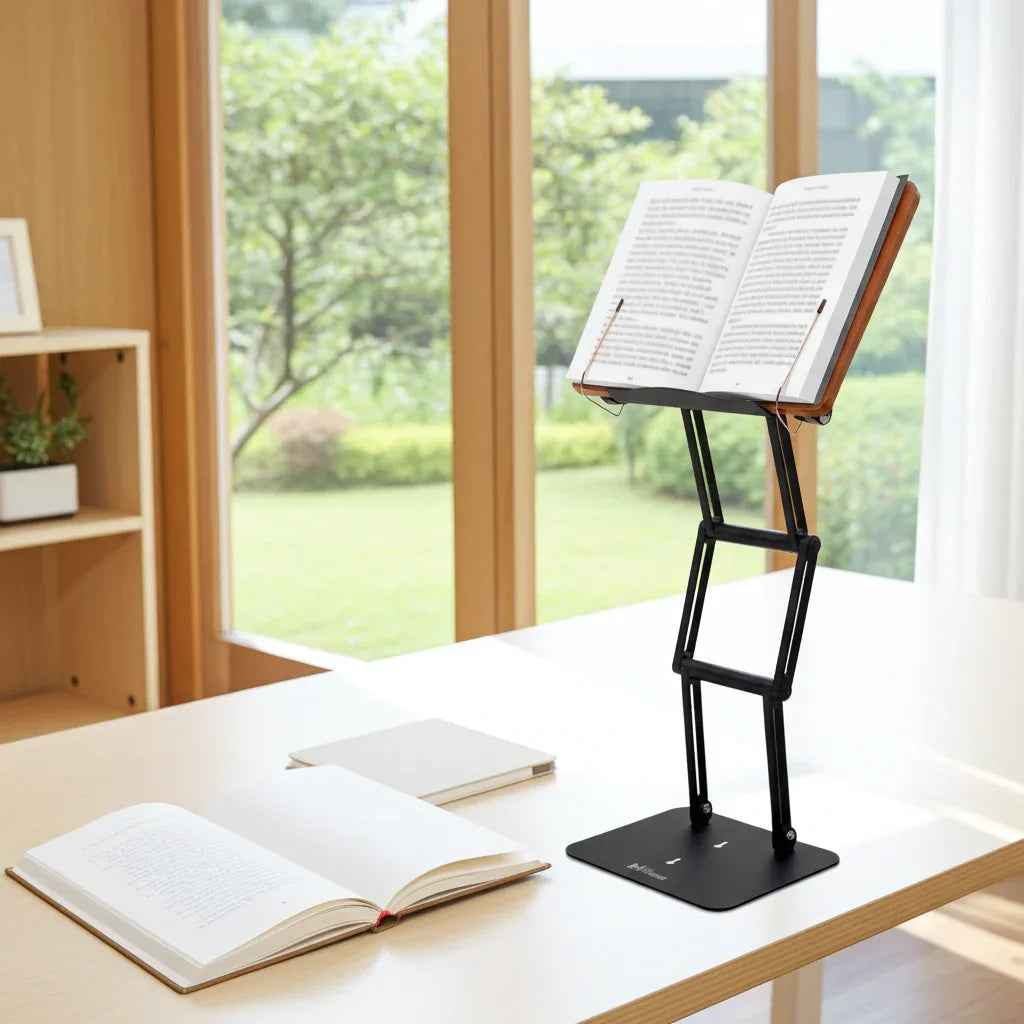
For readers who need a stand that can handle the serious stuff, The Stander is built around that problem. Its 5052 aluminum alloy frame, stainless steel screws and nuts, and friction joints are designed to hold a chosen height and angle without drifting. At 1.5 kg / 3.3 lb, it is tested with books up to 5 kg / 11 lb. The 32 x 22 cm (12.6 x 8.7 in) wooden platform includes adjustable page holders, and its support lip reaches 17.8 in from tabletop to the support lip, with the book sitting higher still. It folds flat to 7 cm / 2.75 in, or 10 cm / 4 in including the book lip, when it is time to clear the bedside table.
A stable bed-reading setup will not make a difficult text less difficult. It will, however, keep the mechanics of reading from competing with the material. Set the backrest first, raise the book on a firm surface, and let the pages stay where you put them. If your current stand cannot manage a heavy book without sagging or wobbling, see The Stander.
The Stander by Dr. Shtaygen
An adjustable stand that holds heavy books steady, even in bed
Height- and angle-adjustable. 5052 aluminum alloy frame, 1.5 kg (3.3 lb), tested with heavy volumes up to 5 kg (11 lb). $95 + shipping, free 30-day returns.
See The Stander