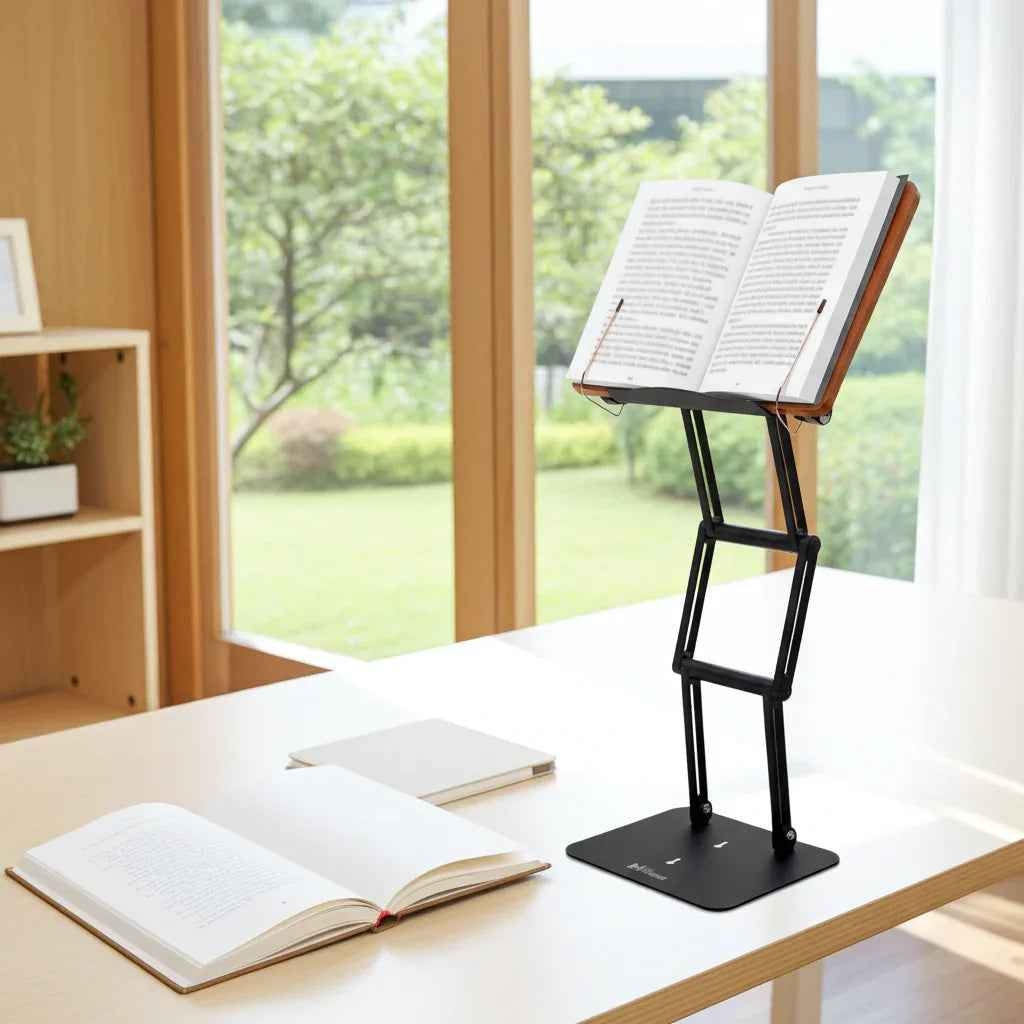
A few hours into serious reading, the body tells the truth. Shoulders roll forward, the neck drops, and the desk that seemed perfectly fine at 9 a.m. starts asking your spine to do unnecessary work. That is the real issue behind reading stand vs flat desk - not aesthetics, but what happens to posture, concentration, and endurance over time.
For light tasks, a flat desk can be perfectly acceptable. For prolonged reading, study, reference work, or screen use, it often becomes a compromise. A raised reading surface changes the geometry of work. It brings the material closer to eye level, reduces repeated neck flexion, and makes long sessions feel less physically expensive. The right choice depends on what you do at your desk, how long you do it, and whether comfort is a nice extra or a requirement.
Reading stand vs flat desk: the core difference
A flat desk places books, papers, and devices below eye level. That sounds obvious, but the consequence matters. Every inch lower the material sits, the more the head tends to tilt forward. Because the head is heavy, that angle increases the load on the cervical spine and surrounding muscles.
A reading stand changes that relationship. Instead of forcing your body down to the work, it brings the work up toward you. This is the ergonomic advantage in plain terms. Better viewing height usually means a more upright torso, less neck bending, and fewer small postural adjustments that quietly build fatigue.
That does not mean a flat desk is useless. It is still the standard surface for writing by hand, broad layout tasks, and work that requires elbow support across a large horizontal area. But reading and writing are not identical activities, and many people use the same flat surface for both even when it is a poor fit for one of them.
Why flat desks cause problems during long reading sessions
The main problem is sustained downward gaze. If you spend ten minutes reviewing a page, your body may tolerate it without much complaint. If you spend three hours reading dense material, cross-referencing notes, or studying from a heavy volume, the strain compounds.
Most people react in predictable ways. They crane the neck forward, collapse through the upper back, or prop themselves awkwardly on one arm. None of those positions are stable. They also tend to reduce breathing efficiency and make concentration feel harder than it should.
A flat desk can also create visual inefficiency. When the material is too low, you are not only bending more. You may be moving your head more often to maintain focus, especially with large textbooks, legal documents, sheet music, or dual-page religious texts. Those repeated adjustments matter during serious study.
This is one reason people often assume they need more discipline, when what they actually need is a better angle.
Where a reading stand performs better
A reading stand is most valuable when the task is visually intensive and time intensive. Reading, studying, reviewing technical documents, teaching from notes, following recipes, displaying sheet music, and using a tablet or laptop for reference all benefit from elevation.
The immediate gain is usually posture. The deeper gain is sustainability. When the material sits higher and at an angle, it is easier to maintain a neutral head position and keep the chest more open. That tends to reduce neck and shoulder tension and preserve focus later into the session.
For scholars and serious readers, there is another benefit: stability under real weight. A flimsy stand may help with a paperback, then fail when asked to support a large textbook, commentary, or hardbound volume. That is why build quality matters. A reading stand that wobbles, shifts, or droops under load creates a new distraction while trying to solve the first one.
This is where a professional-grade stand separates itself from commodity options. Strong materials, reliable joints, meaningful height adjustment, and confidence under heavy books turn a stand from a convenience item into an actual workstation tool.
When a flat desk still makes sense
There are cases where the flat desk remains the better choice. Handwriting for long stretches often feels more natural on a horizontal surface, especially if you need forearm support and room for multiple papers. Drawing, drafting, sorting physical materials, and keyboard-heavy work can also favor a flat plane, depending on the setup.
Some people also shift constantly between activities. They read, annotate, type, and spread out reference materials at the same time. In those cases, the best answer is not always stand or desk. It is often desk plus stand, with each surface doing a different job.
That distinction matters. The comparison should not be treated as a winner-take-all argument. A flat desk is a foundation. A reading stand is a specialized ergonomic upgrade that fixes the flat desk’s weakest category: prolonged downward viewing.
Reading stand vs flat desk for different users
Students usually notice the difference quickly. Long textbook sessions, digital note review, and exam prep all create sustained visual load. A raised surface helps reduce the slump that shows up halfway through a study block.
Professionals who read reports, contracts, technical manuals, or presentation notes often benefit just as much. The issue is not whether the material is academic. It is whether the work keeps pulling the head down.
Researchers and academics tend to be the clearest case. Their reading is not casual, and their materials are often heavy. Stability, height range, and durability become non-negotiable.
Religious scholars occupy a similar category, with the added relevance of tradition. The raised study platform has long existed for a reason. A modern adjustable shtender preserves that logic while adapting it to contemporary workspaces and mixed use with books, tablets, and laptops.
The trade-offs most people miss
Not every reading stand is automatically better than every flat desk setup. The details matter.
If the stand is too low, it will not do enough for neck angle. If it shakes when you turn a page, it interrupts concentration. If it cannot support the actual weight of your books or devices, you will stop using it. And if it takes over the entire desk without fitting your workflow, it may become one more thing to work around.
On the other hand, many people blame themselves for poor posture when their furniture is setting them up to fail. A flat desk asks the body to adapt downward. A well-designed stand reduces that demand. That is not a minor comfort feature. Over months and years, it can shape how tolerable your workday feels.
The strongest setups usually account for both ergonomics and task flow. You want enough height to elevate material meaningfully, enough stability to support serious use, and enough versatility to move between reading and reference tasks without rebuilding the workspace every time.
What to look for if you choose a reading stand
If you are deciding based on performance rather than price alone, look beyond basic adjustability. Height range matters because slight elevation is not the same as eye-level positioning. Build quality matters because weak hinges and light frames fail under real academic or professional use. Surface size matters because a stand that only fits a small tablet will not serve a large hardback.
You should also think about how the stand works across multiple roles. The best units do more than hold a book. They can support a laptop, textbook, tablet, cookbook, lecture notes, or sheet music without feeling improvised. That versatility is one reason serious users often prefer a premium stand over a stack of separate low-grade accessories.
For readers who want one tool that can function as a modern shtender, a laptop riser, and a stable book platform, products built with aluminum structure and steel joints make practical sense. Dr. Shtaygen’s approach reflects that category well: posture-first, heavy-duty, and designed for users who expect their equipment to hold up under real intellectual work.
So which one should you choose?
If your desk time is mostly short, varied, and writing-heavy, a flat desk may be enough. If your day includes long reading sessions, dense study, screen reference, or heavy books, a reading stand is usually the smarter ergonomic choice.
The real question is not which surface is more familiar. It is which one asks less of your neck, shoulders, and attention. Serious work is hard enough on its own. Your setup should not add friction before you even begin.
Choose the arrangement that helps you stay upright, comfortable, and mentally present. That is often where better work starts.