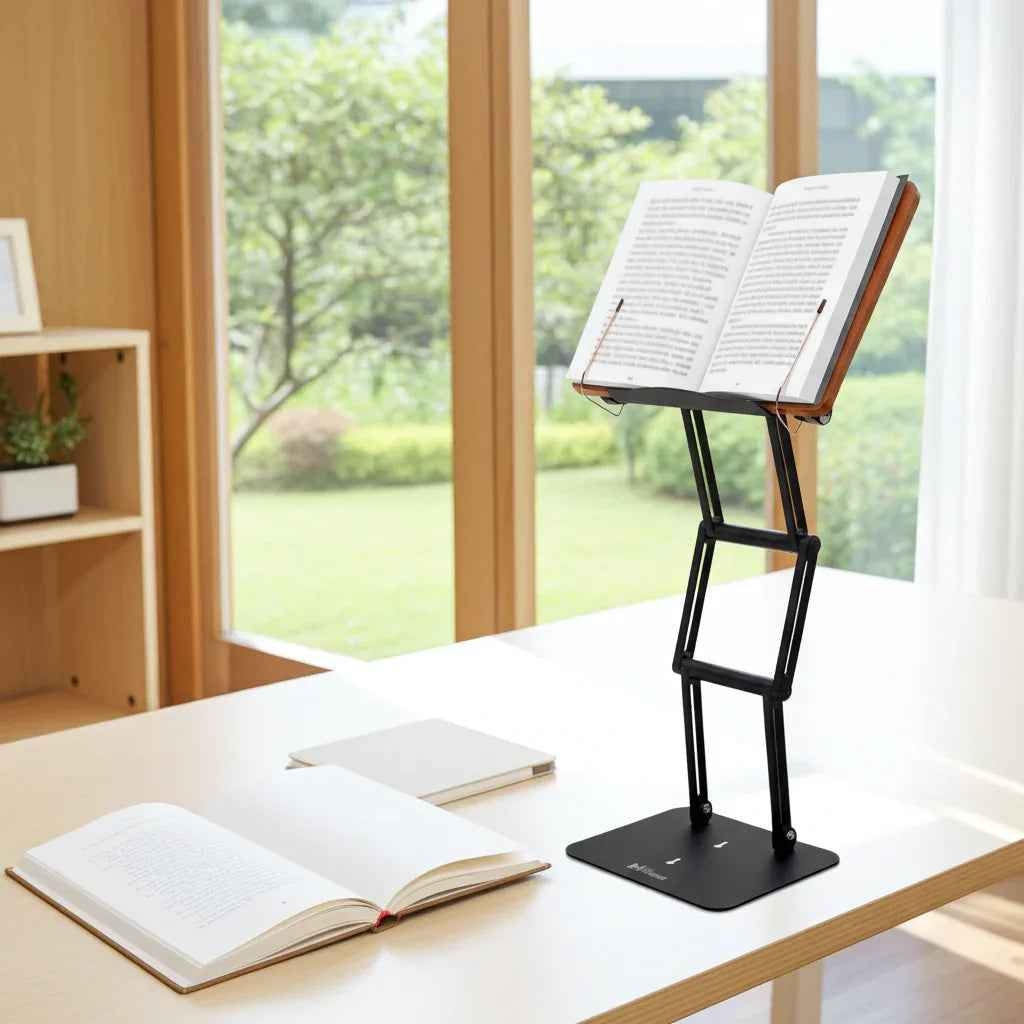
If your neck starts arguing with you 20 minutes into a reading session, the problem is usually not your discipline. It is your setup. Reading with cervical support means arranging the book, screen, and body so your neck does less compensating and your attention can stay on the page instead of on the ache building at the base of your skull.
Most people blame reading itself for neck pain. More often, the real issue is sustained flexion - that familiar head-down posture people adopt over paperbacks, textbooks, tablets, and laptops. The cervical spine can tolerate movement well. What it does not love is being asked to hold the same bent position for an hour while you annotate a casebook, work through Gemara, or reread a dense journal article for the third time because your focus disappeared somewhere between C5 and your trapezius.
What reading with cervical support actually means
In practical terms, reading with cervical support is not about wearing a brace or forcing the neck into a rigid position. It is about reducing the amount of forward head posture required to see the material clearly. When the reading surface is too low, your head drifts forward, your upper back rounds, and the small muscles around the neck begin doing the kind of overtime work they never volunteered for.
A better reading posture keeps the text closer to eye level, allows the shoulders to relax, and lets the neck remain in a more neutral position. Neutral does not mean military straight. It means balanced, sustainable, and repeatable over time. That distinction matters because ergonomic advice often fails when it asks real people to sit like statues.
The strongest form of cervical support during reading is external support through setup, not heroic effort through posture correction alone. If your materials are positioned well, good posture becomes easier. If they are not, no amount of self-reminders to "sit up straight" will save a three-hour study session.
Why the neck suffers during reading
The neck is not working alone. It is part of a chain that includes the eyes, upper back, shoulders, rib cage, and hands. Reading creates a perfect storm because the task is visually demanding, mentally absorbing, and physically quiet. You stop moving because you are concentrating. Then the body gradually collapses into whatever position lets your eyes stay on the page.
Printed books add one problem, and screens add another. Books often sit too flat and too low. Laptops combine a low screen with a fixed keyboard, which is ergonomically about as generous as a folding chair at a six-hour lecture. Tablets and phones are even worse because they invite an almost devotional level of neck bending.
Then there is duration. A poor posture held for five minutes is a nuisance. A poor posture held through morning seder, board prep, dissertation work, or legal research becomes a real mechanical stressor. That is why serious readers need serious support. Flimsy stands made for recipe cards and lightweight tablets are not built for the way scholars, students, and professionals actually work.
Reading with cervical support starts with elevation
The single biggest change is elevating the material. When the page or screen rises, the eyes can look forward instead of down, and the cervical spine no longer has to flex as deeply. This sounds simple because it is simple. It is also effective.
The catch is that elevation has to be meaningful. A stand that lifts a book two inches off the desk may technically count as a book stand, but it does not solve much. For reading with cervical support to make a difference, the material needs to come high enough to meet your line of sight during seated use and, ideally, adapt to standing use as well.
[As a side point, it should be pointed out that many stands give a false sense of "height ability" by listing the total height of the stand, as measured from the tabletop to the top of the reading platform, which is misleading. The actual total lift of a platform should be measured from the tabletop to the book/laptop lip (the part that actually supports whatever is put on it), as that's the actual measure of total "raise". In this regard, The Stander 1.1 is the highest portable stand in the category]
That is where build quality matters. A heavy textbook, thick legal volume, large siddur, or full-size laptop places real demands on the stand underneath it. If the platform wobbles, sags, or tips, your body will compensate again. You lean in, brace your arms, or lower the material back down. The ergonomic benefit disappears.
A stable adjustable platform changes the equation because it supports the object at a usable height rather than merely propping it up. Dr. Shtaygen was built around that reality - not for casual scrolling, but for people who put long hours into reading, studying, and desk work and need a setup that holds its position under serious load.
The posture details that matter most
Once the reading surface is elevated, the rest of the body can settle into a better pattern. Your chin should stay roughly level rather than jutting forward. The shoulders should not creep toward the ears. The elbows should hang comfortably, especially if you are taking notes or typing alongside the text.
Chair height matters, but less than people think. You do not need the perfect chair from a catalog staged by a minimalist philosopher. You need your feet supported, your hips stable, and your rib cage stacked reasonably over your pelvis. If your reading material is still flat on the desk, even an expensive chair will not rescue your neck.
Lighting also affects cervical posture. Dim light encourages you to lean in. Small text does the same. So do glossy pages with glare. Reading with cervical support is partly about neck mechanics and partly about removing the reasons your body keeps diving toward the material.
When cervical support helps immediately, and when it takes time
Some people feel relief the same day they change their setup. That is common when the issue is mainly positional strain. Raise the book, reduce neck flexion, and the body stops complaining quite so loudly.
But not every case resolves overnight. If you have been studying or working for months in a forward-head posture, the muscles around the neck and upper back may already be irritated. In that case, a better reading setup is still the right move, but improvement may come gradually. Ergonomics lowers the load. It does not erase accumulated tension like magic.
There is also an adjustment period. A more neutral posture can feel strange at first because bad posture often feels normal right up until it hurts. That does not mean the new position is wrong. It usually means your body has gotten used to one pattern and now needs time to trust a better one.
The trade-offs people ignore
Not every elevated setup is automatically ideal. If a stand raises the material but forces awkward page turning, cramped note-taking, or unstable viewing angles, you may gain neck comfort and lose workflow efficiency. Serious readers need both. Comfort that interrupts concentration every two minutes is not much of a win.
The same goes for overly rigid posture advice. Reading with cervical support should improve endurance, not make you self-conscious about every inch of your spine. You still need normal movement, small position changes, and occasional breaks. The goal is less strain, not total stillness.
Some readers also need bifocals or progressive lenses, and that changes the geometry. In those cases, the ideal height may differ from standard recommendations because you are trying to align both the material and the lens zone you use for near work. It depends on the reader, the task, and the eyewear. Good ergonomics is precise, not preachy.
Improve Your Setup
If you're looking to elevate your law books, tablets, or laptops to a more comfortable reading position, an adjustable stand can make a significant difference.
What a high-function reading setup looks like
A good setup for reading with cervical support keeps the material high, stable, and easy to access. If you alternate between a textbook and a laptop, the platform should handle both without feeling like a compromise. If you study seated for part of the day and standing for another part, adjustability becomes more than a luxury. It becomes a way to keep your neck and back from paying the price of long static sessions.
This matters especially for scholars and professionals working with heavy materials. A traditional shtender exists for a reason. Raised study is not a gimmick. It is a practical answer to the physical demands of sustained reading. The modern version simply needs to meet modern expectations - better height range, stronger construction, and enough stability for actual work instead of showroom ergonomics.
If your current habit is reading with your book on the desk, your tablet in your lap, or your laptop below eye level, you do not need a dramatic overhaul. You need one meaningful change: bring the material up to you. That is the heart of cervical support.
The page is demanding enough. Your neck should not have to study with it.