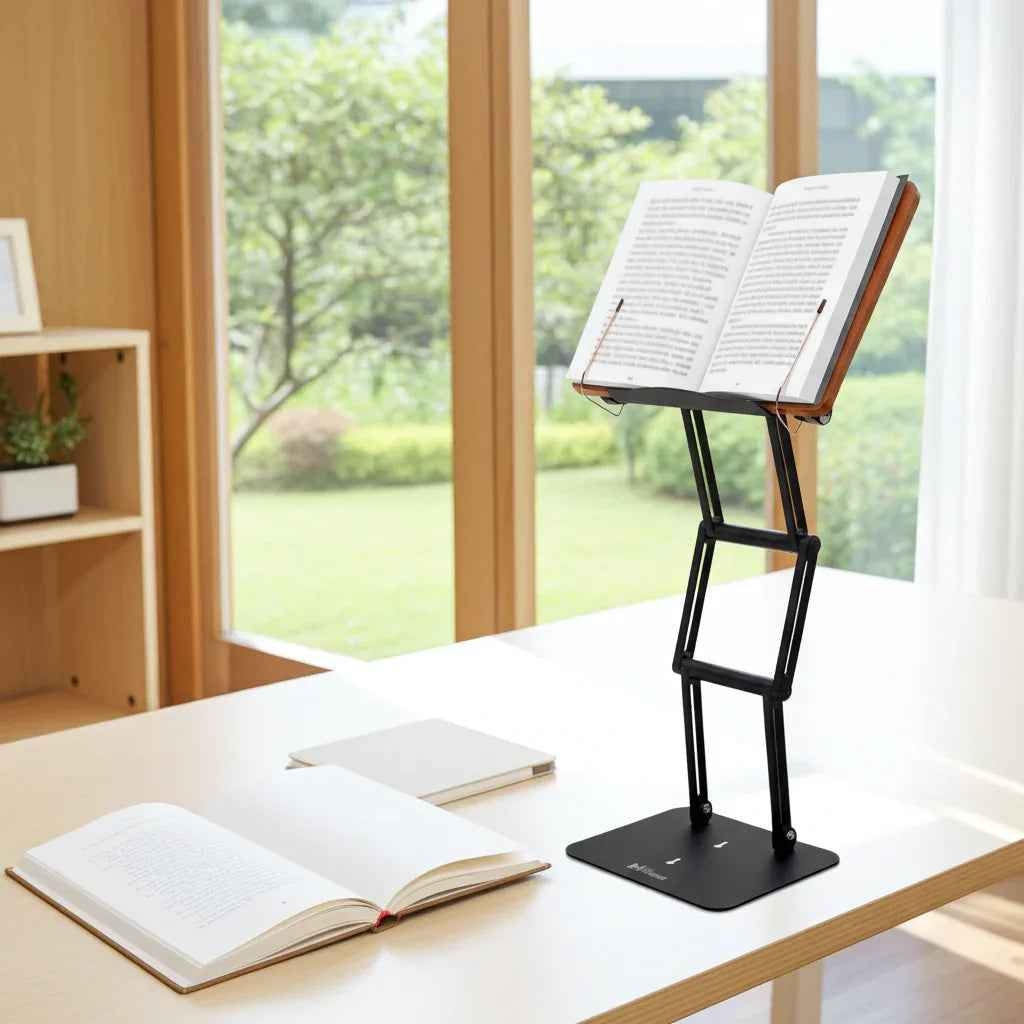
A stack of casebooks can turn a good desk into a bad workstation fast. Legal reading asks more of your setup than ordinary office work. Dense pages, frequent cross-referencing, long sessions, and heavy volumes all create the same problem: your neck drops, your shoulders round forward, and your attention starts leaking out through physical discomfort. That is why the best desk solutions for legal reading are not just about organization. They are about posture, visibility, and sustained concentration.
For law students, attorneys, paralegals, judges, and scholars, the desk has to support real cognitive work. You are not glancing at a paperback for ten minutes. You are reading for precision, marking authority, comparing statutes, and holding your place across multiple sources. A setup that works for casual browsing often fails under that kind of load.
What legal reading demands from a desk
Legal materials are unusually punishing on posture. Casebooks are heavy. Statutory supplements are awkward to hold open. Annotated codes can force you into a fixed, downward gaze for long stretches. Even digital legal reading creates strain when a laptop sits too low and the screen pulls your head forward.
The best desk solutions for legal reading solve three issues at once. First, they elevate reading material closer to eye level. Second, they stabilize heavy books and devices so you are not constantly adjusting them. Third, they preserve enough desk space for notes, a keyboard, and active document review.
That combination matters because the body and the work are connected. When the cervical spine stays in prolonged flexion, fatigue rises. When your material is stable and properly angled, your visual field improves and your hands are freed for annotation. The difference shows up not just in comfort, but in output.
Flat desks are simple, but limited
A standard flat desk is the default setup in law offices, libraries, and home workspaces. It is familiar and easy to furnish. For short tasks, it may be enough. But for extended legal reading, a flat surface creates a predictable problem: everything important sits below ideal viewing height.
That means your book, laptop, or printout repeatedly pulls your eyes and head downward. The issue gets worse with large hornbooks, trial binders, and loose stacks of printed filings. You can compensate for a while by sitting upright with discipline, but posture held by willpower rarely lasts through a three-hour reading block.
Flat desks are not useless. They provide a broad writing surface and room for spreading out materials. But they work best when paired with tools that change the height and angle of what you are reading.
Why a raised reading stand changes the equation
If your work centers on casebooks, legal pads, statutes, briefs, or a laptop, a raised stand is usually the single biggest improvement you can make. It takes the primary reading surface off the desk and brings it into a stronger ergonomic position.
For legal reading, not every stand qualifies. Many consumer book stands are built for light cookbooks or tablets. They wobble under heavier texts, offer limited elevation, or collapse into awkward angles that do not hold up during serious study. That is where buyers often waste money - they choose a stand designed for casual use and expect it to support professional demands.
A better solution is a heavy-duty adjustable stand with real height range, solid joints, and enough platform support for substantial legal volumes. That matters whether you are briefing cases, reviewing discovery, or reading a laptop and printed text side by side. Stability is not a luxury here. It is what keeps you from interrupting focus every few minutes.
A premium stand also gives you flexibility. Some readers need a lower angle for handwritten notes in the margin. Others need a higher position to align a casebook closer to monitor height. The right answer depends on the task, your chair height, and whether you alternate between seated and moderate standing work.
The best desk solutions for legal reading at home or in the office
Most legal readers do not need a complicated setup. They need a desk system that respects how they actually work. In practice, the strongest arrangement usually includes a stable desk, an adjustable chair, targeted lighting, and one central elevation tool for the material you use most.
If you primarily read printed legal texts, a heavy-duty book stand should sit at the center of the workstation. It should hold large casebooks without sagging, raise them high enough to reduce neck flexion, and leave enough room below or beside it for notes. If you split time between digital and print, an adjustable stand that can also support a laptop creates more value because it lets you maintain a similar viewing position across formats.
This is where a product like The Stander 1.1 fits naturally. It is built more like professional equipment than a commodity stand, with the height, stability, and structural strength that serious readers need when the materials are large and the sessions are long. For legal work, that difference is practical. A stand that stays steady under weight supports better posture and fewer interruptions.
Choosing between a book stand, monitor riser, and standing desk
These categories overlap, but they are not interchangeable.
A monitor riser helps if your legal reading happens almost entirely on an external display. It improves screen height, but it does little for a printed statute book or binder. A standing desk adds positional variety, which can be useful for long workdays, but it does not automatically fix downward reading angles. If the book still lies flat, the neck still bends.
A dedicated reading stand addresses the source of the problem more directly. It elevates the material itself. For many legal professionals, that makes it a better first investment than a full standing desk, especially if the budget is limited. If you already own a good desk and chair, adding a serious stand can deliver a sharper ergonomic improvement at lower cost.
That said, it depends on your workflow. If you spend most of the day drafting on a desktop monitor and only part of it reading print, a monitor setup may deserve priority. If your day alternates between review, writing, and document handling, a stand often gives you the broadest functional gain.
Small desk, big reading load
Space is a real constraint in apartments, shared offices, and law school study corners. The answer is not to eliminate tools. The answer is to choose tools that compress the footprint of your work.
A raised stand can actually make a small desk more usable because it lifts the reading material off the main surface and opens room for note-taking underneath or beside it. Compare that with a flat-open casebook consuming half the desk while your legal pad hangs off the edge. Vertical positioning is often the cleanest fix for clutter.
For small spaces, the best desk solutions for legal reading should also reduce visual noise. One stable platform for your primary text is better than a pile of improvised supports, stacked books, and shifting devices. Order matters because legal work depends on sustained attention. Physical disorder invites friction.
Ergonomics that matter more than aesthetics
A good-looking desk is fine. A desk that protects your neck over hundreds of reading hours is better. Serious readers should judge a setup by function first: viewing height, stability, angle adjustment, and clearance for writing.
The basic test is simple. When reading, can you keep your head more upright, your shoulders more relaxed, and your hands free to work? If not, the setup is underperforming, no matter how polished it looks.
This is also where trade-offs matter. Maximum elevation is helpful, but only if the stand remains stable at that height. A large desk surface is useful, but not if it encourages every text to sit flat and low. Minimalist accessories may look clean, but if they slip under the weight of a legal tome, they are solving the wrong problem.
Building a legal reading setup that lasts
The best setups are not fragile and not temporary. Legal reading is repetitive by nature. What you use every day should be designed for repetition. That means materials that can handle weight, joints that hold position, and a structure that does not become another source of distraction.
Think of your desk as a performance environment. Every inch should support visibility, comfort, and concentration. Put the text or screen at the center. Support it properly. Keep your writing tools within easy reach. Use lighting that reduces squinting and glare. Then let the workspace disappear so the reading can take over.
If your neck is sore after every review session, your setup is speaking clearly. The right desk solution for legal reading is the one that lets your body stay out of the way of your mind. That is when long study hours start to feel sustainable again.
Other Related Blogs:
Best Book Stand for Law School Books