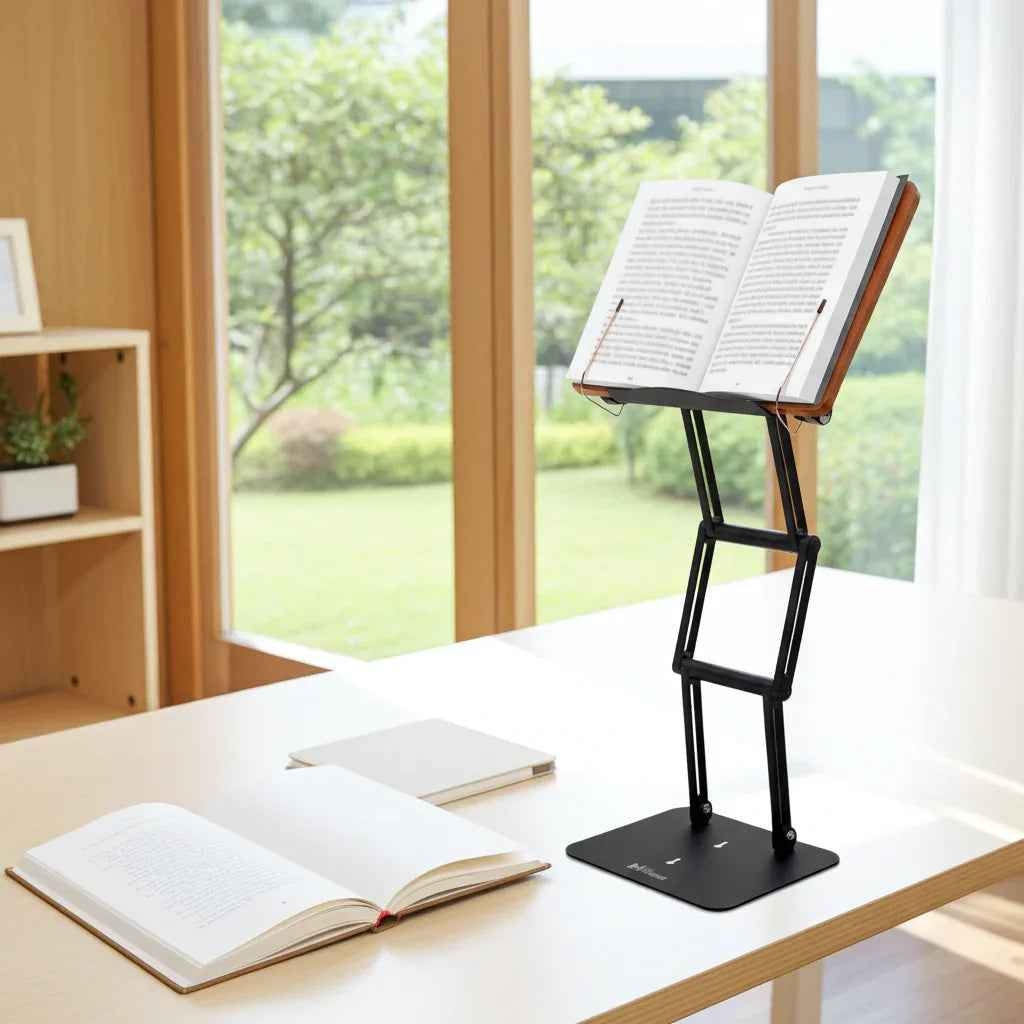
Three hours into a study session, most people do not lose focus because the material is too hard. They lose focus because their neck is cooked, their lower back is complaining, and their desk setup is quietly working against them. A real guide to healthy desk studying has to start there - not with productivity theory, but with the physical mechanics of reading, writing, and thinking for long stretches.
Healthy studying at a desk is not about sitting perfectly still like a museum mannequin. It is about reducing unnecessary strain so your body does not siphon energy away from your brain. When your books are flat on the table, your head drops forward. When your screen sits too low, your cervical spine pays the bill. When your elbows float or your chair is too high, your shoulders tense up and stay there. You can study through that for a while. You just should not have to.
What healthy desk studying actually means
Healthy desk studying is a combination of posture, positioning, movement, and equipment. The goal is simple: keep your materials where your eyes can reach them without dragging your body into a bad position. That sounds obvious, yet it is exactly where most setups fail.
A desk can look tidy and still be ergonomically terrible. A laptop on a bare tabletop often forces a rounded upper back and a bent neck. A heavy textbook laid flat creates the same issue. Many students and professionals assume discomfort is just part of serious work. It is not. Some fatigue is mental. Persistent neck strain from bad angles is mechanical.
The best setup supports neutral posture. That means your ears are generally stacked over your shoulders, your shoulders are not shrugged, and your forearms can rest comfortably while you read or type. Neutral does not mean rigid. It means your body is not constantly fighting gravity.
Start with eye level, not aesthetics
If you change one thing after reading this guide to healthy desk studying, change the height of what you are looking at. This is the hinge point for everything else.
People tend to obsess over chairs first, but for studying, the position of the book, laptop, or tablet is often the bigger problem. Reading from a low surface creates repeated neck flexion. It is one of the most common causes of discomfort during long sessions, especially for students working through dense material, researchers reviewing sources, or anyone alternating between notes and a main text.
Raising reading material closer to eye level reduces the need to hunch over it. That matters for two reasons. First, it lowers stress on the neck and upper back. Second, it makes sustained attention easier because you are not constantly slipping into a collapsed posture that signals fatigue.
This is where a serious stand earns its keep. A flimsy stand for a light tablet is one thing. A stable, height-adjustable platform that can hold a substantial textbook, laptop, or religious volume is another. For serious study, stability is not a luxury feature. If the platform wobbles every time you turn a page, you will use it less, and your body will go back to doing the work your equipment should be doing.
Build your desk around the task
Not every study session is the same, so your setup should reflect the kind of work you are actually doing. Reading a law casebook, annotating a printed article, and typing a seminar paper are related tasks, but they place different demands on your body.
For reading-heavy work, elevate the primary text and keep notes slightly lower. This lets your eyes move down occasionally rather than keeping your head permanently down. For laptop-based studying, raise the screen and use an external keyboard if you will be typing for long periods. If you cannot do that, at least alternate between reading mode and typing mode rather than forcing one compromised position for both.
For dual-material study, such as working from a textbook while writing notes or comparing source texts, keep the most visually demanding item directly in front of you. Twisting toward one side for an hour may feel harmless in the moment, but repetition is what turns awkward angles into pain.
There is also a practical distinction between seated and moderate standing study. Standing can be excellent for shorter reading blocks, review sessions, or moments when you feel your attention fading. But standing all afternoon is not automatically healthier than sitting. It depends on your stamina, footwear, and surface height. The better approach is variation. A setup that can support both seated and moderate standing work gives you more options and fewer excuses.
The small posture cues that make a big difference
You do not need a posture lecture every ten minutes. You need a few cues that actually hold up during real work.
Keep your chin level rather than jutting forward toward the page. Let your shoulders drop instead of creeping upward. Keep your feet supported on the floor or on a footrest if needed. When writing by hand, avoid curling your body around the notebook like it owes you money.
The most useful cue is this: bring the work to you instead of bringing your body to the work. That principle applies to books, laptops, tablets, sheet music, and even cookbooks if your study session happens to be culinary. Good ergonomics is surprisingly unromantic. It is mostly about angles, height, and repetition.
That said, there is a trade-off. If materials are raised too high, your arms may lift awkwardly or your wrists may lose support. If they are too low, your neck bends. The sweet spot depends on whether you are mostly reading, mostly typing, or switching between both. Healthy desk studying is not one universal setting. It is a controlled adjustment process.
Movement is part of the setup
Even an excellent desk arrangement cannot rescue a six-hour session without movement. The body likes variety more than perfection.
Short breaks work best when they are frequent and boring. Stand up. Roll your shoulders. Walk for a minute. Refocus your eyes on something farther away. You do not need a wellness retreat between chapters. You need enough movement to interrupt the slow creep into stiffness.
A good rule is to change something every 30 to 45 minutes. Change your position, your task, your height, or your visual distance. If you are deeply focused, do not destroy momentum with a long break. Just reset the body before discomfort becomes the main event.
Why equipment quality matters more than people admit
Students and professionals often try to solve ergonomic problems with improvised stacks of books, unstable risers, or bargain stands that look acceptable in a product photo and surrender under real weight. That usually works for about a week.
Heavy academic texts, large tablets, and laptops require a platform with real structural stability. Height adjustability also matters more than fixed-angle designs because people are not all built the same, and tasks change throughout the day. A stand that raises material significantly above the tabletop opens up healthier viewing angles and makes seated-to-standing transitions more realistic.
This is precisely why premium ergonomic tools exist. A serious platform like The Stander 1.1 is designed for sustained reading and desk work, not casual scrolling. Its high elevation range, durable aluminum construction, and stable joints address a practical problem: serious readers and scholars often use heavy materials for long periods, and lightweight stands are usually out of their depth.
Healthy desk studying for long-term performance
The point of ergonomics is not to create a beautiful desk for five minutes of internet admiration. The point is to preserve your ability to think clearly and work consistently. When strain drops, endurance usually rises. When posture improves, concentration often follows. Not because your desk has magical powers, but because your body is no longer fighting the setup.
This matters for students during exam season, for academics deep in research, for professionals reviewing dense documents, and for religious study where hours with substantial texts are part of the practice. A traditional shtender had the right instinct: elevate the text, support the reader, and treat study as serious work. Modern desk ergonomics just gives that instinct better engineering.
The best study setup is the one you will actually use every day. Make it stable. Make it adjustable. Make it kind to your neck and honest about how long you really spend at the desk. If your workspace helps you stay upright, comfortable, and engaged, studying stops feeling like an endurance contest and starts feeling like what it should be - focused work with a fair chance of going well.