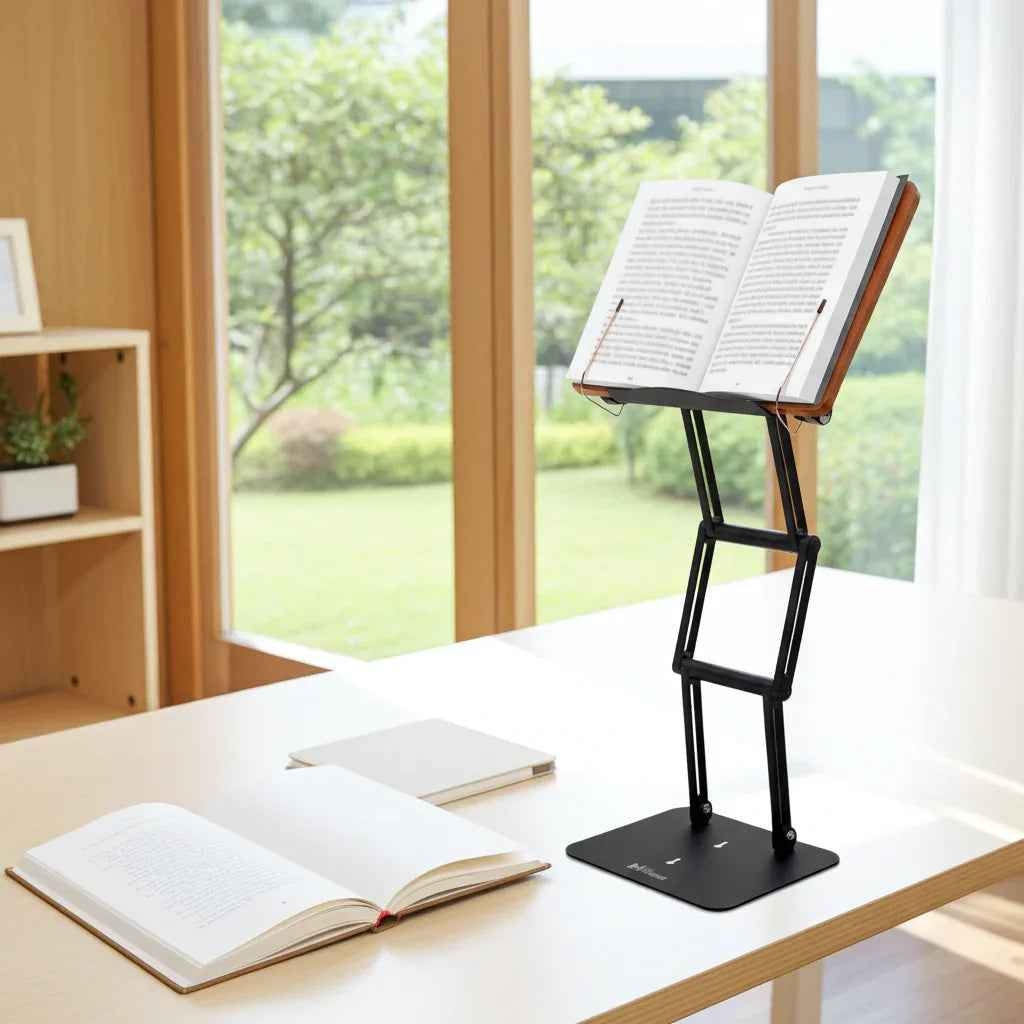
By the second hour of reading at a standing desk, small flaws become obvious. A book sits too low, your chin drops forward, pages shift under their own weight, and the setup that looked fine for ten minutes starts taxing your neck and upper back. A standing desk book holder is not just a convenience accessory. For anyone who spends real time with textbooks, legal volumes, reference materials, tablets, or printed notes, it is part of the ergonomic system that determines whether focused work feels sustainable or punishing.
Why a standing desk book holder matters
Most people understand that monitor height affects posture. Printed material deserves the same attention. When a book lies flat on a desk, your head follows it downward. That repeated forward flexion increases load through the cervical spine and often leads to the familiar chain reaction - rounded shoulders, upper trap tension, and fatigue that builds quietly over the day.
A well-designed holder elevates reading material closer to eye level and places it within a more neutral viewing angle. That single change can reduce unnecessary neck flexion and make standing work more productive. Standing alone does not fix poor positioning. In some cases, it can even make people more likely to crane their necks downward because they feel more mobile and less aware of their posture.
For serious readers and knowledge workers, the goal is not simply to stand. The goal is to create a reading position that supports attention, endurance, and spinal alignment.
The real difference between a cheap stand and a serious one
A book holder can look acceptable in product photos and still fail in daily use. The usual problems are predictable: weak joints, limited height, platform wobble, poor page retention, and a design meant for light tablets rather than dense books.
That distinction matters if your work involves heavy academic texts, large-format religious books, code manuals, binders, or a laptop that occasionally shares the same stand. A lightweight accessory may hold a paperback for twenty minutes. It is a different category of tool from a platform built for long sessions and meaningful weight.
Stability is the first non-negotiable feature. If the platform shifts when you turn a page, tap a screen, annotate a margin, or rest your hands briefly at the bottom edge, it interrupts concentration and encourages awkward compensation. You lean in. You brace the stand. You stop trusting the setup.
Height range comes next. Many holders lift material only slightly above the desk surface, which is not enough for standing use. At a standing desk, the reading surface must rise high enough to bring the material into a usable visual field without forcing shoulder elevation or arm strain.
Then there is joint integrity. A stand with durable metal joints and a firm locking mechanism behaves differently from one that relies on weak hinges or friction that degrades quickly. This is especially important for users who adjust angles throughout the day, switching between close reading, reference checking, and typing.
How to judge a standing desk book holder for ergonomics
The right setup depends on your height, desk height, and what you read, but a few principles hold up across nearly every workstation.
The top third of the reading surface should sit near your natural line of sight. That does not mean every page needs to be perfectly vertical. In fact, a slightly reclined angle is often more comfortable because it balances visibility with glare control and page access. What matters is reducing the amount of downward head tilt required to read normally.
The stand should also allow enough clearance for your hands to interact with the material without collapsing posture. If you constantly reach too high or hold your elbows in an unnatural position, the setup solves one problem by creating another. Good ergonomics is not about forcing one rigid pose. It is about making a neutral posture easier to maintain.
Page management is often overlooked. A standing desk book holder should keep books open securely without covering too much text. This is especially useful for thick textbooks, study Bibles, law books, music scores, and any material that resists staying open on its own. If retention arms are flimsy or poorly placed, users end up fighting the holder instead of benefiting from it.
Best use cases for a standing desk book holder
The strongest case for this type of tool is extended reading or study. Students moving through dense textbooks, graduate researchers reviewing sources, attorneys reading case material, and clinicians studying reference texts all face the same problem: hours of downward visual work that quietly punishes posture.
It also makes sense in mixed-device workflows. Many professionals alternate between printed notes, tablets, and laptops. A stand that can handle multiple formats reduces desk clutter and shortens the gap between tasks. Instead of stacking books flat beside a monitor or hunching over a tablet, you bring each item into the same ergonomic zone.
There is also a clear fit for religious and scholarly study. The traditional shtender exists for a reason. Raised study supports help preserve focus, reduce physical fatigue, and give weighty texts the stable platform they deserve. A modern, height-adjustable version extends that principle into contemporary workspaces where users may move between sacred texts, commentaries, notes, and digital tools.
When a standing desk book holder is not enough on its own
It depends on the rest of the workstation. If your standing desk is too high, too low, or poorly organized, adding a holder will help but not fully correct the issue. Your elbows should still fall into a comfortable working range, your shoulders should remain relaxed, and your screen placement should not compete with your reading setup.
Footwear and standing duration matter too. Some users assume they need to stand for long uninterrupted blocks to get the benefit of a standing desk. That is rarely necessary. Alternating between sitting and standing often produces better comfort and concentration than treating standing as a posture test.
If you are reading for hours, anti-fatigue support underfoot, sensible desk height, and regular movement breaks all contribute to the outcome. The holder is a key piece, but it works best as part of a complete ergonomic environment.
What serious users should look for first
If you are choosing a standing desk book holder for demanding use, prioritize load capacity, elevation, and build quality before aesthetics. The surface must support real weight without drift. The height range must work for standing, not just seated reading. The frame should feel engineered, not improvised.
Material quality matters because repetitive adjustment exposes weaknesses quickly. Aluminum components, well-machined joints, and a platform wide enough for substantial books all signal a product meant for daily work. So does a design that remains composed under pressure instead of vibrating with every touch.
Versatility is valuable, but only when it does not compromise strength. A holder that can support a textbook, laptop, or tablet is useful. A holder that claims to do everything while doing each task poorly is not. The right product serves multiple roles because it has enough structural integrity to perform across them.
This is where premium stands separate themselves from commodity options. Products designed for serious study are not simply prettier versions of low-cost reading easels. They are more stable, more adjustable, and more capable under real-world loads. For users who work hard and read deeply, that difference is felt every day.
A standing desk book holder should support focus, not just posture
Posture is the obvious benefit, but focus may be the more immediate one. When reading material sits at the right height and angle, your attention stays on the content. You are not constantly repositioning a book, rubbing your neck, or shifting into worse postures to compensate for a weak setup.
That has practical value. Better positioning can support longer uninterrupted reading sessions, cleaner note-taking, and less end-of-day tension. For students, that may mean more productive study blocks. For professionals, it can mean fewer physical distractions during research, drafting, or review. For religious scholars, it preserves the dignity and steadiness of sustained text-based work.
A well-built stand like Dr. Shtaygen's Stander 1.1 reflects that standard. It treats reading posture as a performance issue, not an afterthought, and it is built for users who need genuine elevation, serious stability, and dependable support for substantial materials.
If your work depends on reading, do not accept a setup that keeps pulling your eyes and spine downward. The right holder earns its place by making long hours feel more natural, more stable, and more sustainable.
Other Related Blogs:
Cervical Spine Posture While Reading
How to Study Longer Without Neck Pain
Best Adjustable Textbook Holder for Studying