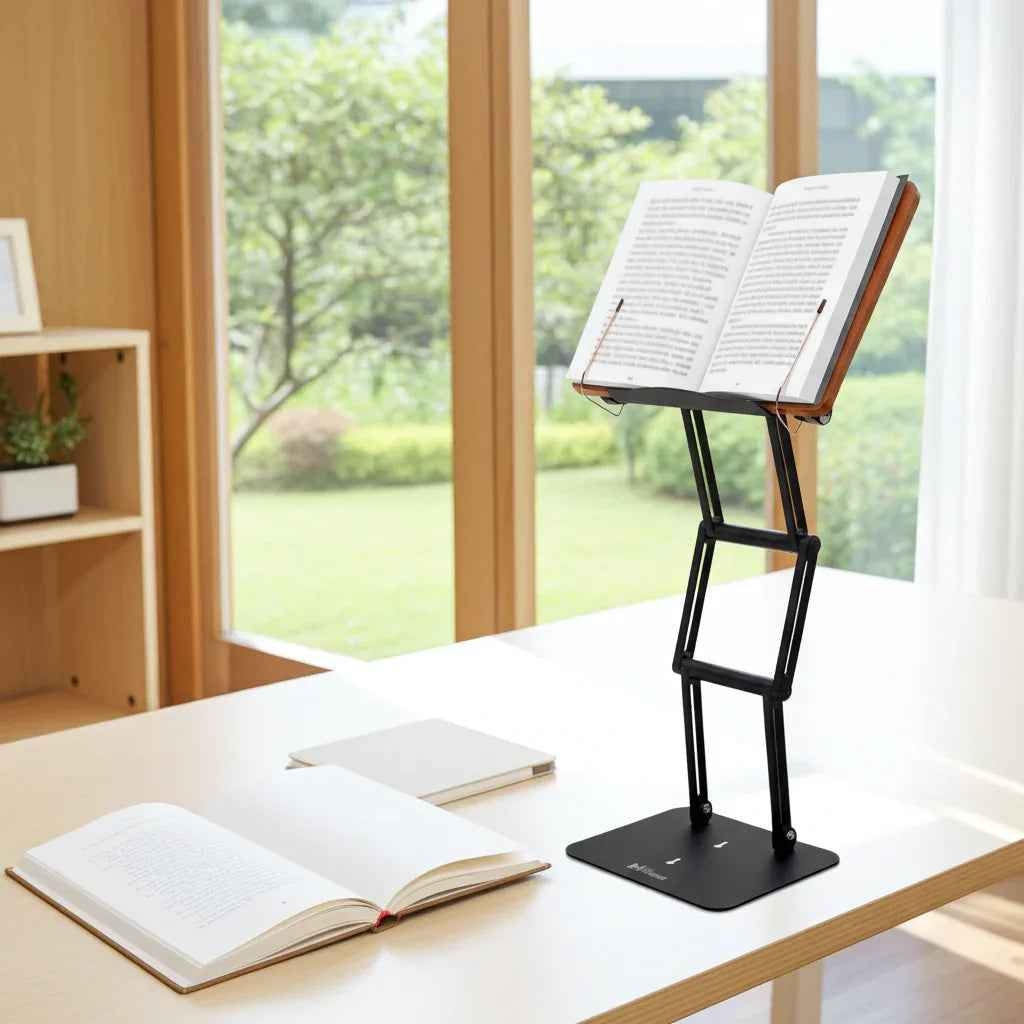
A Bible that stays flat, stable, and easy to read changes more than convenience. The right book holder for bible study can reduce neck strain, improve focus, and make long reading sessions feel sustainable instead of physically taxing. That matters whether you are working through a daily devotional, leading a group, preparing a lesson, or spending hours in deep textual study.
Many people assume any stand will do. In practice, that is where frustration starts. Lightweight holders often wobble under a large study Bible, slide on the desk, or sit too low to make a real ergonomic difference. If your head still drops forward and your shoulders still round, the stand is not solving the problem.
What a book holder for bible study should actually do
A serious study setup needs more than a surface to prop up a book. It should elevate the text closer to eye level, hold pages securely without damaging them, and remain stable when you turn pages, annotate, or rest your hands nearby. Those basics sound obvious, but they separate decorative accessories from tools built for real use.
For Bible study, stability matters even more because many editions are heavier than standard paperbacks. Study Bibles, interlinear texts, and parallel editions can put real stress on a weak frame. A stand that works for a tablet may fail quickly when asked to support a thick hardcover text for an hour or two.
Height also matters. A low-angle stand may look helpful, but if it leaves the book near the desktop, you still end up flexing your neck downward. A better holder raises the material enough to support a more neutral spine. That is the difference between short-term convenience and long-term ergonomic value.
Why posture matters during Bible study
Reading is often treated as restful, but prolonged reading at a desk can be physically demanding. When a book lies flat, the head tends to drift forward. That forward-head posture increases load on the cervical spine and usually brings the upper back and shoulders with it. Over time, that can mean stiffness, fatigue, and the familiar ache that shows up between the shoulder blades.
For casual reading, some people tolerate that posture without thinking much about it. Bible study is different because it is often slower, more concentrated, and longer in duration. You may be cross-referencing passages, writing notes, pausing for reflection, or staying in one position far longer than you would with a novel. The more serious the study, the more your physical setup affects endurance.
An elevated holder supports a cleaner visual line to the page. That can reduce the tendency to crane the neck downward and can help maintain a more upright seated position. It will not fix every ergonomic issue by itself. Chair height, desk height, and lighting still matter. But it is one of the most direct upgrades you can make if your study sessions leave you uncomfortable.
The difference between a casual stand and a serious study stand
A casual stand is usually built for light use. It may fold small, cost very little, and handle a phone, paperback, or tablet reasonably well. For occasional reading, that may be enough.
A serious study stand is engineered for load, stability, and repeat use. It should support heavier books without sagging, maintain its position after adjustment, and feel secure during page turns. If you are using a wide Bible, a thick theological volume, or a combination of book and notebook on your desk, the quality of the joints and base becomes much more important.
This is where many buyers make the wrong comparison. They compare features instead of performance under real working conditions. A stand can claim adjustability, but if the angle slips under weight, the feature does not matter. It can claim portability, but if it compromises stability, it may not be right for a serious reader.
For scholars, clergy, students, and committed readers, the better question is simple: can this stand handle long sessions and heavier texts without becoming another source of distraction?
How to choose the best book holder for bible study
The best choice depends on how you study. If you read for ten minutes at the kitchen table, your needs are different from someone spending two hours at a desk with notes, commentaries, and a laptop nearby. Still, a few criteria consistently matter.
Height range and viewing angle
A useful stand should lift the book enough to reduce downward gaze. More range is usually better because body size, desk height, and chair setup vary. If multiple people use the same workspace, generous adjustability becomes even more valuable.
Stability under weight
A Bible holder should not shake every time you turn a page. Look for a structure that can support heavier books without flexing or drifting. Premium materials and strong joints are not cosmetic details. They affect whether the stand performs well after months of use.
Page support and usability
Some holders grip pages too aggressively, while others do almost nothing to keep a book open. The best designs keep the text visible without making page turns awkward. This is especially important for delicate paper and thin Bible pages.
Desk compatibility
A stand should improve your workspace, not dominate it. Consider the footprint, how close it can sit to your body, and whether it leaves room for notes. If you handwrite during study, you need enough space to move naturally between text and notebook.
Build quality
Flimsy stands tend to fail in predictable ways. Hinges loosen, platforms tilt, and the entire setup starts feeling temporary. For people who study daily, a durable stand is not a luxury purchase. It is a practical one.
When a traditional shtender idea still makes sense
There is a reason the shtender has endured in religious and scholarly life. Raising the text supports attention, reverence, and physical presence during study. The concept is old because it works.
What has changed is the modern desk environment. Many readers now move between sacred text, printed notes, digital references, and video learning. A modern version of that raised study platform needs to do more than hold one book at a fixed angle. It should adapt to different materials and different postures while preserving the core benefit - bringing the work to you instead of forcing your body down to the work.
That is why the best modern options tend to overlap with premium ergonomic stands. They respect the traditional logic of elevated study but apply stronger engineering and broader functionality.
A book holder for Bible study should fit the rest of your work
One overlooked advantage of a high-quality stand is versatility. Many serious readers are not only reading Scripture. They are comparing translations, consulting academic texts, reviewing lesson plans, or alternating between a Bible and a laptop. A stand that can transition between those tasks simplifies the desk and supports a more efficient workflow.
That versatility only helps if the stand remains strong enough for each use case. Some products try to serve every device and end up mediocre across the board. Others are built with enough structural integrity to support books, tablets, and laptops without compromise. That is the sweet spot for people who treat study as real work.
A product like The Stander 1.1 fits this category because it is designed around posture correction and serious load-bearing performance, not just basic display. That matters if you want one platform that can handle a heavy Bible in the morning and a textbook or laptop later in the day.
Common mistakes people make when buying a Bible stand
The first mistake is buying for appearance instead of function. A clean design is good, but the stand still has to hold weight, adjust properly, and remain steady. If it looks refined but performs poorly, it will end up unused.
The second mistake is underestimating reading time. People often shop as if they will use the stand occasionally, then discover they rely on it every day. Daily use exposes weak joints and poor ergonomics quickly.
The third mistake is ignoring body mechanics. If the stand does not bring the book high enough, you may still hunch over it. If it is unstable, you tense your shoulders without realizing it. Good ergonomics should reduce friction, not introduce new forms of it.
Is a premium book holder worth it?
If your Bible study is brief and infrequent, maybe not. A simpler option may be enough. But if you spend long periods reading, annotating, teaching, or working through dense material, the trade-off changes.
A premium stand usually offers better height adjustment, stronger materials, and more dependable stability. That translates into comfort, consistency, and fewer interruptions. Over time, those benefits matter more than the initial price difference, especially for people who already know that neck tension and poor posture interfere with concentration.
The real value is not just in holding a book. It is in supporting better study conditions day after day. When your text sits at the right height and stays firmly in place, your attention can return to the words in front of you.
A good study tool should make serious reading easier on the body and quieter for the mind. That is exactly what the right stand is meant to do.
Other Related Blogs:
Best Book Stand for Law School Books